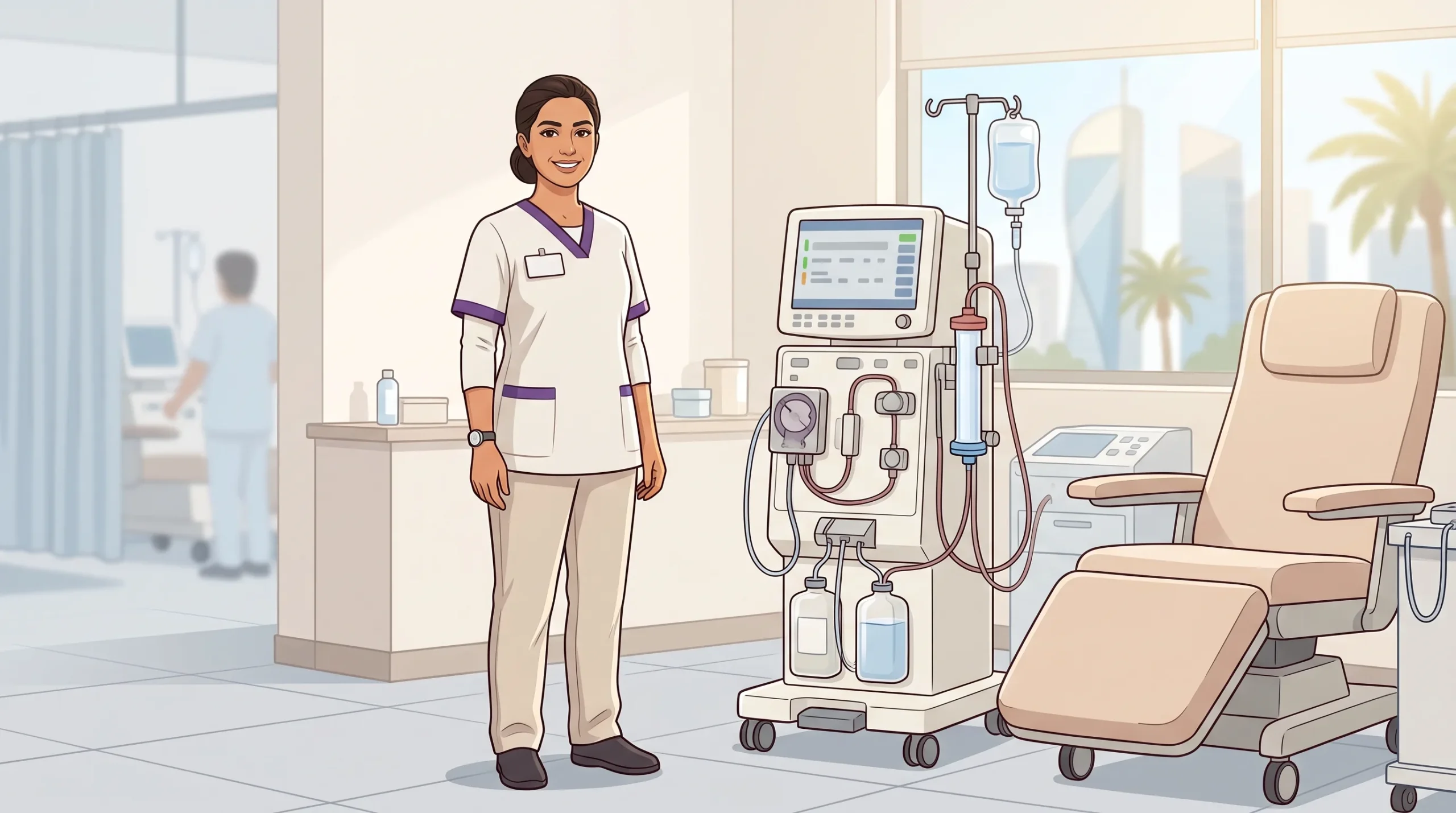
Applying for a dialysis technician or dialysis technologist license in Qatar requires the correct professional category, an appropriate qualification, relevant clinical experience and completion of the applicable DHP verification, evaluation and licensing stages.
Although both professionals work within nephrology and renal replacement services, their qualifications, experience requirements and responsibilities are different. Applicants should confirm the correct category before starting DataFlow verification, QuadraBay verification or DHP evaluation.
Dialysis Technician Vs Dialysis Technologist
Dialysis Technician
A dialysis technician supports the delivery of dialysis treatment under the supervision or guidance of a dialysis technologist or physician.
The published DHP criteria list a diploma in dialysis technology or an approved certification from a nephrology board as the educational requirement. Overseas applicants are generally expected to have at least two years of experience as a dialysis technician.
The technician’s duties may include preparing and priming haemodialysis machines, checking dialysis prescriptions and treatment settings, monitoring the machine during treatment, testing water-treatment systems, recording dialysis treatment data, disinfecting equipment, supporting home haemodialysis and assisting with dialysis care under appropriate supervision.
Dialysis Technologist
A dialysis technologist has a broader clinical and technical role within the nephrology care team. The technologist may provide renal replacement therapies, supervise dialysis technicians, support quality-management systems and participate in developing departmental protocols.
The published educational routes include a bachelor’s degree in Dialysis Technology, or a bachelor’s degree in science followed by a one-year structured academic programme in Dialysis Technology from an internationally approved nephrology board. Overseas applicants are generally expected to have three years of experience as a dialysis technologist in a teaching-hospital setting. Applicants should confirm whether their education, clinical training and work experience support the technologist category before beginning the Qatar medical license evaluation stage.
Not Sure Which Dialysis Category Fits Your Profile?
Review your category before Primary Source Verification or DHP submission.
General Dialysis Licensing Process
1. Qualification And Category Review
The applicant’s qualification, course duration, country of education, graduation year, dialysis experience, professional registration status and current application stage should be reviewed to determine whether the correct route is dialysis technician or dialysis technologist.
2. Primary Source Verification
Academic qualification, official transcript, dialysis training records, experience certificates, professional registration and other supporting documents generally need Primary Source Verification through an accepted provider.
3. DHP Qualifying Examination
Applicants may be required to complete the applicable DHP qualifying examination unless an approved exemption applies. Requirements should be checked according to the exact professional title and current DHP licensing rules.
4. DHP Evaluation
The DHP evaluation may include passport and identification documents, updated CV, academic qualification, official transcript, dialysis training records, experience certificates, professional registration, PSV report and qualifying examination result where applicable.
5. Final Licensing
Evaluation approval is not the final professional license. Final licensing may require additional documents and connection to an appropriately licensed healthcare facility before the license can be issued.
Common Reasons For Application Delays
Dialysis applications may be delayed by selecting technician instead of technologist, qualifications not clearly related to dialysis technology, missing clinical-training evidence, experience certificates showing general nursing or technical duties instead of dialysis work, insufficient experience, technologist experience not completed in an appropriate hospital setting, experience not supported by professional registration, name differences, unresponsive universities or employers, missing translations, previous negative reports and significant breaks from clinical practice. These problems commonly appear in Qatar medical license applications.
A general healthcare qualification or experience in a renal unit does not automatically confirm eligibility for a dialysis-specific professional title.
Why Review The Application Before Submission?
A preliminary review can identify whether the qualification supports the technician or technologist category, whether the experience is specifically related to dialysis, missing academic, training or employment records, registration gaps, documents requiring verification or translation, possible break-from-practice concerns and issues from a previous DataFlow, QuadraBay or DHP application.
Related technician and technologist guides include laboratory technician and technologist licensing and audiology technician and technologist licensing.
Frequently Asked Questions
What is the difference between a dialysis technician and dialysis technologist?
A dialysis technician performs technical and treatment-support duties under supervision. A dialysis technologist has broader responsibilities, which may include renal replacement therapy, staff supervision, quality management and departmental protocols.
What qualification is required for a dialysis technician in Qatar?
The supplied criteria list a diploma in Dialysis Technology or approved certification from a nephrology board.
What qualification is required for a dialysis technologist in Qatar?
The criteria list a bachelor’s degree in Dialysis Technology or a science bachelor’s degree followed by a one-year structured Dialysis Technology programme from an internationally approved nephrology board.
How much experience is required for overseas dialysis applicants?
The supplied criteria generally require two years of experience for dialysis technicians and three years for dialysis technologists. Technologist experience is specified as being in a teaching-hospital setting.
Can a nurse working in a dialysis unit apply as a dialysis technologist?
Working in a dialysis unit does not automatically establish eligibility. The applicant’s academic qualification, registration, job title, scope and actual duties must support the requested category.
Is Primary Source Verification required for dialysis licensing?
Qualifications, dialysis experience and professional registration generally need to be verified as part of the DHP evaluation process.
Dialysis Licensing Support In Qatar
Meem Business Services supports healthcare licensing in Qatar with initial qualification and profile review, professional category assessment, personalized document checklist preparation, DataFlow and QuadraBay verification support, DHP examination guidance, evaluation and licensing application support, application status follow-up, verification report review, returned application guidance and medical license renewal assistance.
Not sure whether you should apply as a dialysis technician or dialysis technologist?
Share your qualification, course duration, country of education, graduation year, dialysis experience, professional registration status and current application stage with Meem Business Services for an initial case review.
Do not share sensitive documents publicly. Use the company’s official contact channel when submitting passports, certificates or personal records.
Requirements, procedures and processing conditions may vary according to the professional category, qualification, issuing authority and individual case. This article provides general information and does not constitute an approval guarantee or an official decision by the relevant authority.
WRITTEN BY

Unais Naranath
Manager at Meem Business Services
Unais is a specialist in government relations with a background shaped by key roles in Qatar’s medical and public sectors. His experience includes 2 years with Naseem Al Rabeeh Medical Center (MOPH) and 1 year as a Qatar Public Relations Officer.