
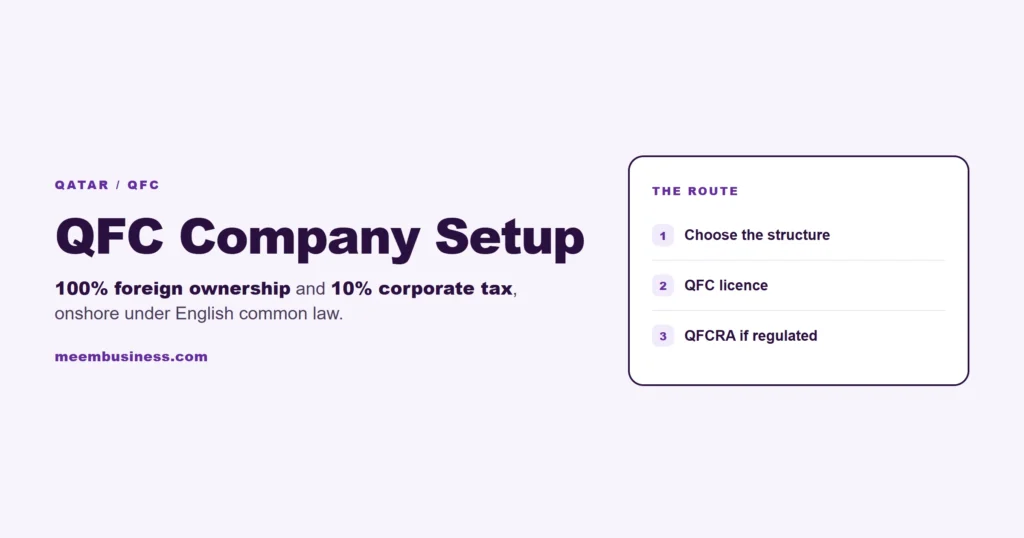
The Qatar Financial Centre is an onshore financial and business hub with its own English common-law framework. A QFC company can be 100% foreign-owned, pays 10% corporate tax on locally sourced profits, and is licensed through the QFC rather than MOCI. Regulated activities need separate QFCRA authorisation.
QFC Setup: The Numbers to Know
- Foreign ownership: up to 100%, with 100% repatriation of profits.
- Corporate tax: 10% on locally sourced profits; 0% personal income tax.
- Tax treaties: access to Qatar’s 80+ double taxation agreements.
- LLC minimum capital: none for non-regulated activities.
- Regulated activity: separate QFCRA licence before the firm can operate.
Why Set Up in the QFC Now?
The QFC lets a foreign firm own 100% of the company, pay 10% corporate tax on locally sourced profits and use Qatar 80+ double taxation agreements, while operating onshore under English common law. Qatar had 3,370,611 residents in March 2026, which is the client base a QFC service firm sells into.
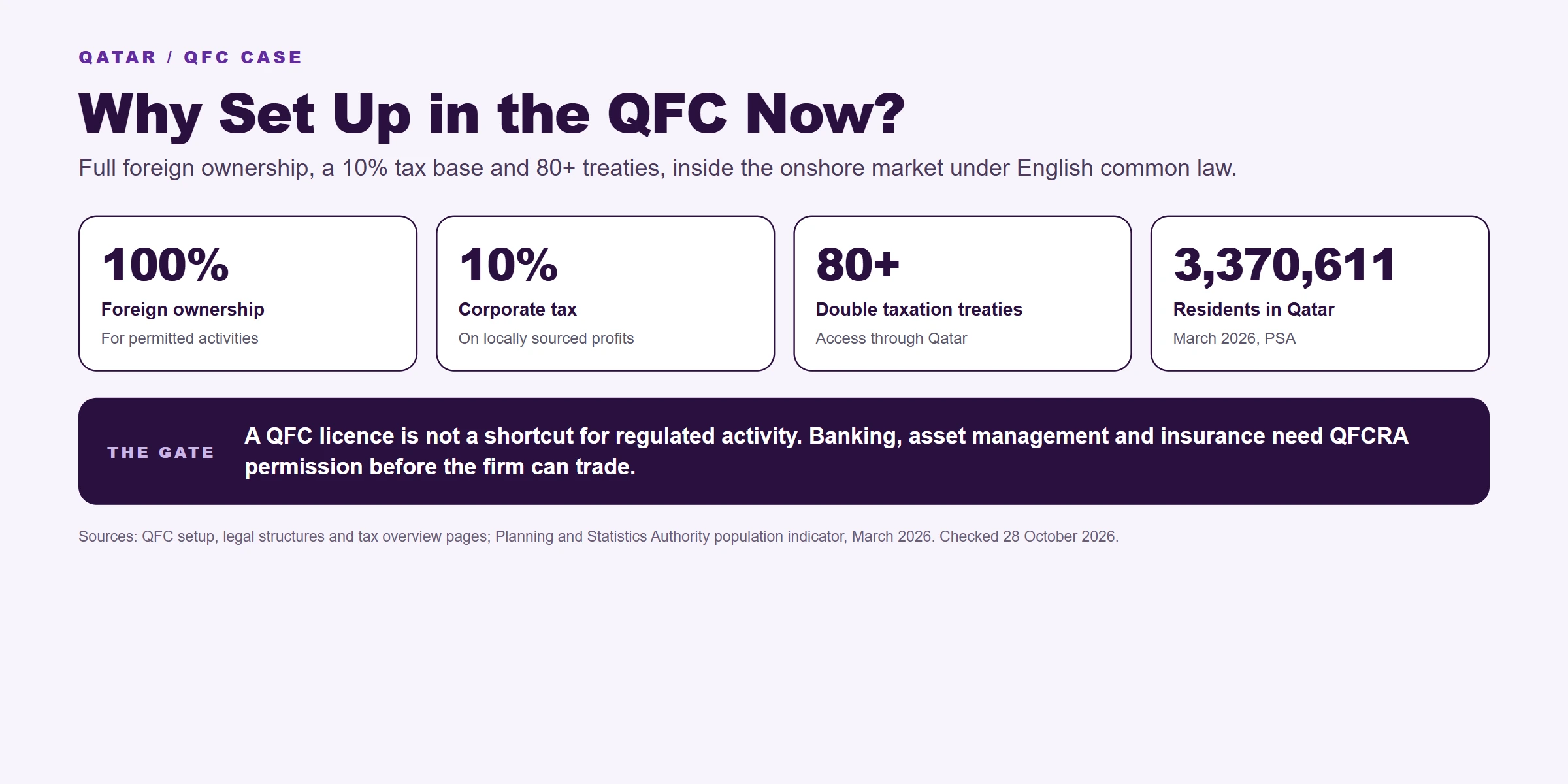
The QFC is a licensing choice, not a shortcut. A regulated activity needs QFCRA permission before the firm can trade, and that permission is much harder to copy than a trade licence.
What Is the QFC?
The Qatar Financial Centre is a business and financial centre established in Doha with its own legal, regulatory and tax framework, operating onshore rather than as a free zone. QFC-licensed firms contract under English common law, can trade in any currency, and are supervised by the QFC Authority and, for regulated activity, the QFC Regulatory Authority.
The QFC is not a free zone and it is not the mainland. A QFC licence allows a firm to operate in or from Qatar under QFC rules, and it can serve the local market within the scope of its licensed activities.
Can Foreigners Own 100% of a QFC Company?
Yes. A QFC company can be wholly owned by foreign shareholders, and the QFC permits 100% repatriation of profits. This is the main reason international firms choose the QFC over a mainland structure that may require a Qatari shareholder for certain activities.
Ownership does not remove the licensing test. The activity must be one the QFC licenses, the firm must meet the application requirements, and a regulated activity needs QFCRA approval in addition to the QFC licence.
How Is a QFC Company Taxed?
A QFC company pays 10% corporate tax on profits sourced in Qatar and 0% personal income tax, and it can use Qatar’s network of more than 80 double taxation agreements. The QFC tax framework also provides specific concessions and reliefs that change the effective rate for some firms.
| Tax item | What applies |
|---|---|
| Corporate tax | 10% on locally sourced profits |
| Personal income tax | 0% |
| Concessionary rate | 0% for an investment manager, reinsurer, captive insurer, or a firm at least 90% Qatari-owned, subject to conditions |
| Fund and holding structures | Exemptions on income for investment funds, holding structures and SPCs, subject to conditions |
| Dividends and capital gains | Exemptions on dividends, public treasury bond returns and gains on disposals of shareholdings of 10% or more |
| Losses | Carry forward with no time limit; carryback is not available |
| Group relief | Available for QFC firms with at least 75% common ownership |
| Advance ruling | Typically issued within 30 days and binding on the QFC |
Tax registration happens after the QFC licence is issued. A firm registers with the QFC Tax Department, then meets the filing, payment and record-keeping requirements that apply to its structure.
Which Legal Structure Should You Choose in the QFC?
The QFC licenses several corporate and wealth structures, and the choice depends on the activity, the owners and the purpose of the entity. A trading firm usually compares an LLC with a branch, while a fund or family group looks at SPCs, foundations and trusts.
| Structure | Best for | Key point |
|---|---|---|
| Limited Liability Company | Trading and professional firms | One or more members; no minimum capital for non-regulated activities |
| Branch of a non-QFC company | An existing foreign company extending into Qatar | Functionally distinct branch of the parent, registered in the QFC |
| Holding Company | Group ownership and acquisitions | Centralised group management and risk ring-fencing |
| Special Purpose Company | Transactions, asset holding, financing | Dedicated vehicle for a defined purpose |
| Limited Liability Partnership | Professional collaboration | Two or more members; no share capital requirement |
| Company Limited by Guarantee | Associations and councils | Member-based, without share capital |
| Single Family Office, Foundation, Trust | Wealth and succession | QFC frameworks for private wealth and asset protection |
Which Activities Can a QFC Company License?
The QFC licenses two broad categories: regulated activities, which need QFCRA authorisation, and non-regulated activities, which are listed by the QFC and licensed by the QFC Authority. Non-regulated activities cover professional services, corporate headquarters and management offices, shipping services, classification and rating, trust and company services, and corporate support services.
Regulated activity includes financial services such as banking, asset management, insurance and related activities. A firm cannot start a regulated activity on the strength of a QFC company registration alone; the QFCRA permission comes first.
How Long Does QFC Setup Take?
QFC setup runs in three stages: submit the application, receive the licence, then complete post-licence registrations. The timeline depends on whether the activity is regulated, how complete the application is, and how quickly the firm responds to QFC or QFCRA requests, so a single fixed number would be misleading.
- Apply. Submit the structure, activity, shareholders and business plan to the QFC.
- License. Receive the QFC licence for the approved activity and structure.
- Register. Complete the tax registration, office and banking steps that follow.
How Much Does QFC Setup Cost?
QFC costs separate a one-time application fee from the annual licence, with additional charges for extra activities and some structures. The QFC publishes the current schedule in its portal, so the figures below should be confirmed before an application is filed.
| Item | Published amount |
|---|---|
| QFC application, non-regulated activities | USD 500 |
| Annual licence, one activity | USD 5,000 |
| Each additional activity | USD 50 per year |
| HoldCo or SPC | USD 500 annual |
The licence fee is not the whole budget. Office premises, visas, banking, legal and accounting support, and the QFCRA application for a regulated activity sit outside the application and licence line items.
What Documents Does a QFC Application Need?
A QFC application needs the corporate and personal documents that identify the entity, its owners and its activity, plus the business plan and the AML information the QFC requests. A branch adds the parent company documents, and a regulated activity adds the QFCRA application pack.
- Application form with the proposed structure and activity.
- Business plan for the QFC entity.
- Passport copies and proof of address for shareholders and directors.
- Certificate of incorporation and constitutional documents for a corporate shareholder or a branch.
- AML and source-of-funds information requested by the QFC.
- Regulatory application documents where the activity is regulated.
What Happens After QFC Registration?
After the QFC licence is issued, the firm registers for tax with the QFC Tax Department, secures an office that meets QFC requirements, opens a bank account and applies for the visas it needs. These steps have their own conditions and timelines, and none of them is automatic.
Is QFC Better Than Mainland or a Free Zone?
No route is better for every firm. The QFC fits firms that want 100% foreign ownership, an English common-law framework and access to QFC-regulated activities and tax treaties. The mainland fits firms that need activities reserved to mainland licensing, and a free zone fits firms that meet a zone’s eligibility and want its customs and facility model.
| Factor | QFC | Mainland | Free zone |
|---|---|---|---|
| Foreign ownership | Up to 100% | Depends on the activity | Up to 100% for eligible investors |
| Corporate tax | 10% on locally sourced profits | 10% on locally sourced profits | Zone incentives can apply |
| Legal framework | English common law | Qatari law | Zone rules and Qatari law |
| Regulator | QFC and QFCRA | MOCI and sector regulators | Zone authority and sector regulators |
| Local market access | Within the licensed activity | Direct | Customs rules apply on entry to the mainland |
The mainland, free zone and QFC comparison covers the trade-offs across the three routes, and the QFC company formation service covers the filing itself.
QFC Setup Questions, Answered
Can a foreigner own 100% of a QFC company?
Yes. A QFC company can be wholly owned by foreign shareholders, and the QFC permits 100% repatriation of profits. The activity must still be one the QFC licenses, and a regulated activity needs QFCRA authorisation.
What is the corporate tax rate in the QFC?
QFC companies pay 10% corporate tax on locally sourced profits and 0% personal income tax. Concessions and exemptions apply to certain activities and structures, including investment managers, reinsurers, captive insurers, funds, holding structures and SPCs, subject to conditions.
Is the QFC a free zone?
No. The QFC is an onshore financial and business centre with its own legal, regulatory and tax framework. A free zone is a separate customs and licensing area, and goods moving from a free zone into the local market follow customs rules.
What legal structure can I use in the QFC?
The QFC licenses limited liability companies, branches of non-QFC companies, holding companies, special purpose companies, limited liability partnerships, companies limited by guarantee, and wealth structures such as single family offices, foundations and trusts.
How much does QFC setup cost?
The fee schedule separates the application from the annual licence. The application for non-regulated activities is USD 500, the annual licence for one activity is USD 5,000, each additional activity is USD 50 per year and a HoldCo or SPC is USD 500 annual. Confirm the current schedule with the QFC before filing.
How long does QFC setup take?
QFC setup runs from application to licence to post-licence registrations. The timeline depends on whether the activity is regulated, how complete the application is and how quickly the firm answers QFC or QFCRA requests.
Do I need an office in the QFC?
A QFC firm needs premises that meet the QFC requirements for its activity and structure. The office step follows the licence and has its own lease and fit-out conditions, so it should be planned before the firm expects to operate.
What can a QFC company do in the local market?
A QFC company can operate in or from Qatar within the scope of its licensed activity. Activities outside that scope need the relevant licence or approval, and regulated financial activity needs QFCRA permission.
Official QFC Sources
- QFC: Business Setup, checked 27 October 2026.
- QFC: Legal Structures and Solutions, checked 27 October 2026.
- QFC: Tax Overview, checked 27 October 2026.
- QFC: Non-Regulated Activities, checked 27 October 2026.

Jisham
Head of Operations at Meem
4+ years of hands-on Qatar PRO experience, handling approvals and government procedures across multiple ministries and authorities, including establishment licensing and approvals.
Connect On LinkedIn →