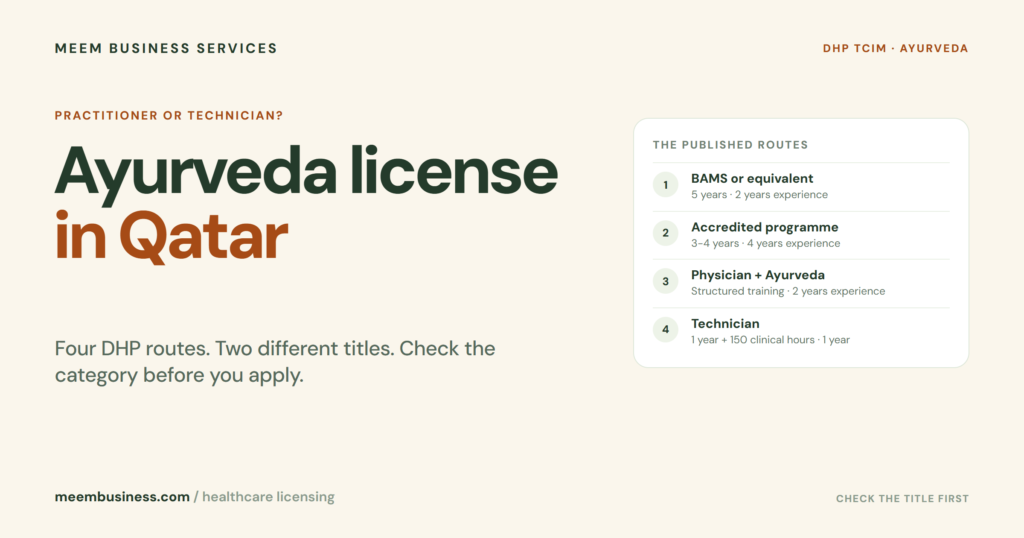
Ayurveda is regulated in Qatar by the Department of Healthcare Professions (DHP) under the Traditional, Complementary and Integrative Medicine (TCIM) framework. DHP treats Ayurveda Practitioner and Ayurveda Technician as separate titles, with different qualifications, experience and scope.
Ayurveda Practitioner routes cover BAMS or an equivalent five-year degree, an accredited three-to-four-year programme and licensed physicians with structured Ayurveda training. Ayurveda Technician is a supervised role with a one-year certificate or diploma and at least 150 in-person clinical hours.
Choosing Practitioner when your qualification supports Technician, or the other way round, is one of the most common reasons an Ayurveda application runs into trouble.
What Are the Ayurveda License Requirements in Qatar for 2026?
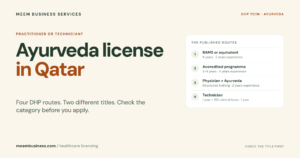
DHP’s 2026 TCIM standards list four Ayurveda routes in Qatar: BAMS or equivalent, another accredited Ayurveda programme, a licensed physician with Ayurveda training, and Ayurveda Technician. The qualification and experience change by route.
| Category | Basic qualification | Experience |
|---|---|---|
| Ayurveda Practitioner: BAMS or equivalent | Approved Ayurveda degree of at least five years | 2 years |
| Ayurveda Practitioner: other accredited programme | Three to four years, including at least 2,500 theory and practical hours and 500 hours of supervised internship | 4 years |
| Licensed physician with Ayurveda training | Medical license plus a structured programme with at least 1,500 theory and practical hours and 500 hours of supervised clinical training | 2 years |
| Ayurveda Technician | Certificate or diploma of at least one year, including 150 hours of in-person clinical client encounters | 1 year |
What Is the Difference Between an Ayurveda Practitioner and Technician?
An Ayurveda Practitioner has a broader clinical scope and can assess patients, provide Ayurveda-based treatment and lifestyle guidance, and work within the scope DHP approves for the practitioner title. An Ayurveda Technician supports a licensed practitioner and performs approved non-invasive therapies under supervision.
Ayurveda Practitioner
Broader assessment and treatment scope, including Ayurveda-based therapeutic management, lifestyle and dietary guidance, herbal treatment within the approved scope, therapeutic yoga and massage. DHP limits independent conventional medical diagnosis or treatment.
Ayurveda Technician
A support role under a licensed Ayurveda Practitioner. The technician performs approved non-invasive therapies, prepares treatment materials and supports the treatment room within the limits of the one-year qualification and supervised training.
What Are the Ayurveda Practitioner License Routes?
BAMS or an Equivalent Five-Year Ayurveda Degree
A BAMS degree or equivalent Ayurveda qualification of at least five years can qualify for the Ayurveda Practitioner category, with two years of experience. DHP still checks the institution, transcript, internship and professional registration; the BAMS title alone is not automatic approval.
Other Accredited Ayurveda Programmes
An accredited Ayurveda programme of three to four years can qualify when the programme includes at least 2,500 theory and practical hours and 500 hours of supervised internship. DHP lists four years of experience for this route.
Licensed Physicians With Ayurveda Training
A licensed physician can use a structured Ayurveda training route with at least 1,500 theory and practical hours plus 500 hours of supervised clinical training. DHP lists two years of experience for this physician route.
What Does an Ayurveda Practitioner Do in Qatar?
An Ayurveda Practitioner in Qatar may provide lifestyle and dietary guidance, preventive health counselling, Ayurveda-based therapeutic management, herbal and traditional treatment within the approved scope, therapeutic yoga and breathing techniques, Ayurveda massage and related therapies, and patient education and follow-up.
DHP limits what the practitioner can do independently, particularly where conventional medical diagnostics or treatment are involved. The approved scope depends on the qualification, title and license.
What Are the Ayurveda Technician Requirements in Qatar?
DHP lists a certificate or diploma in Ayurveda or Traditional Medicine with a minimum duration of one year, including 150 hours of in-person clinical client encounters, plus one year of experience for the Ayurveda Technician category.
The technician category can suit applicants whose qualification is below practitioner-degree level but includes structured Ayurveda training and supervised clinical exposure.
What Can an Ayurveda Technician Do?
An Ayurveda Technician works under the supervision and direction of a licensed Ayurveda Practitioner. The technician may assist with approved therapies such as Abhyanga, Shirodhara, Swedana, Kizhi and Nasya, prepare treatment materials, provide basic patient support, and prepare and maintain the treatment room and hygiene.
Is Any Ayurveda Diploma Accepted by DHP?
No. A short private Ayurveda course may not be sufficient for either the practitioner or technician category. DHP looks at programme duration, theoretical hours, clinical training, internship, qualification level, institution, professional registration and relevant work experience.
What Else Does DHP Require for Ayurveda Licensing?
DHP may also require valid professional registration or licensing from the home country or country of last employment, academic transcripts showing theoretical and clinical training, relevant experience evidence, Primary Source Verification where applicable, and DHP evaluation through the appropriate licensing system.
The exact requirements depend on the applicant’s route. Applicants who need primary source verification can use the PSV provider comparison to understand the current DHP options.
The Qatar healthcare licensing update explains how evaluation and verification fit together. Applicants comparing other TCIM titles can read the Hijama license guide or the acupuncture license routes. The 13 DHP TCIM professions guide places Ayurveda alongside the other recognised scopes.
Why Do Ayurveda License Applications Run Into Trouble in Qatar?
Ayurveda applications in Qatar commonly run into trouble because the applicant chooses Practitioner instead of Technician, the qualification duration does not match the requested category, clinical training or internship evidence is missing, experience is insufficient, transcripts are incomplete, professional registration has gaps, or the institution needs further assessment.
A review before verification or submission catches most of these issues. The same discipline applies to the wider medical license application process.
What Do Ayurveda Applicants Get Wrong in Practice?
- The qualification title is not enough. A BAMS, diploma or certificate still has to match the DHP category and the clinical hours behind it.
- Applicants often apply as a Practitioner when their one-year diploma and 150 clinical hours point to the Technician category.
- Two applicants with similar Ayurveda qualifications can have different routes depending on internship, experience and professional registration.
Should You Get an Ayurveda Eligibility Review Before Applying?
An Ayurveda eligibility review checks which DHP category the qualification and experience support. Meem reviews the qualification, course duration, transcripts, clinical training, internship, experience, professional registration and current DHP status before the applicant pays for verification or submits an application.
This matters most for diploma holders, mixed profiles and applicants with BAMS or Ayurveda qualifications earned outside Qatar. The category decision changes the qualification, experience and scope requirements.
Meem also assists with:
Meem also assists with
- Initial eligibility assessment
- Practitioner vs Technician category review
- Qualification and transcript assessment
- Experience review
- Document checklist preparation
- Primary Source Verification support
- DHP evaluation assistance
- Application follow-up
- Returned application and issue guidance
- Final licensing support
Ayurveda License in Qatar: Questions
How much experience is required for a BAMS holder in Qatar?
DHP lists two years of experience for the BAMS or equivalent Ayurveda Practitioner route. DHP may still assess the institution, programme, internship, professional registration and the exact qualification before approving the application.
Can an Ayurveda diploma holder apply for a license in Qatar?
Possibly. The correct category depends on the programme duration, qualification level, clinical training and experience. A one-year Ayurveda or Traditional Medicine certificate or diploma with 150 in-person clinical hours may fit the Ayurveda Technician route. A diploma does not automatically support the Practitioner title.
How much experience does an Ayurveda Technician need in Qatar?
DHP lists one year of experience for the Ayurveda Technician category. The technician also needs a certificate or diploma of at least one year, including 150 hours of in-person clinical client encounters.
Can a doctor practice Ayurveda in Qatar?
Potentially. DHP provides a route for licensed physicians who complete a structured Ayurveda programme with at least 1,500 theory and practical hours and 500 hours of supervised clinical training. DHP lists two years of experience for this physician route.
Is BAMS automatically accepted by DHP?
No. BAMS or an equivalent five-year degree is one recognized route, but DHP may still assess the institution, programme, internship, experience and professional registration. The degree title alone does not guarantee approval.
Can an Ayurveda Technician work independently in Qatar?
No. DHP describes the Ayurveda Technician as a support professional working under the supervision and direction of a licensed Ayurveda Practitioner. The technician must stay within the approved supervised scope.
How Do You Check Your Ayurveda Category Before Applying in Qatar?
Before starting an application, send Meem Business Services your Ayurveda qualification, course duration, country of qualification, graduation year, internship or clinical training details, total Ayurveda experience, professional registration status and current Qatar or DHP status.
Meem reviews whether the profile fits the Ayurveda Practitioner or Ayurveda Technician category, then explains what needs correcting before verification, evaluation or submission.
Source: DHP Traditional, Complementary and Integrative Medicine Registration and Licensure Standards, Circular DHP/04/2026. DHP assesses each application individually.
Unais Naranath
Head of Healthcare Department, Meem Business Services
Oversees medical licensing operations, regulatory compliance alignment and healthcare workflow.