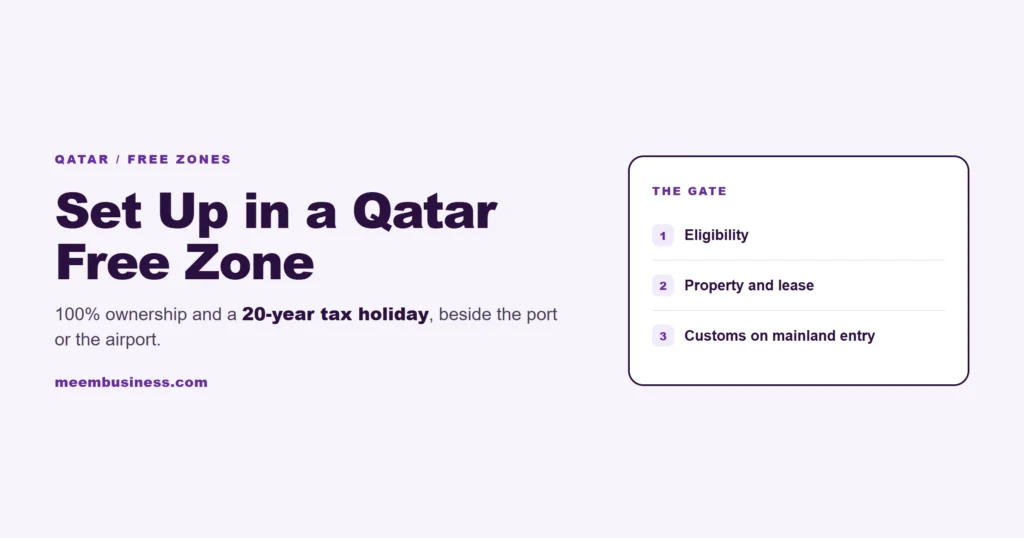
Qatar Free Zones is a licensing and customs area with two sites: the Airport Free Zone at Ras Bufontas and the Port Free Zone at Umm Alhoul. A QFZ company can be 100% foreign-owned and runs its onboarding in three stages, from business contact to licence, visas and bank account to site permits and operations.
QFZ Setup: The Essentials
- Sites: Airport Free Zone at Ras Bufontas and Port Free Zone at Umm Alhoul.
- Ownership: 100% foreign ownership for eligible investors.
- Tax: renewable 20-year corporate tax holidays under the QFZ framework.
- Onboarding: three stages, run through the QFZ investor portal.
- Mainland sales: goods entering the local market follow customs procedures.
Why Set Up in a Qatar Free Zone Now?
A QFZ company can be 100% foreign-owned, with renewable 20-year corporate tax holidays, at a site beside Hamad Port or Hamad International Airport. Qatar is raising LNG capacity to 142 million tonnes a year by 2030 and had 3,370,611 residents in March 2026, so the trade and logistics base the zones serve keeps growing.
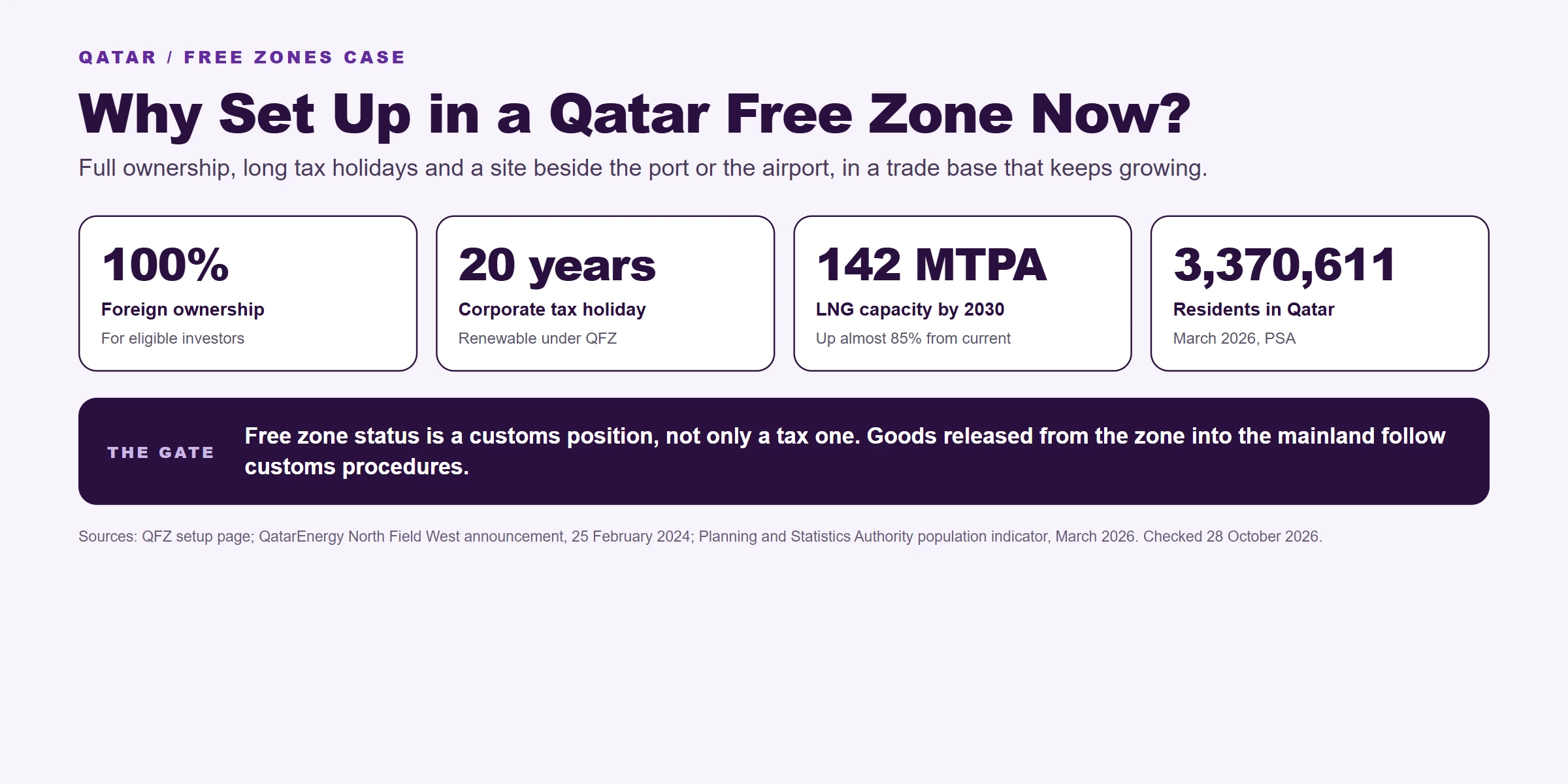
Free zone status is a customs position, not only a tax one. Goods released from the zone into the mainland follow customs procedures, so model the local-market route before choosing the zone.
What Are the Qatar Free Zones?
The Qatar Free Zones Authority licenses companies in two purpose-built zones next to the country’s air and sea gateways. The Airport Free Zone sits at Ras Bufontas beside Hamad International Airport, and the Port Free Zone sits at Umm Alhoul beside Hamad Port. Both zones combine licensing, customs status and ready or build-to-suit property under the QFZ Authority.
Should You Choose the Airport Free Zone or the Port Free Zone?
The choice between the two QFZ sites follows the movement of the goods and the people in the business. The Airport Free Zone suits air freight, time-sensitive trade, aviation services and businesses that need close airport access. The Port Free Zone suits sea freight, bulk logistics, manufacturing, chemicals and operations that depend on deep-sea port access.
| Site | Best for | Check before choosing |
|---|---|---|
| Airport Free Zone, Ras Bufontas | Air cargo, aviation, time-sensitive trade, light industrial units | Unit availability, airside access rules, fit-out and lease terms |
| Port Free Zone, Umm Alhoul | Sea freight, logistics, manufacturing, chemicals, large land plots | Plot size, utilities, environmental permits, customs registration |
What Are the Three QFZ Onboarding Steps?
QFZ onboarding runs in three stages: business contact, handshake and road to operations. The business development team handles the application, property, visa allocation, entity registration, lease and licensing in stage one, the investor relations team handles visas, QID, driving licence and bank account in stage two, and the site permits and handover complete in stage three.
- Business contact. QFZ supports the application inquiry and assessment, property terms and solutions, visa allocations, entity registration, lease agreement and licensing of the business.
- Handshake. After the lease, licence and compliance review, QFZ handles approved customer information, business and work visas, QID, driving licence and bank account setup.
- Road to operations. For land and Light Industrial Unit solutions, QFZ facilitates asset handover, environment permits, building permits, customs registration, property management and 5G services.
QFZ issues a certificate of completion after the three stages. A service business in a ready unit follows a shorter path than a manufacturer that needs a plot, a building permit and an environmental approval.
Which Sectors Does QFZ Target?
QFZ focuses on trade, logistics and export, manufacturing and chemicals, emerging technology, maritime, and industrial and consumer businesses. The zones are positioned around the airport and the port, so the sector focus follows the transport and energy advantages of each site.
What Documents Does a QFZ Application Need?
A QFZ application needs the company and shareholder documents, the proposed activity, the property requirement and the visa plan. The QFZ team reviews the activity against the zone rules and confirms the lease and licence conditions before the handshake stage begins.
- Application form and business plan for the QFZ entity.
- Passport copies and proof of address for shareholders and directors.
- Certificate of incorporation and constitutional documents for a corporate shareholder.
- Proposed activity and property requirement.
- Visa allocation plan and staffing estimate.
- Financial information requested during the assessment.
How Much Does QFZ Setup Cost?
QFZ setup costs combine a registration and licence fee with the property solution, utilities and the permits for the site. The QFZ Authority quotes fees with the property offer, so the amount depends on the zone, the unit or plot and the activity rather than a single price list.
| Cost item | What it covers |
|---|---|
| Registration and licence | Entity registration and the QFZ licence for the approved activity |
| Property | Ready unit, office or land plot, with lease terms set by QFZ |
| Fit-out and permits | Building permit, environment permit and fit-out for land or industrial units |
| Utilities and services | Power, water, 5G and property management |
| People | Visa allocation, QID and staffing costs |
Fee figures circulate in the market, including registration from QAR 4,000 for a branch and QAR 6,000 for an LLC with a QAR 5,000 annual licence. QFZ quotes the fee with the property offer, so those figures should be confirmed with the Authority before they are used in a budget.
How Long Does QFZ Onboarding Take?
QFZ does not publish a single onboarding timeline. The licence and lease stage can move quickly once the activity and property are agreed, while the road to operations stage depends on the building permit, the environmental approval and the fit-out. A ready unit with a straightforward activity completes sooner than a land plot that needs construction.
Can a QFZ Company Sell to the Qatar Mainland?
A QFZ company can sell into the Qatar mainland, and goods released from the free zone into the local market follow customs procedures. The free zone status applies while the goods stay inside the zone, so the duty position changes at the point of entry into the mainland.
Qatar Free Zone Questions, Answered
Can a foreigner own 100% of a QFZ company?
Yes, eligible investors can own 100% of a QFZ company, and the QFZ framework offers renewable 20-year corporate tax holidays. Eligibility depends on the activity and the zone requirements, which QFZ confirms during the application.
What is the difference between the Airport Free Zone and the Port Free Zone?
The Airport Free Zone at Ras Bufontas sits beside Hamad International Airport and suits air cargo, aviation and time-sensitive trade. The Port Free Zone at Umm Alhoul sits beside Hamad Port and suits sea freight, logistics, manufacturing and chemicals.
How long does QFZ setup take?
QFZ does not publish a single timeline. The licence and lease stage moves quickly once the activity and property are agreed, while the road to operations stage depends on building permits, environmental approval and fit-out, especially for land plots.
How much does QFZ registration cost?
QFZ quotes registration, licence and property together, so the cost depends on the zone, the unit or plot and the activity. Market figures such as QAR 4,000 or QAR 6,000 registration and QAR 5,000 annual licence should be confirmed with the Authority.
Can a QFZ company trade with the Qatar mainland?
Yes. A QFZ company can sell into the mainland, and goods released from the free zone into the local market follow customs procedures. The free zone customs status applies while the goods remain inside the zone.
What documents are needed for a QFZ application?
A QFZ application needs the company and shareholder documents, a business plan, the proposed activity, the property requirement and the visa plan. QFZ reviews the activity and confirms the lease and licence conditions before onboarding continues.
Which sectors does QFZ focus on?
QFZ focuses on trade, logistics and export, manufacturing and chemicals, emerging technology, maritime, and industrial and consumer businesses. The sector focus follows the airport and port advantages of the two zones.
Does a QFZ company need a Qatari partner?
No. Eligible QFZ investors can hold 100% of the company without a Qatari partner. The activity must still be accepted by QFZ, and regulated activities may need additional approvals.
Official QFZ Source
- QFZ: Set up a new company, checked 27 October 2026.

Jisham
Head of Operations at Meem
4+ years of hands-on Qatar PRO experience, handling approvals and government procedures across multiple ministries and authorities, including establishment licensing and approvals.
Connect On LinkedIn →