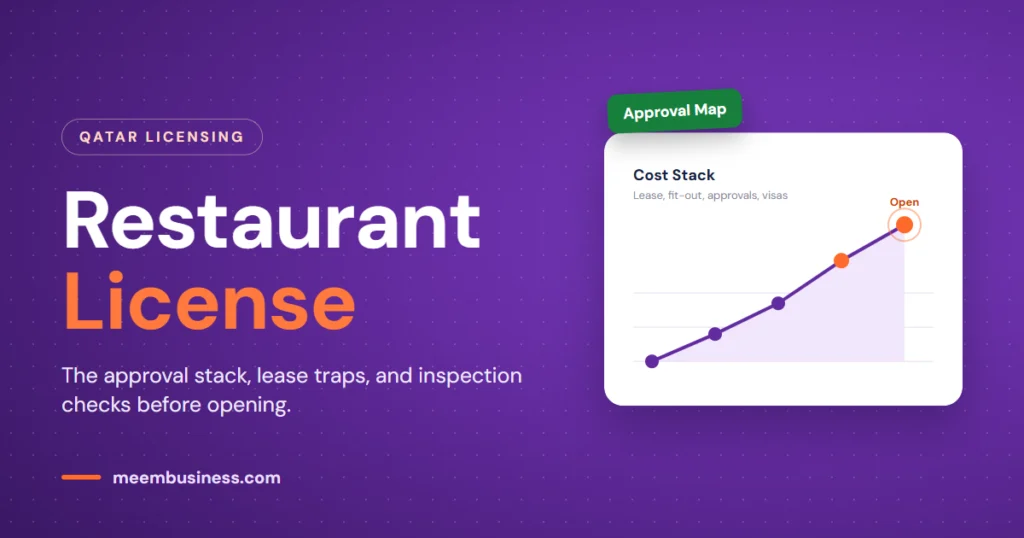
A restaurant license in Qatar is not one fee and not one office. You pay for company formation, the trade license, the municipality food permit, MoPH Wathiq registration, and Civil Defence clearance. The budget also covers food handler cards, visas, the lease, and the fit-out.
The approval layer is small compared with the lease and fit-out. The MoPH Wathiq registration itself is free. The expensive mistakes come from signing the lease before the site is cleared for food use.
Use the company setup cost calculator for the formation layer. Then price the lease, fit-out, and equipment with real quotes.
What Should You Budget to Open a Restaurant in Qatar?
- The lease and fit-out usually take 45 to 65 percent of the opening budget.
- The approval layer is closer to 5 to 10 percent. The approval layer still stops the opening.
- MoPH Wathiq registration is free. Wathiq is not the trade license.
- A lease that says “commercial use” but not “food use” can block the municipality permit.
- The CR activity must include dine-in, takeaway, delivery, or catering as separate activities.
- Civil Defence checks the kitchen gas, exits, suppression, and occupancy.
- Food handler cards are a staffing requirement, not a formality.
- Do not install signage or buy equipment before the layout is approved.
Meem planning guide, 2026. Replace each line with a quote.
What Does a Restaurant Licence Cost in Qatar?
A restaurant license in Qatar has eight cost layers. Each layer is priced by a different party.
| Cost layer | What it covers | Who prices it |
|---|---|---|
| Company formation | Trade name, CR, Chamber, establishment card | MOCI and the service provider |
| Trade license | Activity license for the restaurant | MOCI |
| Municipality permit | Food use, layout, signage, health inspection | Ministry of Municipality |
| MoPH Wathiq | Food establishment registration | MoPH, free service |
| Civil Defence | Fire safety and occupancy | Civil Defence |
| Food handler cards | Staff health certificates | Health service provider |
| Visas and onboarding | Work permits, QID, medical | MOI and the service provider |
| Lease and fit-out | Rent, kitchen, dining, equipment | Landlord and contractors |
The first seven layers are the license and approval file. The eighth layer is the business. Most online cost guides mix all eight into one number, which hides the part you control.
Where the Opening Budget Usually Goes
Use this split to sanity-check a budget. The split is a planning guide from the files we handle, not a quote.
| Budget block | Typical share | What changes it |
|---|---|---|
| Lease and fit-out | 45 to 65 percent | Size, location, ventilation route, grease trap, power load |
| Kitchen and equipment | 15 to 25 percent | Menu, covers, gas or electric, cold storage |
| Approvals and government | 5 to 10 percent | Activity count, site, inspections |
| Staff and visas before opening | 5 to 10 percent | Headcount, food handler cards, quota |
| Working capital | 10 to 15 percent | Rent-free period, supplier terms, launch stock |
Where the opening budget goes
Bars use the midpoint of the planning range in the table above.
Source: Meem planning guide, 2026. The approval bar is small, but it controls the opening date.
A guide that gives one total without separating lease, fit-out, and approvals is not a budget. The single total is a guess.
Which Approvals Does a Restaurant Need, and in What Order?
The approval file runs on two tracks. The company track starts with the CR. The premises track starts with the lease and fit-out. Both tracks must finish before you open.
Company track
Premises track
The lease is the point of no return. Clear the food use before you sign it.
Who Approves What
| Authority | What it approves | What it inspects |
|---|---|---|
| MOCI | Trade name, CR, activity codes, trade license | Company record and activity |
| Ministry of Municipality | Food use, layout, signage | Premises and food handling conditions |
| MoPH Wathiq | Food establishment registration | Food safety file and responsible person |
| Civil Defence | Fire safety and occupancy | Exits, gas, suppression, occupancy |
| Meem | File preparation and follow-up | Document gaps before submission |
What MoPH and Civil Defence Inspect
Each inspector looks at a different part of the same kitchen. A layout that passes one check can fail another.
Municipality (Baladiya): Food Use and Layout
- The site is zoned and approved for food use.
- The kitchen flow separates raw, cooked, clean, and waste.
- Handwash sinks sit where staff need them.
- Dry, chilled, and frozen storage are separate.
- Ventilation and exhaust match the cooking load.
- The grease trap is accessible and sized for the kitchen.
- Waste storage and pest control are planned.
- Wall, floor, and ceiling finishes are cleanable.
Civil Defence: Fire, Gas, and Occupancy
- Exits are the right number, width, and distance.
- Fire extinguishers and suppression cover the cooking line.
- Gas installations have shutoff and ventilation.
- Emergency lighting and exit signs work.
- The kitchen duct is accessible for cleaning.
- The occupancy load matches the seating plan.
MoPH Wathiq: Food Safety File
- The CR activity matches the food operation.
- The establishment card and company details match the CR.
- The responsible person and letter are in place.
- The menu matches the kitchen and storage capacity.
- The HACCP or food safety plan covers the operation.
- The risk analysis and process flow match the menu.
- Pest control and food handler cards are current.
When Does the MoPH Wathiq Registration Happen?
Wathiq is the MoPH system for food establishments and products. The establishment registration is free. The trade license and municipality permit are separate.
Register the establishment before you register a product. The account holder is the Qatar-registered food business. Sharek lists the establishment service as free and estimates 2 days and 30 minutes for a complete file.
The file needs the CR, establishment card, company stamp and logo, owner QID, and a responsibility letter. Restaurants add the trade license, pest control contract, menu, HACCP or food safety certificate, risk analysis, and process flow diagram.
The full route is in the food registration in Qatar guide. Wathiq takes the establishment first, then the products registered against it.
When Do Restaurant Staff Need a Health Card?
Every person who handles food needs a health certificate and a food handler licence before working in the kitchen or on the floor. Two bodies run the process: the Medical Commission issues the health certificate, and Qatar Chamber runs the food safety test and the licence.
| Step | Fee | Typical time | Where |
|---|---|---|---|
| Health certificate | QAR 20 | About 6 days | Medical Commission |
| Food safety test | QAR 50 per person per test | Booked by the employer | Qatar Chamber, in person |
| Food handler licence | QAR 50 | Valid 3 years | Qatar Chamber |
Sequence matters. Register the establishment in Wathiq before registering handlers, because the system accepts a handler only against an active establishment and a valid health certificate. The supervisor also needs a food safety qualification, which is a separate document from the handler licence.
The test is mandatory and takes place in person. The date and candidate list cannot be changed after booking, and a failed test needs a new registration and a new fee. Plan the test date before the first shift, not after the kitchen is ready. Qatar Chamber runs the Food Handlers Certification and Authorization Program.
Source: Sharek health certificate and food handler registration services; Qatar Chamber FHCP, accessed 29 October 2026.
What Should You Check in a Restaurant Lease Before Signing?
The lease is the largest commitment in the project. The lease is also the document most likely to block the permits.
On a QAR 20,000 monthly rent, a two-month permit delay costs QAR 40,000 before the first customer. That is the cost of a lease signed before the food use is confirmed.
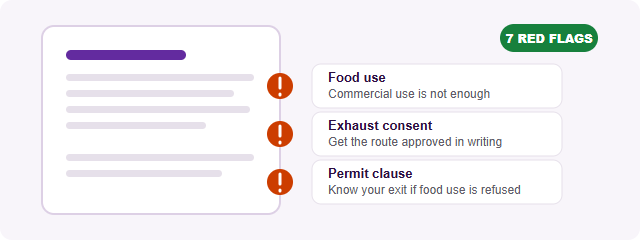
The lease decides whether the permit file moves or stalls. Read it before the fit-out, not after.
Lease Red Flags
- The lease says “commercial use” but not “food use.”
- The landlord will not approve the exhaust route in writing.
- The unit has no grease trap or no access to clean it.
- The power load is too low for the kitchen equipment.
- The unit has no gas supply or no safe gas route.
- The building has no waste storage area for food waste.
- The lease does not define signage rights.
- The lease does not define delivery or loading access.
- The fit-out grace period is shorter than the approval timeline.
- The lease has no exit clause if the food use is refused.
Ask for a permit contingency clause. The clause gives you a way out if the municipality refuses the food use.
Documents to Prepare
- Draft lease and tenancy contract.
- Activity codes for dine-in, takeaway, delivery, and catering.
- Kitchen layout and equipment plan.
- Ventilation, exhaust, and grease trap details.
- Waste storage and pest control plan.
- HACCP or food safety plan.
- Responsible person ID and responsibility letter.
- Civil Defence drawings for exits, gas, and suppression.
- Food handler plan for every staff member who handles food.
A site that cannot support the menu or the ventilation will cost more after the lease than before it.
Which Licence Fits: Restaurant, Cafe or Cloud Kitchen?
The license route is similar. The premises file and the cost shape are not.
| Setup | Premises file | What changes | Biggest cost risk |
|---|---|---|---|
| Small cafe | 30 to 60 sqm, light menu, limited seating | Smaller kitchen, simpler ventilation, fewer staff | Rent per seat and fit-out |
| Dine-in restaurant | 120 to 250 sqm, full kitchen, seating | Gas, grease trap, larger Civil Defence file | Kitchen fit-out and rent |
| Cloud kitchen | 20 to 40 sqm, delivery only | Extraction, packaging, no dining area | Rent per kitchen and delivery commission |
| Catering | Production kitchen and transport | Capacity, cold chain, events | Kitchen capacity and staff |
A cloud kitchen still needs a food-approved kitchen, Wathiq registration, and the correct delivery activity. A cloud kitchen does not skip the food safety file.
Can a Foreigner Own a Restaurant in Qatar?
The activity code decides the ownership route. Do not assume every restaurant activity is open to 100 percent foreign ownership.
Some mainland food activities allow full foreign ownership under the investment law. Others still require a Qatari partner or agent. Confirm the route before you sign a lease or a partnership agreement.
A Qatari partner is not a formality. The partnership agreement sets profit share, management, and exit. Review it before you sign.
How Long Does It Take to Open a Restaurant in Qatar?
The company formation is fast. The fit-out and inspections set the opening date.
| Stage | What happens | What can block it |
|---|---|---|
| 1. Activity and ownership check | Confirm the CR activities and the ownership route | Wrong activity, partner requirement |
| 2. Company formation | Trade name, CR, Chamber, establishment card | Name rejection, missing documents |
| 3. Lease and fit-out | Site, drawings, ventilation, grease trap | Landlord consent, power, gas |
| 4. Wathiq establishment | Responsible person and food safety file | CR mismatch, missing HACCP |
| 5. Municipality permit | Food use, layout, signage | Layout, grease trap, waste |
| 6. Civil Defence | Fire, gas, exits, occupancy | Exits, suppression, drawings |
| 7. Food handlers and visas | Cards, visas, onboarding | Staff count, medical |
| 8. Open | Soft launch and handover | Outstanding inspection |
What Does a Restaurant Cost After Opening?
The license is not a one-time cost. Budget for these renewals and updates.
- Commercial Registration and trade license renewal.
- Municipality permit renewal.
- Civil Defence renewal.
- Wathiq updates when the menu, products, or site change.
- Food handler certificate renewals.
- Staff residency and QID renewals.
- Pest control, hygiene, and inspection follow-up.
- Signage or layout changes that need a new approval.
Why Qatar Restaurant Licence Files Stall
The same six issues show up in the files we review. Each one costs rent before the first sale.
- The lease is signed before the food use is confirmed.
- The activity code is missing delivery, takeaway, or catering.
- The kitchen layout changes after the municipality drawing is approved.
- The responsibility letter is unsigned or names the wrong person.
- The menu lists more items than the cold storage and kitchen can support.
- The signage is installed before the permit is issued.
A menu built for 40 items needs cold storage and prep space for 40 items. A kitchen designed for 20 items will force a menu change or a second fit-out.
Fix the file before the fit-out. Fixing it after the inspection adds rent, contractor time, and a second inspection.
Qatar Restaurant Licence Cost Checklist
Before committing to a restaurant lease or fit-out budget, confirm the activity code, premises approval, Wathiq file and Civil Defence route.
How Meem Handles the Approvals
Meem starts with the activity codes and the lease. We map the CR activities and review the site for food use. Then we list the documents the municipality, Wathiq, and Civil Defence will ask for.
Then we prepare the Wathiq establishment file, the municipality layout pack, and the Civil Defence drawings. We submit, track the inspections, and answer the clarification requests.
The work covers restaurants, cafes, cloud kitchens, catering companies, and food factories. Meem does not issue the approvals. The authorities issue them. Start with the company formation in Qatar route and the commercial license file.
What to Settle Before You Commit to a Restaurant Lease
The restaurant license cost is a stack, not a single number. The lease and fit-out take most of the budget. The approval layer is smaller, but it sets the opening date.
Clear the food use before the lease. Match the activity codes to the operation. Register the establishment in Wathiq. Then build the kitchen the inspectors have already approved on paper.
Qatar Restaurant Licence FAQ
How much does a restaurant license cost in Qatar?
There is no single fee. The total includes company formation, approvals, visas, lease, and fit-out; the approval layer is usually 5 to 10 percent of the opening budget. The lease and fit-out take most of it.
What is the biggest cost mistake restaurant owners make?
Signing the lease before the site is cleared for food use. A refusal of the food use or the ventilation route starts the rent before the approval. The fit-out may need a redesign.
Do I need a local partner to open a restaurant in Qatar?
The activity code decides the ownership route. Some mainland food activities allow 100 percent foreign ownership under the investment law. Others still require a Qatari partner or agent. Confirm the route before you sign a lease or partnership agreement.
How long does it take to open a restaurant in Qatar?
The company formation is the shorter part. The lease, fit-out, municipality permit, Wathiq file, and Civil Defence inspection set the opening date. A complete file moves faster than a file corrected after inspection.
What does the municipality inspect?
The municipality checks food use, kitchen flow, handwash sinks, separate storage, and ventilation. The check also covers grease trap access, waste storage, pest control, cleanable surfaces, and signage.
What does Civil Defence inspect?
Civil Defence checks exits, travel distance, fire extinguishers, and suppression. The check also covers gas shutoff, emergency lighting, duct access, and the occupancy load against the seating plan.
What is Wathiq?
Wathiq is the MoPH system for food establishment and product registration. Register the establishment before the product. The establishment registration is free.
Can I open a cloud kitchen with a restaurant license?
A cloud kitchen needs a food-approved kitchen, Wathiq registration, and the correct delivery activity. A cloud kitchen does not need a dining area, but it does not skip the food safety file.
Can I add delivery or catering later?
You can add an activity, but it may require a CR amendment, a municipality update, and a Wathiq update. Add the activities before the first license, not after the first order.
What documents should I prepare first?
Prepare the CR, trade name certificate, draft lease, kitchen layout, and ventilation plan. Add the HACCP plan, responsible person letter, Civil Defence drawings, and food handler plan.

Head of Operations at Meem
4+ years of hands-on Qatar PRO experience, handling approvals and government procedures across multiple ministries and authorities, including establishment licensing and approvals.
Connect On LinkedIn