

Last reviewed: 5 August 2026
Quick answer: Foreign nationals can establish businesses in Qatar, and eligible projects may be approved with up to 100% foreign ownership. Full foreign ownership is not automatic for every mainland activity. The correct setup depends on the exact activity, customers, jurisdiction, premises and sector approvals.
Confirming these points before preparing documents or signing a lease can prevent incorrect attestations, unsuitable premises and avoidable setup expenses.
Key Takeaways
- Foreign investors may own up to 100% of an eligible Qatar business.
- Mainland foreign-ownership applications are assessed according to the selected activity and applicable approval requirements.
- Banks, insurance companies and commercial agencies remain restricted under Law No. 1 of 2019 unless an applicable exception is granted.
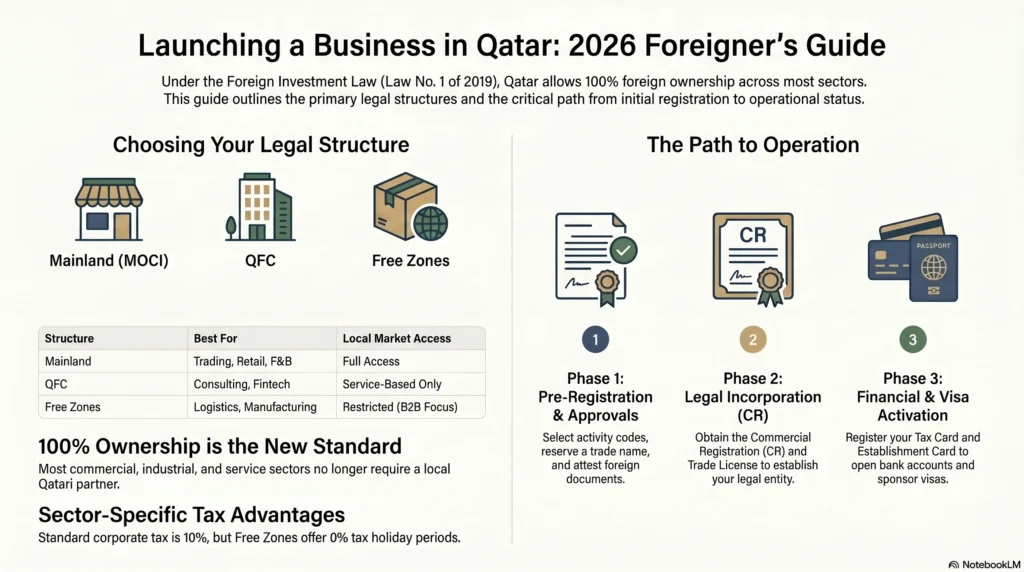
- The principal routes are mainland, Qatar Financial Centre, Qatar Free Zones, a foreign-company branch and a commercial representative office.
- A Commercial Registration does not always authorise immediate operation; a commercial licence and external approvals may also be required.
- Costs and timelines depend on the activity, structure, shareholders, premises, approvals and visa requirements.
- Tax, licence, immigration and corporate-compliance duties continue after registration.
Can a Foreigner Start a Business in Qatar?
Yes. A foreign individual or foreign corporate entity can establish a business in Qatar, subject to the rules governing the selected activity and legal structure.
Article 2 of Law No. 1 of 2019 permits non-Qatari investment of up to 100% of the capital in economic sectors, subject to the law, its implementing rules and the restrictions in Article 4.
Article 4 restricts non-Qatari investment in banks and insurance companies unless an exception is granted by the Council of Ministers, commercial agencies, and any additional fields restricted by a Council of Ministers decision. Natural-resource, petroleum and concession-based projects may follow separate legal or contractual frameworks.
Confirm these points before applying
- Whether the exact activity is available for registration
- Whether it qualifies for the proposed foreign-ownership percentage
- Whether a Qatari shareholder is required
- Whether preliminary or final regulatory approval is needed
- Which jurisdiction can legally license the intended operation
- Whether the proposed premises satisfy the activity conditions
Read Meem’s detailed guide to 100% foreign ownership in Qatar before selecting shareholders or preparing incorporation documents.
Can Foreigners Own 100% of a Qatar Company?
Foreign investors may own up to 100% of a Qatar company when the activity and jurisdiction qualify. The general permission in the Foreign Investment Law does not mean that every mainland activity is automatically approved.
For a mainland business, the ownership application is linked to the precise activity selected. The Ministry of Commerce and Industry publishes forms and document requirements for companies with 100% non-Qatari capital. Investors should confirm the activity classification before attesting documents or agreeing an ownership structure.
QFC companies may have up to 100% foreign ownership when they conduct activities permitted and licensed by QFC. Companies admitted by the Qatar Free Zones Authority can also receive 100% foreign ownership, subject to QFZ approval and the terms issued for the project.
Which Business Structure Should a Foreign Investor Choose?
The right structure depends on what the business will do, where it will operate, and who its customers will be. Review Meem’s full mainland vs QFC vs Qatar Free Zone comparison before choosing a route.
| Structure | Commonly suitable for | Ownership | Main consideration |
|---|---|---|---|
| Mainland | Trading, retail, restaurants, contracting and local services | Up to 100% for approved activities | Activity, ownership and premises must be confirmed |
| QFC | Consulting, professional services, financial services, fintech and technology | Up to 100% | The activity must be within QFC’s permitted framework |
| QFZ | Logistics, manufacturing, technology, warehousing and regional operations | 100% for approved investors | The project must satisfy QFZ admission criteria |
| Foreign branch | Execution of a qualifying Qatar contract by an overseas company | Owned by the foreign parent | Operations are tied to the approved contract |
| Representative office | Promotion, liaison and market research | Not an operating equity structure | Cannot conduct ordinary revenue-generating business |
1. Mainland company
A mainland company is generally suitable for a business that needs direct access to Qatar’s domestic market. Examples include retail, restaurants, trading, distribution, contracting, maintenance and locally delivered commercial services.
Mainland companies are registered through the Ministry of Commerce and Industry. The setup may require foreign-ownership approval, trade-name reservation, incorporation documents, a Commercial Registration, a commercial licence, suitable premises, external approval, tax registration, establishment registration and labour or immigration procedures.
Check the activity and premises before signing a long-term lease. MOCI advises investors to obtain necessary preliminary approvals before committing to premises for activities that require them.
2. Qatar Financial Centre
The Qatar Financial Centre is an onshore business and financial centre with its own legal, regulatory, tax and licensing framework. It is commonly considered for management consultancy, business consultancy, financial services, fintech, holding-company activities, information technology, marketing, project management and other professional services.
QFC permits up to 100% foreign ownership and generally applies a 10% corporate-tax rate to locally sourced profits, subject to its regulations, exemptions and concessions. Its legal framework incorporates English common-law principles and includes an independent court and regulatory tribunal. Review the official QFC benefits and application process before proceeding.
3. Qatar Free Zone company
The Qatar Free Zones Authority provides a separate route for approved investment projects. QFZ is commonly associated with logistics, manufacturing, warehousing, technology, aviation, maritime industries, regional distribution and international operations.
Approved investors may receive 100% foreign ownership, full capital repatriation, renewable 20-year corporate-tax holidays and customs incentives. Every benefit remains subject to QFZ approval, regulations and the terms applicable to the individual project. See the official QFZ investor benefits and Meem’s free-zone company guide.
4. Branch of a foreign company
An overseas company may establish a branch in Qatar to perform work connected to a qualifying contract. MOCI normally requires documents covering the parent company, the Qatar contract, the branch manager, authorised signatory and legal representative. Overseas documents generally require proper certification and may need accredited Arabic translation.
A contract-based branch may carry out only the activities covered by the approved contract. Read Meem’s guide to opening a foreign-company branch in Qatar.
5. Commercial representative office
A representative office gives an overseas company a limited presence for promotion, coordination, liaison and market research. It is not permitted to conduct ordinary trading, sell products or provide normal revenue-generating commercial services. Read the representative-office requirements.
Not sure which structure fits? The decision should be based on the exact activity, customer type, premises, shareholder structure and visa plan—not only the advertised setup cost.
Step-by-Step Process to Start a Business in Qatar
The exact sequence differs according to the activity and jurisdiction, but the following framework covers the main stages.
Step 1: Identify the exact business activity
Avoid beginning with a broad description such as “trading,” “consulting” or “services.” The exact activity can determine ownership eligibility, external approvals, permitted structures, qualifications, premises and commercial-licence conditions.
Step 2: Confirm ownership and regulatory requirements
Confirm whether the activity permits the proposed foreign ownership and whether preliminary or final approval is required from a sector regulator. Regulated fields can include healthcare, education, financial services, legal services, engineering, food production, industry, tourism and telecommunications.
Step 3: Select the jurisdiction and legal form
Choose between mainland, QFC, QFZ, a contract-based branch or a representative office. The decision should reflect where the business will operate, what it will sell, who its customers are and which regulator controls the activity.
Step 4: Reserve the trade name
For a mainland company, reserve a compliant name through MOCI’s channels. The name should not conflict with an existing registration or trademark, mislead customers or violate applicable naming rules. Review the official MOCI trade-name guidance.
Step 5: Prepare and attest shareholder documents
The documents depend on whether shareholders are individuals or corporate entities. Foreign records may require notarisation, authentication in the issuing country, embassy attestation, Qatar Ministry of Foreign Affairs attestation and certified Arabic translation.
Use Meem’s Qatar company-registration document checklist and confirm the required chain before paying for attestation.
Step 6: Obtain external approval
A regulated activity must obtain the approval required by the responsible authority. Approval may be required before incorporation, before the commercial licence is issued, or before operations begin.
Step 7: Sign the incorporation documents
Depending on the structure, the documents may include articles or a memorandum of association, shareholder or board resolutions, powers of attorney, manager appointments, authorised-signatory appointments and beneficial-owner declarations. MOCI publishes official company-establishment forms for different structures.
Step 8: Obtain the Commercial Registration and commercial licence
The Commercial Registration records the company’s legal details and approved activities. The commercial licence authorises operation from approved premises and may require review of the lease, municipality conditions, building use, Civil Defence requirements, signage and sector-specific conditions.
Important: A Commercial Registration should not be treated as final permission to begin every type of operation.
Step 9: Complete tax registration
Businesses must assess their registration, accounting, return and payment obligations with the General Tax Authority. Tax treatment depends on the ownership, activity, jurisdiction and source of income.
Step 10: Complete establishment, labour and immigration procedures
The company may need establishment registration before accessing immigration and employee-related services. Owner and employee visa eligibility depends on the company records, visa category, labour approvals and current Ministry of Interior requirements.
Step 11: Open the corporate bank account
Banks conduct their own Know Your Customer and Anti-Money-Laundering reviews. Commonly requested records include the Commercial Registration, commercial licence, tax and establishment documents, constitutional documents, shareholder and signatory identification, ownership information, business plans and expected transaction details. Registration does not guarantee immediate bank approval.
Documents Commonly Required
No single checklist applies to every Qatar company. Requirements depend on the shareholder type, legal form, nationality, activity and licensing authority.
Individual shareholders
- Valid passport
- Qatar ID, where applicable
- Proof of residential address and contact information
- Power of attorney when a representative handles the application
- CV, qualification or professional licence for regulated activities
Corporate shareholders
- Certificate of incorporation and current commercial registration
- Memorandum and articles of association
- Board resolution approving the Qatar investment
- Board resolution appointing the authorised representative
- Power of attorney
- Shareholder and ultimate-beneficial-owner information
- Identification for directors and authorised signatories
Company and premises documents
- Trade-name approval
- Incorporation application and constitutional documents
- Manager and authorised-signatory appointments
- Beneficial-owner declaration
- Lease or commercial-address documents
- External activity approval
- Commercial-licence and establishment-registration documents
Do Foreign Investors Need a Qatari Partner?
A Qatari equity partner is not required for every business. Law No. 1 of 2019 provides a route for fully foreign-owned companies in eligible sectors, but mainland ownership eligibility must still be confirmed for the exact activity.
Qatari participation can remain relevant for activities that do not qualify for full foreign ownership, commercial-agency arrangements, specially regulated sectors, contractual local-content requirements, certain tenders and voluntary joint ventures.
A PRO service provider or government-relations consultant is not automatically an equity shareholder. Investors can appoint professional support for government procedures without giving away ownership, provided the company structure permits it. Read Meem’s local sponsor guide.
What Businesses Can Foreigners Open in Qatar?
Foreign investors may apply for activities across many industries, subject to activity availability, ownership rules and regulatory approval.
- Trading, distribution and e-commerce
- Restaurants, cafés, catering and food services
- Marketing, advertising and management consultancy
- Information technology, software and digital services
- Construction, contracting, maintenance and facility services
- Logistics, warehousing and manufacturing
- Healthcare, education and training
- Professional, fintech and financial services
The inclusion of an industry in this overview does not mean that every activity inside it automatically qualifies for full foreign ownership. Verify the exact activity code, qualifications, regulator, premises and permitted legal forms before proceeding.
How Much Does It Cost to Start a Business in Qatar?
There is no single reliable price for opening every type of Qatar company. The total may include government registration and licensing fees, foreign-ownership approval, legal-document costs, external approvals, office rent, fit-out, premises compliance, translation, attestation, tax support, establishment procedures, visas and professional services.
A precise quotation should be prepared only after reviewing the exact activity, chosen jurisdiction, shareholder structure, premises, external approvals and visa plan.
How Long Does Company Formation Take?
There is no universal company-formation timeline. The duration can be affected by foreign-ownership approval, activity classification, document readiness, attestation and translation, external regulatory approval, premises, commercial licensing, establishment registration, bank due diligence and immigration procedures.
A straightforward application with complete documents can progress faster than a healthcare, education, financial, industrial or other regulated application. Any estimate should clearly identify whether it covers only ownership approval, incorporation, final licensing, bank activation or visa processing. Read Meem’s guide to company-registration timelines in Qatar.
What Taxes Apply?
Qatar generally taxes Qatar-sourced business income. The General Tax Authority states that Qatar-sourced income is generally subject to a 10% income-tax rate, subject to exemptions and special rules. Petroleum and certain related activities can receive different treatment.
- Mainland: treatment depends on ownership, activity, income source, exemptions and applicable treaties.
- QFC: generally 10% corporate tax on locally sourced profits, subject to QFC tax regulations, exemptions and concessions.
- QFZ: approved investors may qualify for renewable 20-year corporate-tax holidays and customs incentives under the terms of their approval.
Businesses should confirm their actual position with the relevant authority or a qualified tax adviser rather than relying only on a general online summary.
Ongoing Compliance After Registration
Company formation does not end when the Commercial Registration and commercial licence are issued. Ongoing responsibilities may include:
- Commercial Registration and commercial-licence renewal
- Lease and premises compliance
- Tax registration, returns and accounting records
- Beneficial-owner and corporate-information updates
- Establishment, labour and immigration compliance
- Employee-document and sector-licence renewals
MOCI requires businesses to renew registrations and licences, update changed information and avoid activities outside those authorised in the registration and licence. Review the official investor obligations and consider ongoing PRO support in Qatar.
Common Mistakes to Avoid
- Choosing a structure before confirming the activity: the activity controls ownership, approval and licensing conditions.
- Assuming full ownership is automatic: the precise activity and restrictions still require review.
- Signing a lease too early: the premises may not satisfy the selected activity.
- Submitting incorrectly prepared foreign documents: missing attestations or inaccurate Arabic translations can create rework.
- Ignoring external approval: regulated businesses cannot rely on MOCI registration alone.
- Treating the CR as the final licence: premises and commercial licensing may still be outstanding.
- Expecting automatic bank approval: each bank applies its own compliance and commercial assessment.
- Missing renewal deadlines: company formation is only the start of the compliance cycle.
Frequently Asked Questions
Can a foreigner register a Qatar company without a local partner?
Yes. A foreign investor may apply for up to 100% ownership in an eligible activity under Law No. 1 of 2019. The exact activity, restrictions and approval requirements must still be confirmed.
Is 100% foreign ownership guaranteed?
No. The law permits investment of up to 100%, but eligibility depends on the activity, jurisdiction, restrictions, documentation and approval process.
Is QFC a free zone?
No. QFC is an onshore business and financial centre with its own legal, regulatory, tax and licensing framework.
Can a QFC company perform any business activity?
No. A QFC company may perform only the regulated or non-regulated activities authorised within its QFC licence.
Can a representative office sell products in Qatar?
No. A representative office is intended for promotion, liaison and market research. It cannot conduct ordinary trading or revenue-generating commercial operations.
Does obtaining a Commercial Registration mean the company can operate?
Not always. The company may also require a commercial licence, suitable premises and approval from the authority regulating the activity.
Is there one fixed company-formation cost?
No. The total depends on the activity, jurisdiction, shareholders, premises, approvals, documentation and visa requirements.
Do all companies require the same documents?
No. Requirements change according to shareholder type, legal form, jurisdiction, activity and regulatory authority.
Can Meem Business Services help with the complete setup?
Yes. Meem can assist with activity and ownership assessment, mainland formation, QFC and QFZ guidance, trade-name reservation, incorporation documents, Commercial Registration, licensing, external approvals, translation, attestation, establishment support and ongoing PRO services.
Start With the Correct Structure
Send Meem Business Services your proposed activity, shareholder nationalities, number and type of shareholders, preferred location, visa requirements and whether the company will sell directly in Qatar. The team can review the suitable setup route before registration begins.
Meem Business Services
Al Maha Business Center, Salwa Road, Doha, Qatar
Call or WhatsApp: +974 7178 1944
Important notice: Business-ownership, licensing, tax, immigration and regulatory requirements can change and may differ by applicant, activity and authority. This article provides general information and is not legal, tax or regulatory advice. Confirm final requirements with MOCI, QFC, QFZ, the General Tax Authority, the Ministry of Interior or the authority regulating the selected activity.