
A company formation consultant in Qatar assesses the business model, the activities, the ownership and the customers, then recommends a Mainland, QFC or QFZ route with a written scope and a fee split. A consultant who quotes a package before asking about the business has not assessed the file.
What Separates a Good Qatar Formation Consultant From a Weak One?
- A good consultant asks about customers and revenue before naming a route.
- A good consultant names the route that was rejected, and explains the trade-off.
- A good consultant separates government fees, service fees and third-party costs.
- A good consultant puts the scope, exclusions and named contact in writing.
- A good consultant refuses to guarantee approval, visas or a bank account.
What Does a Company Formation Consultant in Qatar Do?
Company formation advice in Qatar should decide the route, legal form and activity list before registration begins. The consultant maps the business model to Mainland, QFC or QFZ, names the authorities that must approve the activity, and gives the owner a written scope with the costs split.
Six decisions belong in a paid assessment: activities, route, legal form and ownership, approvals and premises, people and operations, and cost and timing. Each decision should end in a written answer rather than a verbal opinion.
- Activities. The registered activities should match the products or services the business sells. The activity review should name the licensing authority and any external approval.
- Route. Mainland, QFC or QFZ should be chosen against the customers, ownership, premises and staffing of the business, not against one headline benefit.
- Legal form and ownership. The legal form must fit the shareholders, the manager and the activity. Foreign ownership should be confirmed for the applicant’s case, not promised in general.
- Approvals and premises. Some Qatar activities need a specific location, an inspection or a sector regulator. The premises check should happen before the business signs a lease.
- People and operations. Company registration does not deliver visas, a bank account or labour approvals. Those are separate files with their own conditions.
- Cost and timing. A useful estimate separates authority fees, service charges, premises, attestations and recurring costs, and does not promise a date controlled by an authority.
What Is the Difference Between a Consultant, an Agent and a PRO in Qatar?
A formation consultant decides what should be filed and why. A formation agent executes the filings the consultant recommends, and a PRO handles defined government transactions after registration. Some Qatar firms sell all three roles, so the quotation should name which role is being paid for.
| Role | What it covers | Use it when |
|---|---|---|
| Company formation consultant | Assesses the business and recommends a structure, route and activity set | The route, ownership or approvals are still unclear |
| Formation agent | Runs the agreed incorporation and licensing steps | The structure is decided and the business needs execution |
| PRO service | Handles defined government, labour, immigration and renewal transactions | The company is registered and needs ongoing paperwork |
A quotation can cover more than one role. The quotation should still name the role, the deliverable and the boundary, so the client does not pay consultant rates for data entry or agent rates for advice.
How Do Company Formation Consultants Charge in Qatar?
Formation consultancy fees in Qatar follow five common models: a fixed fee for a defined scope, a phase-based fee, a success-linked fee, a monthly retainer or an hourly rate. The model matters more than the headline price, because the same scope can be priced in different ways.
| Model | How it works | What to check |
|---|---|---|
| Fixed fee for a defined scope | One price for a stated deliverable, such as a route assessment or an LLC registration | Exclusions, third-party costs and the number of revisions included |
| Phase-based | A price for each stage: assessment, registration, licence, post-setup | What triggers the next phase and what happens if a stage fails |
| Success-linked | Part of the fee is paid when the licence or registration is issued | What counts as success and what is refundable |
| Retainer | A monthly fee for ongoing PRO and compliance work | Hours, response times and what sits outside the retainer |
| Hourly | Time-based advice, often for a second opinion | The rate, the estimate and a cap before work starts |
Every Qatar quotation should split three buckets: government fees, the firm’s service fee, and third-party costs such as attestation, translation, premises and sector approvals. A single lump sum hides which part is negotiable and which part is fixed by an authority.
What Questions Should You Ask a Company Formation Consultant?
Nine questions separate a consultant who has assessed the business from one who is selling a package: what the company sells, which route fits and which was rejected, which activities apply, which authorities approve, what is included, how fees are split, who owns the file, what could delay the file, and whether the client can speak to a comparable reference.
| Question | A good answer sounds like | Walk away if |
|---|---|---|
| What will the company sell, and to whom? | Questions about customers, contracts and revenue before any route is named | The first reply is a package price |
| Which route fits, and which was rejected? | A named route, a rejected alternative and the trade-off between them | The same route for every business |
| Which activities will the company be licensed for? | Activity codes, the licensing authority and any external approval | “We will add the activity later” |
| Which authorities approve the setup? | MOCI, QFC or QFZ, the sector regulator, the municipality and labour where relevant | “We handle everything, do not worry” |
| What is included, and what is not? | A written scope with exclusions and assumptions | A verbal scope and a promise to sort it out |
| How is the fee structured, and what is variable? | A fee split with third-party costs identified | One lump sum with no breakdown |
| Who is responsible for the file? | A named person, a direct contact and an escalation route | No name until the client pays |
| What could delay the setup? | The dependencies, the likely bottlenecks and the fallback | A guaranteed completion date |
| Can the consultant provide a comparable client reference? | A relevant reference, with permission | No references, or logos used without names |
How Do You Verify a Company Formation Consultant in Qatar?
Verification takes about fifteen minutes: check the firm’s commercial registration number in the MOCI register, match the legal name on the quotation to the bank details, confirm the person who signs and handles the file, and get the scope and fee split in writing. A firm that resists any of the four checks is a firm to leave on the shortlist.
- Ask for the commercial registration number and check the firm’s legal name in the MOCI register.
- Match the legal name on the quotation to the name on the bank details.
- Ask who signs the submission and who handles the file day to day.
- Get the scope, the fee split and the exclusions in writing before any payment.
- Ask for two references whose route and activity resemble the applicant’s case.
- Confirm how the firm stores, returns and deletes client documents.
The MOCI trade search confirms whether a name is registered. The MOCI trade search does not confirm that a firm is a licensed consultant, so the search is one check among several rather than a full credential.
What Are the Red Flags in a Qatar Company Formation Proposal?
Six red flags appear repeatedly in Qatar setup proposals: guaranteed approval, claims of special government relationships, a package price before any questions, no written scope, fees without a government and third-party split, and pressure to sign a lease before the activity is confirmed. Any one of the six is a reason to pause the decision.
- Guaranteed approval. No firm controls MOCI, a sector regulator, a bank or the immigration system.
- Claims of special government relationships. Influence is not a service, and influence cannot be written into a scope.
- A package price before questions. A price without a business assessment is a guess with a logo.
- No written scope. If inclusions and exclusions are not on paper, the client and the firm will argue about them later.
- Fees without a split. A single number hides what is government, what is service and what is third party.
- Pressure to sign a lease early. Premises come after the activity and approval check, not before.
How Do You Score a Consultant Shortlist?
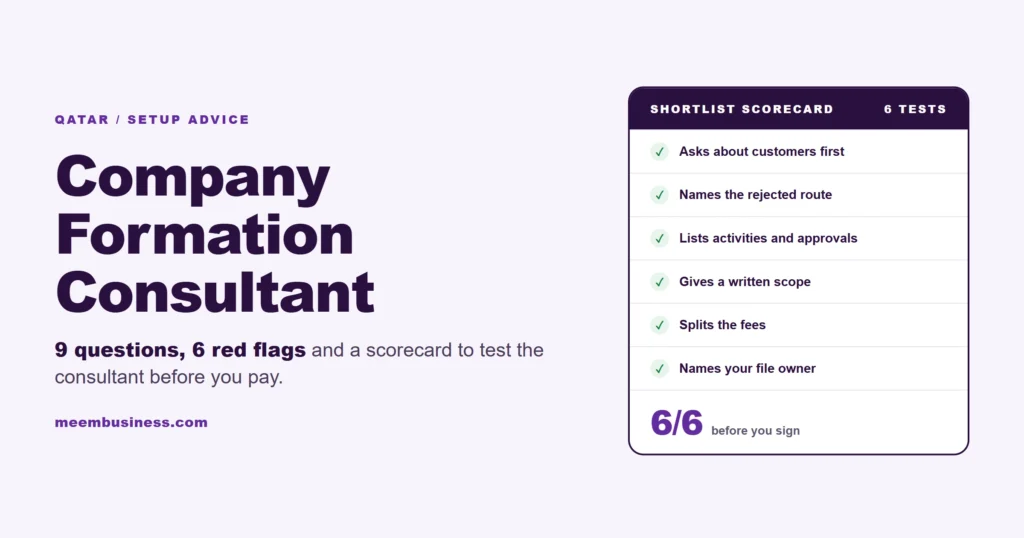
Score each consultant on six checks: whether the consultant asked about customers and revenue first, named the rejected route, listed the activities and approvals, gave a written scope, split the fees, and named the person responsible for the file. A score of six out of six indicates a strong shortlist candidate; four or five means request the missing items in writing; three or fewer means do not pay yet.
Shortlist scorecard
The scorecard is a decision aid, not an endorsement or a guarantee of any outcome.
What Should a Company Formation Consultation Cover?
A paid assessment covers seven areas: the business model, customers and contracts, activities, shareholders and management, premises, employees and visas, and banking and tax. The consultation should connect each area to a route and a cost, so the owner can see why the recommendation fits.
| Area | Why it matters |
|---|---|
| Business model | Connects the legal structure to how the company earns revenue |
| Customers and contracts | Shows whether the business needs local market access, international reach or both |
| Activities | Identifies the licence, authority and approval dependencies |
| Shareholders and management | Affects the legal form, ownership, documents and signatories |
| Premises | Can change licensing, inspections, cost and route eligibility |
| Employees and visas | Connects staffing to labour, immigration and office requirements |
| Banking and tax | Prepares the company for operations after registration |
Should You Choose Mainland, QFC or QFZ for a Qatar Company?
Mainland suits businesses that sell to the local Qatar market, QFC suits activities permitted by the Qatar Financial Centre, and QFZ suits projects that meet Qatar Free Zones eligibility and sector requirements. The route should be chosen against customers, ownership, premises and staffing, not against one headline benefit.
| Route | Often considered when | Confirm before choosing |
|---|---|---|
| Mainland | The business serves the local Qatar market through activities licensed by mainland authorities | Activity availability, legal form, ownership, premises, external approvals |
| Qatar Financial Centre | The activity is permitted by QFC and the owner values its onshore legal, regulatory and tax environment | Permitted activity, regulated status, office requirements, compliance duties, annual cost |
| Qatar Free Zone | The project fits QFZ eligibility, target sectors or facility requirements | Eligibility, local market access, customs treatment, property, staffing |
QFC permits registered firms up to 100% foreign ownership and applies 10% corporate tax on locally sourced profits, subject to QFC rules. QFZ offers eligible investors 100% foreign ownership and renewable 20-year corporate tax holidays under the QFZ framework, and goods sold into the local market remain subject to customs procedures.
Final eligibility, ownership and licensing remain with the responsible authorities. A consultant should state that limit plainly instead of promising the outcome. The mainland, free zone and QFC comparison covers the trade-offs across the three routes.
What Should You Prepare Before the First Consultation?
Prepare six items before the first Qatar company formation consultation: a description of the product or service and its buyers, shareholder names and nationalities, the intended ownership split, customer and supplier locations, premises and staffing plans, and the launch budget and target start date. A licence category is not required at this stage.
- The products or services, and who buys them
- Shareholder names, nationalities and the intended ownership split
- Where customers and suppliers are located
- Premises needs and staffing plans
- Launch budget and target start date
- Any quotation or activity list the business already holds
What Should You Receive From a Company Formation Consultation?
The written output should include six items: a recommended route with the reason, a viable alternative with trade-offs, activity and authority notes, document and approval requirements, cost categories with exclusions, and a milestone sequence with the open risks. A verbal recommendation cannot be compared against a second opinion.
- A recommended route with the reason, and a viable alternative with its trade-offs
- Activity, licence and authority notes
- Document and approval requirements
- Cost categories and the important exclusions
- A realistic sequence of milestones and dependencies
- Risk flags and the questions that still need confirmation
Is a Company Formation Consultant Worth It in Qatar?
The fee is worth it when the route, ownership or approval is unclear, because a wrong route costs more than the assessment. A consultant adds less value when the structure is already decided and the file only needs filing, which is formation agent work rather than consultant work.
The test is simple: if the first meeting produces a route, the rejected alternative, the authority list and a written scope, the assessment paid for itself. If the first meeting produces a package price and a promise, the business has learned what to avoid.
Want a Second Opinion Before You Sign?
Meem has advised more than 500 business owners and supported the incorporation of more than 100 businesses through 2026. Start with the company formation service or the PRO support that follows registration. If the company name is still open, trade name registration is a separate file.
Why Does a Good Consultant Sometimes Say No?
A consultant who says yes to every route, every activity and every timeline is selling optimism rather than advice. A useful Qatar consultant says which option does not fit, which approval could delay the file, and what the file cannot deliver.
Use the nine questions, check the answers in writing, and score the shortlist before paying. A paid assessment should cost less than the mistake it prevents.
Company Formation Consultant Questions, Answered
What does a company formation consultant in Qatar do?
A company formation consultant in Qatar assesses the business model, activities, ownership and customers, then recommends a Mainland, QFC or QFZ route. The deliverable includes the route rationale, the authorities involved, the document list, the cost categories and the next steps.
How much does a company formation consultant cost in Qatar?
Company formation consultant fees in Qatar depend on the scope and the model: fixed fee, phase-based, success-linked, retainer or hourly. The quotation should split government fees, the firm’s service fee and third-party costs such as attestation, translation and premises.
Can I hire a company formation consultant from outside Qatar?
Yes. A company formation consultant can run the business assessment and most of the planning remotely. Some stages still need original documents, attestation, signatures or a local appointment, depending on the route and the authority.
Is a Qatari partner always required for a company in Qatar?
No single rule applies to Qatari company ownership. Ownership depends on the jurisdiction, legal form, activity and approval. QFC permits registered firms up to 100% foreign ownership, and QFZ offers 100% ownership to eligible investors. Mainland requirements must be checked for the proposed activity.
What is the difference between a formation consultant and a formation agent?
A formation consultant decides what should be filed and why. A formation agent executes the agreed incorporation and licensing steps. Some Qatar firms do both, but the quotation should name the role, the deliverable and the boundary.
What questions should I ask before signing with a consultant?
Ask what the company will sell and to whom, which route fits and which was rejected, which activities and authorities apply, what is included and excluded, how fees are split, who owns the file, what could delay it, and whether the client can speak to a comparable reference.
How do I verify a company formation consultant in Qatar?
Ask for the commercial registration number and check the legal name in the MOCI register, match the name on the quotation to the bank details, confirm who signs and handles the file, and get the scope and fee split in writing before paying.
When should I walk away from a consultant?
Walk away from guaranteed approval, special-relationship claims, a package price before any questions, no written scope, a lump sum with no fee split, or pressure to sign a lease before the activity and approval check.
Does a formation consultant guarantee a bank account or visas?
No. Banks and government authorities make their own decisions. A consultant can prepare and coordinate the bank file, labour and immigration requirements, but approval of a bank account, visa or licence cannot be guaranteed.
When should I speak to a company formation consultant?
Speak to a company formation consultant before signing a lease, paying a deposit or committing to a package. The earlier the assessment, the more options remain open and the less rework the file needs.
Official Qatar Setup Sources
- MOCI Trade Search, checked 27 October 2026.
- Single Window investor portal, checked 27 October 2026.
- Qatar Financial Centre, checked 27 October 2026.
- Qatar Free Zones Authority, checked 27 October 2026.
- Invest Qatar, checked 27 October 2026.

Jisham
Head of Operations at Meem
4+ years of hands-on Qatar PRO experience, handling approvals and government procedures across multiple ministries and authorities, including establishment licensing and approvals.
Connect On LinkedIn →