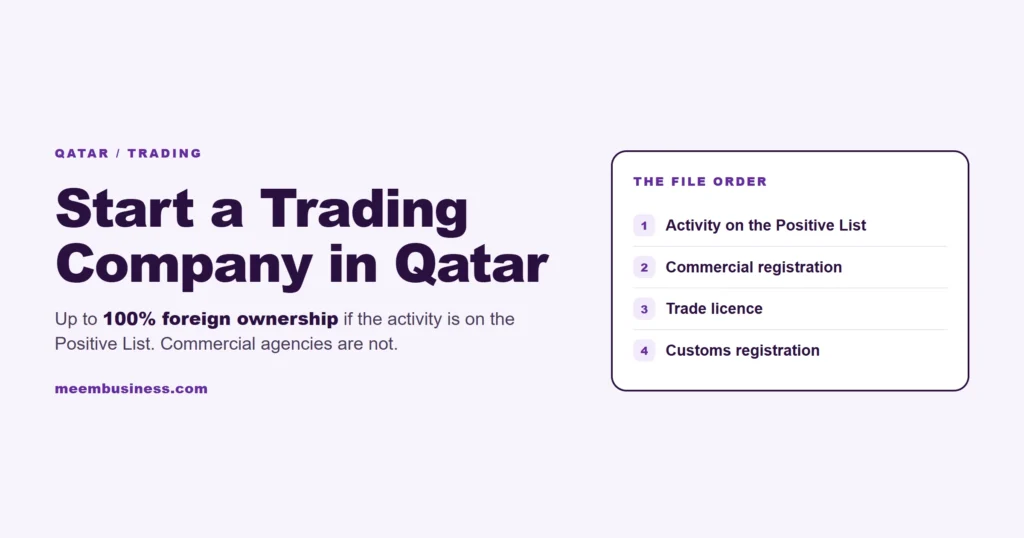
A trading company in Qatar needs a commercial registration and a trade licence for the goods it will buy and sell. A foreign investor can own up to 100% of the company if the trading activity is on the Positive List, but commercial agencies, banks and insurance are excluded from full foreign ownership.
Trading Company in Qatar: The Essentials
- Foreign ownership: up to 100% under Law No. 1 of 2019, if the activity is permitted.
- Excluded from full foreign ownership: banks, insurance and commercial agencies.
- Minimum capital: no specified minimum in the investment law; the project size sets the capital.
- Activity check: the Positive List on Single Window decides what a foreign investor may trade.
- Route: CR first, then the trade licence, then customs registration for imports.
Why Start a Trading Company in Qatar Now?
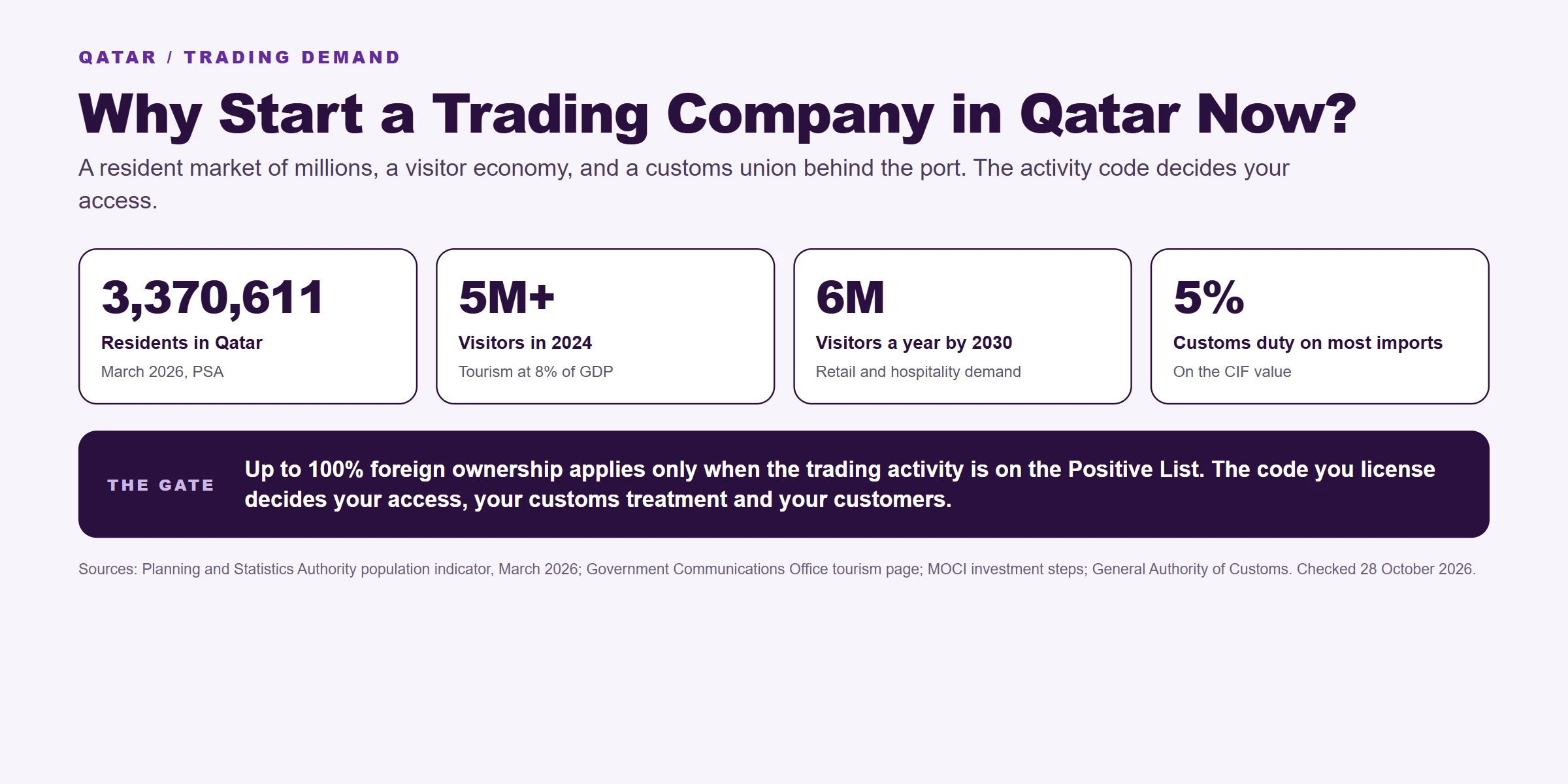
Qatar has 3,370,611 residents, more than 5 million visitors in 2024 and a target of 6 million a year by 2030, and most goods are imported and cleared at 5% customs duty. That combination supports a distribution or retail business, provided the activity code is on the Positive List.
Trading is a working-capital business. The licence is cheap; the stock, the freight and the receivables are not. Plan the first container, the warehouse and the payment terms before the licence.
What Is a Trading Company in Qatar?
A trading company in Qatar buys and sells goods, either locally, through imports, or both. The company holds a commercial registration with trading activities and a trade licence that covers the goods it deals in, and a trading company that imports needs a customs registration before the first shipment clears.
The activity code matters more in trading than in most sectors. A licence for specific goods does not authorise general trading, and a general trading code does not automatically cover regulated products such as food, medicines, chemicals or telecommunications equipment.
Can a Foreigner Own 100% of a Trading Company in Qatar?
A foreign investor can own up to 100% of a trading company in Qatar when the trading activity is on the Positive List under Law No. 1 of 2019. Banks, insurance companies, commercial agencies and any sector excluded by a Council of Ministers decision are outside that rule, and a restricted activity needs specific authorisation.
The Positive List is the document that decides the answer for a specific product. Two trading businesses can sit in the same building with different ownership outcomes because one sells an open activity and the other sells a restricted one.
What Is the Difference Between Trading and a Commercial Agency?
A trading company buys and sells goods on its own account, while a commercial agency distributes another company’s products under an agency agreement. Commercial agencies are one of the activities excluded from full foreign ownership, which is why a foreign investor usually structures distribution as trading rather than as a registered agency.
How Much Capital Does a Trading Company Need in Qatar?
Qatar sets no specified minimum capital for a foreign investment project under Law No. 1 of 2019; the capital follows the size of the project. A trading company still has to show enough capital for the activity, the premises and the stock, and the bank will test the funding when the account is opened.
Individual activity rules can add their own conditions. A regulated product may require a licence, a storage facility or an inspection that effectively sets a floor, even when the investment law sets none.
Which Activity Code Should a Trading Company License?
A trading company should license the product groups it actually sells, not one broad code. The activity description decides what customs will accept, what the shop or warehouse may store, and whether a second authority has to approve the goods.
- Specific goods. Electronics, furniture, building materials, machinery or textiles, each with its own activity description.
- General trading. A broad code that still has to fit the permitted list and the premises.
- Regulated products. Food, medicines, chemicals and telecoms equipment need the sector authority before the goods clear.
- Import and export. The customs registration and the product approvals sit on top of the trade licence.
How Do You Start a Trading Company in Qatar Step by Step?
A trading company in Qatar starts with the activity and the Positive List, then moves through the commercial registration, the trade licence and the customs file. The order matters, because the activity decides the ownership, the premises and the product approvals before any of the later steps can be filed.
- Check the activity. Confirm the product group is on the Positive List and whether a second authority regulates it.
- Choose the structure. An LLC is the usual trading vehicle, with the ownership split the activity allows.
- Prepare the documents. Shareholder IDs, the activity, the premises and the legal-form documents.
- Register the company. File the commercial registration and the trade licence through the Single Window or the Invest in Qatar Center.
- Register for customs. An importing trading company needs the customs registration before the first shipment.
- Open the bank account. A non-Qatari investor needs a Qatar bank account for the project.
- Staff the operation. The establishment card, visas and QIDs follow the licence.
What Does a Trading Company Cost in Qatar?
The government cost of a trading company is the commercial registration and the trade licence, with the CR at QAR 500 for one activity and QAR 300 for each additional activity. The Invest in Qatar Center charges no fee for the application itself, and the fees are collected at commercial registration and licensing.
The larger cost sits outside the government fees: the premises, the initial stock, the customs and freight, the bank requirements and the working capital between paying a supplier and collecting from a customer.
How Is a Trading Company Different from a Contracting Company?
A trading company sells goods, while a contracting company delivers works such as construction, installation or maintenance. The two activities can sit in one company only when both are licensed, and a contractor that supplies materials as part of a project still needs the contracting activity to sign the works.
The commercial registration guide covers the CR file, and the activity approval guide covers the approvals behind a regulated product.
Trading Company Questions, Answered
Can a foreigner own 100% of a trading company in Qatar?
Yes, if the trading activity is on the Positive List under Law No. 1 of 2019. Banks, insurance companies, commercial agencies and any sector excluded by a Council of Ministers decision are outside the 100% rule and need specific authorisation.
Is there a minimum capital for a trading company in Qatar?
The investment law sets no specified minimum capital for a foreign investment project; the capital follows the size of the project. Individual activities can add conditions such as premises, storage or product approvals that effectively set a floor.
What is the difference between trading and a commercial agency in Qatar?
A trading company buys and sells goods on its own account. A commercial agency distributes another company’s products under an agency agreement, and commercial agencies are excluded from full foreign ownership.
How much does it cost to register a trading company in Qatar?
The commercial registration costs QAR 500 for one activity and QAR 300 for each additional activity, with the trade licence fees collected at licensing. The Invest in Qatar Center charges no fee for the application itself.
Do I need a customs registration as a trading company?
A trading company that imports goods needs a customs registration before the first shipment clears. The customs file sits on top of the trade licence and follows the product approvals for regulated goods.
Can a trading company import regulated products?
Yes, with the approval of the authority that regulates the product. Food, medicines, chemicals and telecoms equipment need their sector approval before the goods clear customs, even when the trade licence covers trading.
Which activity code should a trading company choose?
Choose the product groups the company actually sells rather than one broad code. The activity description decides what customs accepts, what the premises may store and whether a second authority has to approve the goods.
Can one company hold trading and contracting activities?
Yes, when both activities are licensed on the commercial registration. A contractor that also supplies materials needs the contracting activity to sign the works and the trading activity to sell the goods.
Official Trading Company Sources
- MOCI: Investment Steps for Foreign Investors, checked 28 October 2026.
- Single Window: Start Your Business, checked 28 October 2026.

Jisham
Head of Operations at Meem
4+ years of hands-on Qatar PRO experience, handling approvals and government procedures across multiple ministries and authorities, including establishment licensing and approvals.
Connect On LinkedIn →