
If you’re considering starting an ecommerce business in Qatar or investing in the region’s digital retail sector, you’ve likely encountered conflicting opinions about Qatar ecommerce market.
Some believe the market has matured while others claim explosive growth is underway.
The truth is clear: Qatar’s ecommerce market is experiencing robust growth, not decline. In fact, it’s one of the most profitable markets in the Middle East for online retailers.
This comprehensive guide, based on authoritative market research like Qatar Central Bank, and government data, explains exactly what’s happening in Qatar’s e-commerce landscape and why now is an ideal time to enter this market.
Qatar Ecom Market Size and Growth Trajectory
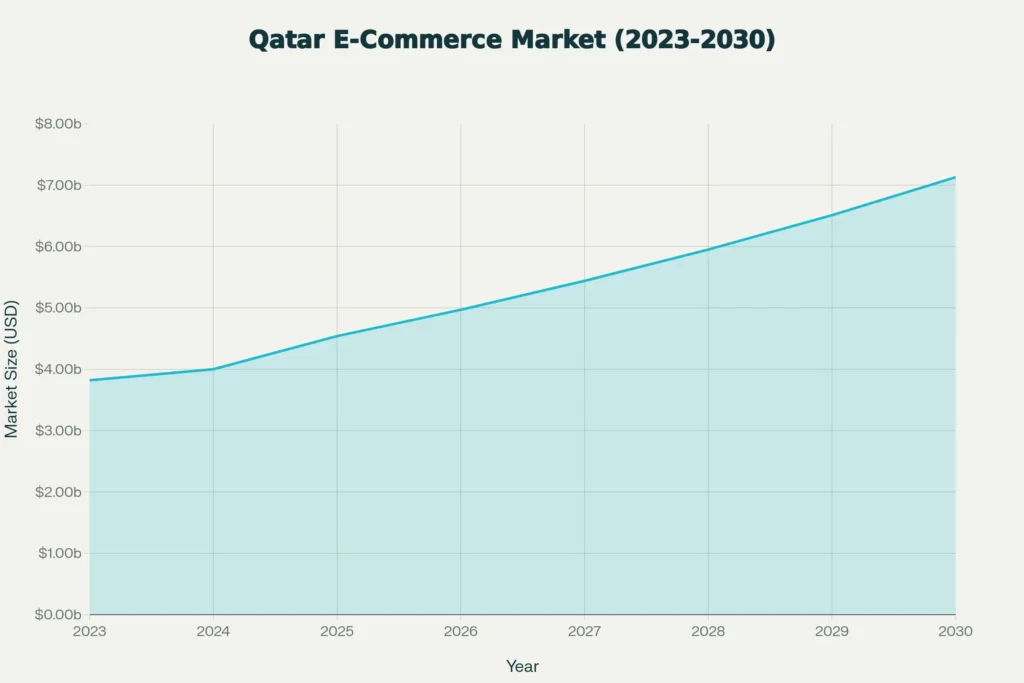
Current Market Valuation (2025)
Qatar’s e-commerce market was valued at USD 4.54 billion in 2025, according to Mordor Intelligence.
This represents significant growth from previous years and demonstrates strong consumer adoption of online shopping across all demographics.
For context, here’s what major research firms project:
| Research Firm | 2025 Valuation | 2030/2033 Projection | Growth Rate (CAGR) |
|---|---|---|---|
| Mordor Intelligence | USD 4.54B | USD 7.13B (2030) | 9.43% |
| IMARC Group | USD 3.8B | USD 10.1B (2033) | 10.27% |
| Technavio | USD 3.99B | — | 13.8% |
Why These Growth Numbers Matter
A 9.43% compound annual growth rate (CAGR) might seem modest compared to emerging markets, but it’s exceptional for a small, mature market like Qatar.
The market is growing at twice the pace of physical retail in the region (2.2% CAGR), signaling a significant shift in consumer purchasing behavior away from traditional brick-and-mortar stores.
This growth is happening despite Qatar’s small population of 3.1 million residents, proving that market size isn’t determined by population when consumers have exceptional purchasing power.
If you want to start an ecommerce business in Qatar you can contact our expert PROs who can assist you to get trade license and other paper works.
We can also assist you in marketing and arranging shipping and deliver partners and affordable payment gateways.
Market Evidence from Qatar Central Bank Data
When considering investment in any market, official government data provides the most reliable indicator. Here’s what Qatar Central Bank (QCB) has reported about e-commerce transactions:
Real-Time Transaction Growth (2025)
| Month | E-Commerce Transactions | Total Digital Payment Value (QR bn) | Growth Rate |
|---|---|---|---|
| March 2025 | 8.2 million | 16.1 | Baseline |
| June 2025 | 9.64 million | 15.9 | +14.95% YoY |
| July 2025 | 9.8 million | 16.13 | Strong momentum |
| October 2025 | 10.82 million | 18.47 | +10.73% MoM |
Key Insight: E-commerce transactions grew 15% year-over-year in June 2025, reaching QR4.28 billion in value. This verified growth pattern contradicts any claims of market decline.
E-Commerce Market Share Among Digital Payments
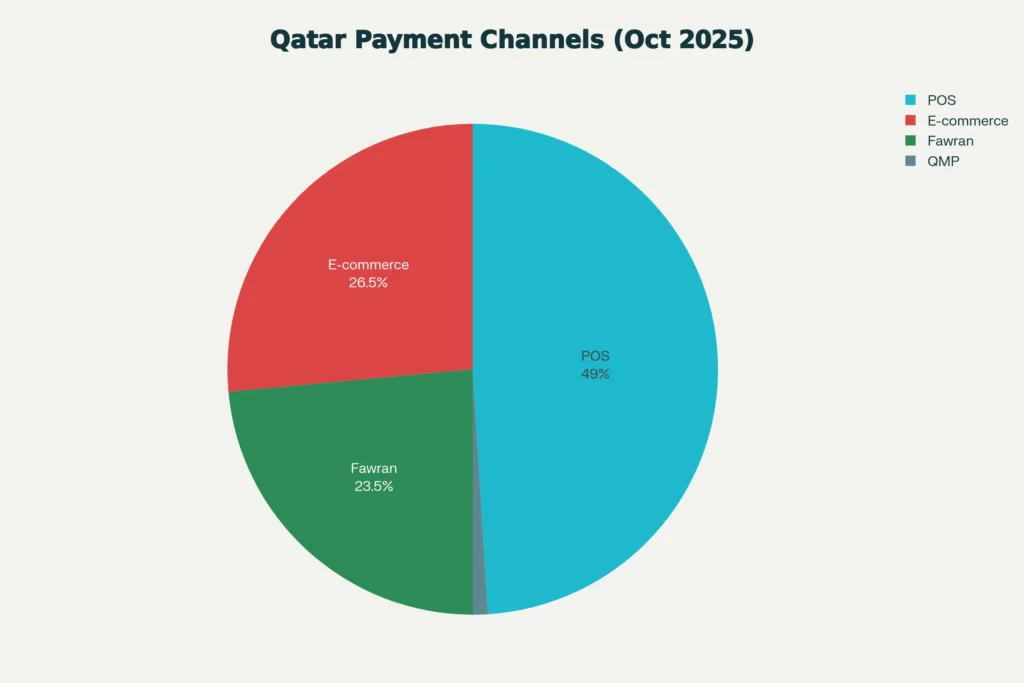
While e-commerce is growing rapidly, it’s important to understand its role within Qatar’s broader digital payment ecosystem:
- E-Commerce: 27% of all digital transactions
- Point of Sale (POS): 50% of digital transactions
- Instant Payments (Fawran): 24% of digital transactions
This diversification indicates a mature payments infrastructure that supports various transaction types—a prerequisite for sustainable e-commerce growth.
Why Qatar’s E-Commerce Market is Profitable
Market growth alone doesn’t guarantee profitability. The real question entrepreneurs ask is: “Can I make money here?” The answer is unequivocally yes. Here’s why:
Exceptional Consumer Purchasing Power
Qatar boasts the highest GDP per capita in the Middle East. Key economic indicators include:
- GDP Per Capita (2025): USD 70,000
- Projected GDP Per Capita (2028): USD 83,000
- Household Disposable Income: USD 34,970
- Total Consumer Spending (2025): USD 67.87 billion
This means Qatar’s 3.1 million residents have significantly higher purchasing power than consumers in other regional markets.
A family in Doha spends substantially more online than comparable households in larger regional centers.
Rising Average Revenue Per User (ARPU)
ARPU measures the average revenue generated per customer and is a critical profitability metric:
- ARPU 2023: USD 1,700
- ARPU 2027 (Projected): USD 2,300
- Growth: 74% increase over four years
This 74% ARPU growth far exceeds inflation rates and indicates that Qatari consumers are not just shopping online more frequently.
They’re spending significantly more per transaction. This translates directly to higher profit margins for e-commerce retailers.
Premium Product Preferences
The average digital transaction value in Qatar reached USD 3,960 in 2024, more than double typical GCC averages. This reflects Qatar’s population’s strong preference for premium and luxury products.
Product category breakdown:
- Fashion & Apparel: 32% of market share (highest category)
- Electronics: Strong demand for premium brands
- Luxury Goods: Disproportionately high transaction values
- Specialty Products: Limited competition in niche categories
If you’re selling educational toys, specialty items, or premium products, Qatar’s affluent consumer base is ideal.
Infrastructure Advantages That Enable Growth
Market demand alone doesn’t drive e-commerce success. The underlying infrastructure must support seamless online shopping. Qatar possesses world-class digital infrastructure:
Internet and Mobile Connectivity
| Metric | Value | Global Rank |
|---|---|---|
| Internet Penetration | 99% | Among highest globally |
| Internet Users | 3.1 million | — |
| Mobile Connections | 4.82 million | 156% of population |
| Mobile Broadband Penetration | 99.2% | — |
| 5G Coverage | 98% | Industry-leading |
| Median Mobile Internet Speed | 511.35 Mbps | World’s fastest |
What this means for e-commerce: Nearly every potential customer has reliable, ultra-fast internet access. Mobile shopping is seamless, video streaming works flawlessly, and live shopping experiences are possible.
Mobile Commerce Dominance
Mobile devices generated 70% of e-commerce revenue in 2024, translating to USD 3.18 billion in 2025 and growing at 11.4% CAGR. This is critical because:
- Most e-commerce in Qatar happens on phones, not desktops
- 90% smartphone penetration means virtually every customer has a mobile device
- Android dominates at 77.23% market share, followed by iOS at 22.77%
Implication for business owners: Your e-commerce platform must be optimized for mobile first, not as an afterthought.
Government Support and Digital Transformation Initiatives
Government backing significantly impacts market growth. Qatar’s government is actively supporting e-commerce expansion:
National Digital Agenda 2030 (NDA2030)
Qatar’s government launched the National Digital Agenda 2030 with ambitious targets:
- Projected GDP contribution: USD 11 billion (QR40 billion) from digital economy by 2030
- Jobs created: 26,000 new ICT positions
- Digital penetration goal: Mainstream adoption across all business sectors
- International ranking: Qatar ranks 20th globally in IMD World Digital Competitiveness (up from 26th in 2024)
Strategic Investment in Infrastructure
In February 2025, Qatar invested QR2 billion (USD 550 million) in artificial intelligence and data centers. This infrastructure development supports:
- Predictive logistics for faster delivery
- Personalized recommendations powered by AI
- Fraud detection and payment security
- Scalable cloud services for growing e-commerce platforms
Digital Payment Infrastructure
The Fawran instant payment system has revolutionized how Qataris pay online:
- Registered accounts: 3.2 million
- October 2025 transaction value: QR4.56 billion
- Monthly growth rate: 23.58%
This reduces payment friction and increases conversion rates for online retailers.
Profitable Ecommerce Business Ideas in Qatar for 2026 & Beyond
Not all e-commerce categories are created equal. Here’s where the strongest growth is happening:
Online Grocery (The Fastest-Growing Segment)
| Metric | Value |
|---|---|
| Current Market Size (2025) | USD 172 million |
| Projected Size (2031) | USD 1.1 billion |
| CAGR | 41.5% |
Online grocery is experiencing explosive growth because of last-mile delivery innovations.
Startups now guarantee delivery under 60 minutes across Doha, making online grocery more convenient than driving to a physical store.
Food & Beverage Delivery
- Growth Rate: 12.7% CAGR
- Drivers: Ghost kitchens, AI-powered menu curation, instant delivery
- Market Maturity: Highly competitive but still growing
Fashion & Apparel
- Market Share: 32% of e-commerce
- Growth Driver: Exclusive capsule drops, livestream shopping, luxury preferences
- Profitability: Premium pricing supports healthy margins
Buy Now Pay Later (BNPL)
- Growth Rate: 18.3% CAGR (2025-2030)
- User Adoption: 220,000 users signed up within six months of regulatory approval (July 2024)
- Implication: Lower friction for larger purchases
Takeaway: If you’re entering e-commerce in Qatar, align with one of these high-growth categories or a niche within them.
If you want to open ecommerce store in Qatar you can contact our expert PROs who can assist you to get trade license and other paper works.
We can also assist you in marketing and arranging shipping and deliver partners and affordable payment gateways.
Challenges and Realistic Considerations
Growth statistics don’t tell the complete story. Successful e-commerce requires understanding the challenges:
Cash-on-Delivery (COD) Preference
Cultural and trust factors make COD the dominant payment method in Qatar:
- Challenge: COD return rates are 1.7 times higher than prepaid orders
- Impact: Higher reverse logistics costs and inventory management complexity
- Solution: Implement verification steps before fulfillment, partner with reliable COD payment providers
Geographic Concentration
While Qatar’s digital infrastructure is excellent, most consumers and delivery networks concentrate in Doha:
- Cost disadvantage: Delivery to outside areas costs 30% more
- Market limitation: Effectively reduces serviceable addressable market to core urban zones
- Opportunity: Doha-based businesses have a significant cost advantage
Small Population Base
With only 3.1 million residents, the total addressable market is limited:
- Implication: Specialization is critical; broad product catalogs don’t work well
- Opportunity: Niche, premium products find their audience quickly in a concentrated market
Competitive Landscape
Understanding who you’re competing against is essential:
Market Leaders
| Company | Focus | Competitive Advantage |
|---|---|---|
| Amazon (Souq.com) | General marketplace | Logistics network, same-day delivery |
| Noon | Regional marketplace | Local market knowledge |
| Talabat | Food delivery | 1 million daily GCC orders, strong branding |
| Lulu Hypermarket | Omnichannel retail | Physical presence, store integration |
| Carrefour Qatar | Grocery & general | Established physical network |
Market concentration: The top five platforms capture approximately 40% of the market, leaving substantial room for specialized entrants and niche players.
Opportunity for newcomers: The fragmented landscape means there’s significant whitespace for businesses that target specific customer segments or product categories effectively.
Here is the list of 20 profitable businesses that you can start in Qatar.
Is Qatar’s E-Commerce Market Booming or in Decline? The Final Verdict
Based on comprehensive analysis of official government data, reputable market research, and transaction evidence, the answer is unambiguous:
The Market is in a Clear Growth Phase (Boom)
Evidence supporting growth:
- Double-digit transaction growth verified by Qatar Central Bank data (15% YoY in June 2025)
- Consistent CAGR projections of 9-14% from multiple independent research firms
- World-leading digital infrastructure with 99% internet penetration and 98% 5G coverage
- Exceptional consumer spending power with 74% ARPU growth projected through 2027
- Active government support through NDA2030 and QR2 billion infrastructure investments
- Sector-specific explosions like online grocery growing at 41.5% CAGR
- Fragmented competition with top five players controlling only 40% market share
Profitability Outlook
For entrepreneurs with:
- Premium products or services (aligns with luxury preferences)
- Niche positioning (fragmented market favors specialists)
- Mobile-first strategies (70% of revenue from mobile)
- Doha focus (concentrated market, lower delivery costs)
- Efficient COD management (addresses customer payment preference)
…profitability in Qatar’s e-commerce market is highly achievable.
Getting Started in Qatar’s E-Commerce Market
If you’re inspired to launch an e-commerce business in Qatar, here’s where to begin:
1. Conduct Market Validation
- Analyze competitor strategies using Meta Ads Library for social media campaigns
- Survey target customers through focus groups or online surveys
- Test product concepts through dropshipping or low-inventory models
2. Establish Legal and Regulatory Compliance
- Register your business under Qatar’s Ministry of Commerce and Industry (MOCI)
- Obtain a Commercial Registration (CR) and Trade License for e-commerce
- Understand Qatar’s Consumer Protection Law and data privacy requirements
- Ensure VAT compliance if applicable
You can check our company formation cost calculator to know more about potential costs and expense you might need.
If you want to start an ecommerce business in Qatar you can contact our expert PROs who can assist you to get trade license and other paper works.
We can also assist you in marketing and arranging shipping and deliver partners and affordable payment gateways.
3. Select Your Sales Channels
Primary options:
- Social media-first model (Instagram, TikTok, Snapchat) – leverages 70% mobile commerce
- Marketplace integration (Noon, Amazon) – reaches established audiences
- Independent website (Shopify, WooCommerce) – builds brand authority
4. Optimize for Mobile and Payment
- Ensure your platform is mobile-optimized (not just responsive)
- Integrate Fawran instant payments and traditional payment gateways
- Offer COD as a primary option to match customer preference
- Implement secure payment processing
5. Plan Your Logistics
- Partner with local delivery providers for same-day/next-day service
- Focus initially on Doha to minimize delivery costs
- Consider dropshipping or marketplace fulfillment initially
Conclusion
Qatar’s e-commerce market is not declining: it’s booming. With 9.43% projected CAGR through 2030, exceptional consumer purchasing power, world-class infrastructure, and fragmented competition leaving room for specialists, now is an opportune time to enter the market.
The fundamental question isn’t whether the market is growing (it clearly is), but whether your business model aligns with Qatari consumer behavior and market structure.
Focus on mobile-first, culturally aware, premium-positioned offerings, and the profitability potential is substantial.
The data is clear. The opportunity is real. The next step is yours.
If you want to start an ecommerce business in Qatar you can contact our expert PROs who can assist you to get trade license and other paper works.
We can also assist you in marketing and arranging shipping and deliver partners and affordable payment gateways.
This article is based on research from Mordor Intelligence, Ken Research, Qatar Central Bank, International Trade Administration, and IMARC Group.