
This guide explains how to start a business in Qatar, from choosing the route to registering and operating through the first 90 days.
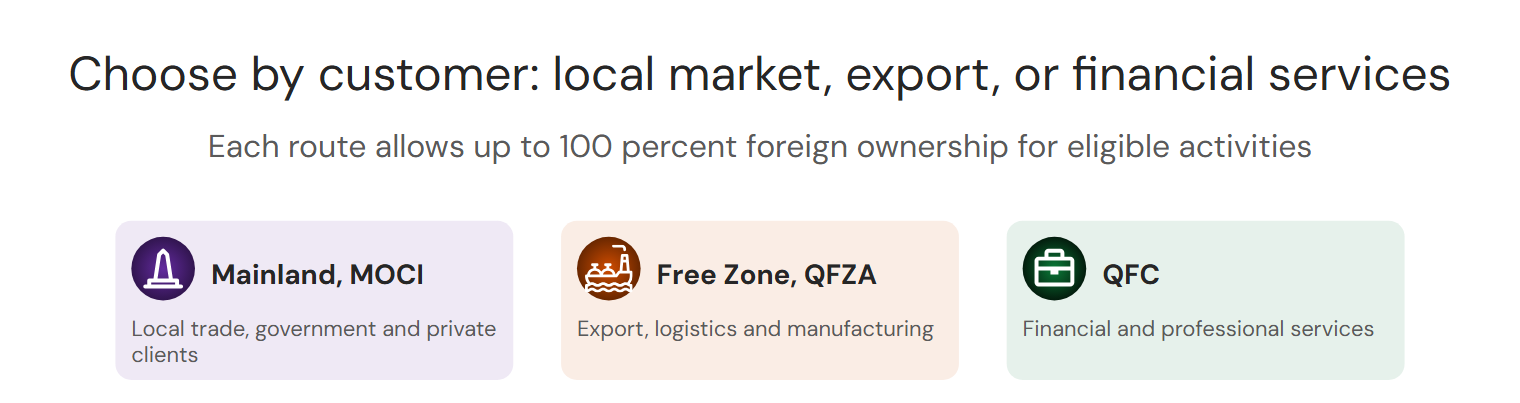
Qatar has three setup routes: a mainland company, a free zone company, and a Qatar Financial Centre (QFC) company. Mainland suits local trade, a free zone suits export and international services, and the QFC suits financial and professional services.
Each route allows up to 100% foreign ownership for eligible activities. Setup starts from QAR 7,000 and usually takes 2 to 8 weeks depending on the route.
Key Takeaways
- Three routes: mainland (MOCI), free zone (QFZA), and QFC. Each allows up to 100% foreign ownership for eligible activities.
- Mainland suits local trade and customers in Qatar. A free zone suits export, logistics, and manufacturing. The QFC suits financial and professional services.
- Setup starts from QAR 7,000, and the final cost depends on the activity, the structure, the office, and the visa scope.
- Typical timeline: 4 to 8 weeks mainland, 2 to 5 weeks free zone, and 3 to 6 weeks QFC.
- After registration you handle the Qatar Chamber, the establishment card, the bank account, tax registration, and staff visas.
The Three Ways to Set Up a Business in Qatar
Qatar offers three routes for company formation: the mainland, a Qatar free zone, and the Qatar Financial Centre.
A mainland company registers with MOCI and can trade anywhere in Qatar, including with government and private clients.
A free zone company registers with the Qatar Free Zones Authority and is built for export, logistics, technology, and manufacturing.
A QFC company registers with the Qatar Financial Centre and suits financial, advisory, and professional services. All three routes allow up to 100% foreign ownership for eligible activities, subject to approval of the activity and the structure.
| Route | Regulator | Best For | Foreign Ownership |
|---|---|---|---|
| Mainland | Ministry of Commerce and Industry (MOCI) | Local trade, government and private clients, retail and services | Up to 100% in approved activities |
| Free zone | Qatar Free Zones Authority (QFZA) | Export, logistics, manufacturing, technology, regional operations | 100% for approved free zone activities |
| QFC | Qatar Financial Centre (QFC) and QFCRA where regulated | Financial, advisory, and professional services | 100% for eligible activities |
Which Setup Route Fits Your Business?
The right route depends on four things: who you sell to, how much ownership you want, whether you need a physical base in Qatar, and how quickly you need to trade.
A business that sells directly to customers inside Qatar usually needs a mainland company. A business that exports or serves clients abroad, and wants full foreign ownership, usually fits a free zone. A business that provides financial or professional services usually fits the QFC.
Regulated activities, such as food, health, education, and media, need an extra approval from the relevant authority alongside the mainland licence.
| Your Situation | Likely Route |
|---|---|
| You sell to customers in Qatar and need a physical base | Mainland (MOCI) |
| You export or serve clients abroad and want 100% foreign ownership | Free zone (QFZA) |
| You offer financial, advisory, or professional services | QFC |
| Your activity is regulated (food, health, education, media) | Mainland plus a sector approval |
Use the Route Finder
Answer three questions. The tool points to a likely route. Confirm the final route with the relevant authority.
Can a Foreigner Start a Business in Qatar?
A foreign investor can own a business in Qatar, and a foreign shareholder can reach 100% ownership for eligible activities.
On the mainland, ownership is up to 100% in approved activities, which means the specific activity decides the ceiling. A free zone allows 100% ownership for approved free zone activities, and the QFC allows 100% for eligible activities.
Some activities remain restricted to Qatari or Gulf Cooperation Council (GCC) ownership, and those need a local partner. The route and the activity code you choose decide which rule applies to you.
The structure you register also affects the file. A WLL is the standard choice for most founders. A branch lets an existing foreign company operate in Qatar without a separate legal personality. A holding company holds shares in other companies. For the full mainland walkthrough, see LLC company formation in Qatar.
In every case, the beneficial owners are declared through a UBO filing, and corporate shareholders provide board resolutions, company documents, and attested papers.
What Does It Cost to Start a Business in Qatar?
Company setup in Qatar starts from QAR 7,000 for many straightforward cases.
That starting range covers standard government and authority fee coordination, the setup service, and core filing guidance once the activity, ownership route, office need, and visa scope are checked. The figure is a starting point, not a fixed price, because the final quote depends on the activity and the structure.
Government fees are quoted in Qatari riyal (QAR). Six things change the final quote.
- Setup route: mainland, QFC, and free zone packages have different authority and office requirements.
- Business activity: some activities need extra approvals or regulated review.
- Shareholder structure: individual, corporate, foreign, or mixed ownership changes the document path.
- Office and address: a virtual office, a physical office, a facility, or a warehouse each cost differently.
- Translation and attestation: foreign documents, powers of attorney, and notarisation add third-party cost.
- PRO and visa scope: investor visas, staff visas, labour files, and the establishment card vary by company.
Request an itemised quote for your activity and structure. A single general estimate hides the office, translation, and visa items that usually move the total. Use the company opening cost calculator to plan your budget.
How Long Does It Take to Start a Business in Qatar?
Company formation in Qatar usually takes 2 to 8 weeks, and the route sets the window.
A mainland setup commonly runs 4 to 8 weeks, a free zone setup runs 2 to 5 weeks, and a QFC setup runs 3 to 6 weeks.
These are planning windows, not promises. The real timeline depends on activity approvals, document readiness, signatures, and the office requirement.
What Changes the Timeline
- Sector approval: an activity that needs a second authority to approve the licence takes longer.
- Trade name: a rejected name restarts the reservation step.
- Documents: an incomplete or untranslated file is returned for changes.
- Signatures: shareholders who sign from abroad add attestation and courier time.
Step-by-Step: How to Register a Business in Qatar
Registration follows a fixed order.
The activity and the route come first, because they set the licence and the ownership path.
Skipping a step, such as reserving the trade name or matching the activity code, causes most returns.
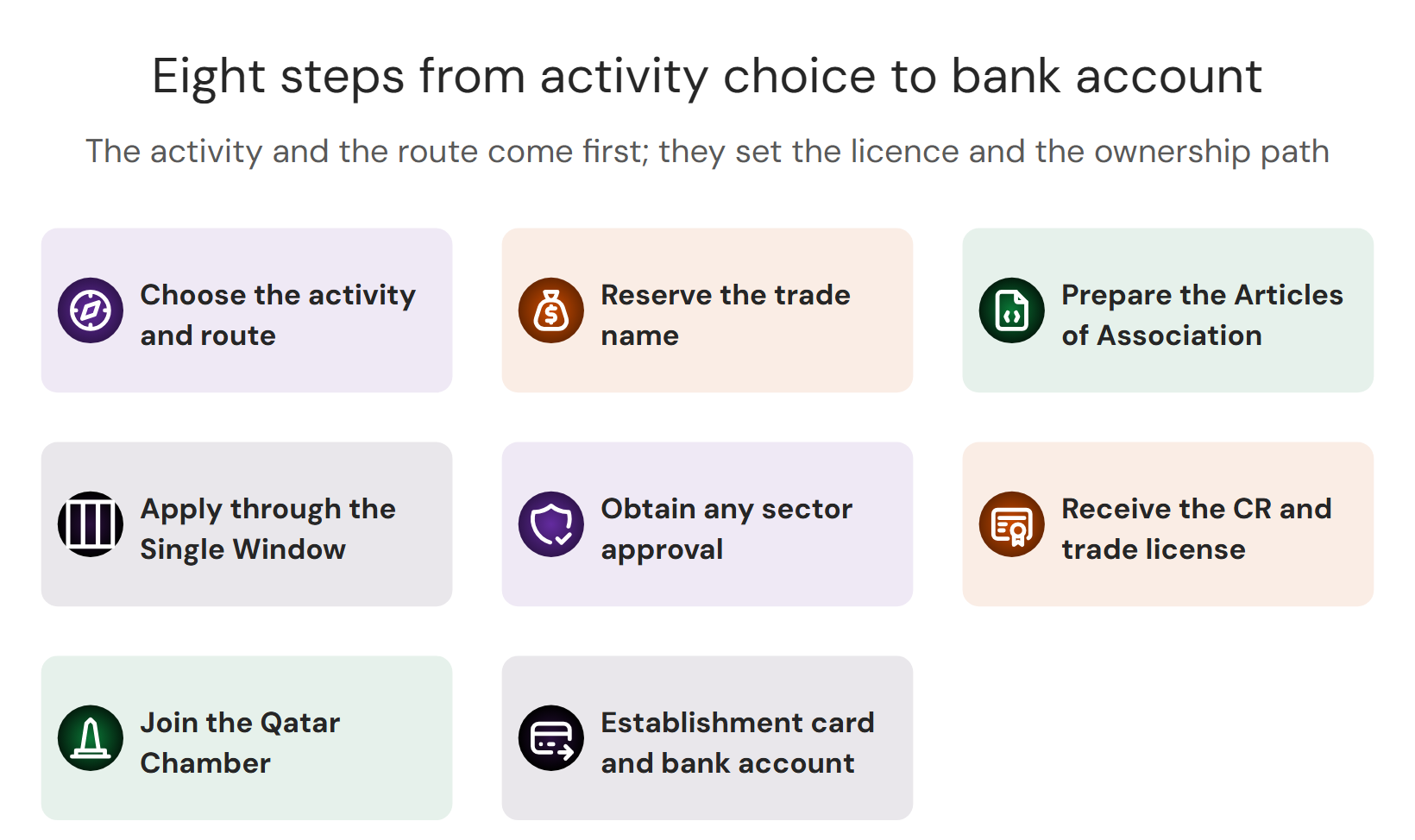
- Choose the activity and the route.
- Reserve the trade name with MOCI or the relevant authority.
- Prepare the Articles of Association (AOA) or Memorandum of Association (MOA).
- Submit the application through the Single Window or the chosen authority portal.
- Obtain any sector approval the activity needs.
- Receive the Commercial Registration (CR) and the trade license.
- Join the Qatar Chamber.
- Open the establishment file and apply for the establishment or computer card.
- Open the corporate bank account and complete KYC.
- Apply for residence permits (QID) and staff visas, then register for tax with the General Tax Authority.
What Documents Do You Need to Start a Business in Qatar?
The document set depends on the route and the activity, but most applications start from a common core.
Some documents come from you, because they prove identity, ownership, or shareholder authority. The rest are prepared, translated, notarised, or submitted on your behalf.
- Passport and QID copies of the shareholders, partners, directors, and authorised signatories.
- A reserved trade name.
- Articles of Association (AOA) or Memorandum of Association (MOA).
- An activity wording that matches the MOCI or authority activity list.
- Proof of a commercial address, lease, or facility, according to the route.
- Corporate shareholder papers, including board resolutions and attested company documents.
- Arabic translations, notarisation, and attestations where required.
- Any sector approval the activity requires.
Do You Need an Office or a Local Partner?
A mainland company needs an approved commercial address, so a physical premises or an accepted office arrangement is part of the setup.
A free zone company normally takes premises inside the zone, and some zones offer shared or flexible options, which is why free zone timelines can be shorter. A QFC company needs a QFC-approved office address.
A local partner is needed only for activities restricted to Qatari or GCC ownership. Most activities allow full foreign ownership, so the requirement follows the activity, not the fact of being foreign.
What Are the Ongoing Obligations After Setup?
Formation is the start, not the finish. After registration, a company keeps its CR, trade license, establishment card, and Chamber membership current.
Tax registration and filing run through the General Tax Authority (GTA) and its Dhareeba portal. Qatar applies a commonly 10% corporate tax framework for mainland businesses, with no personal income tax on salaries, and free zones offer their own incentives.
Renewals run on a calendar, so licences, cards, and visas carry their own expiry dates that need tracking.
Which Authorities Are Involved in Setting Up a Company?
Depending on the route, several bodies are involved, and you do not deal with each one alone.
The main authorities are the Ministry of Commerce and Industry for the Commercial Registration and mainland setup, the Qatar Free Zones Authority for free zone licensing, and the Qatar Financial Centre with the QFC Regulatory Authority for QFC companies.
- Ministry of Commerce and Industry (MOCI): Commercial Registration, trade name, activities, and mainland company setup.
- Qatar Chamber: membership and commercial requirements for many mainland setups.
- Ministry of Labour (MOL): the labour file and workforce records.
- Ministry of Interior (MOI) and Metrash: the establishment card, immigration records, and visas.
- General Tax Authority (GTA): tax registration and compliance after formation.
- Qatar Free Zones Authority (QFZA): free zone licensing and facilities.
- Qatar Financial Centre (QFC) and QFCRA: QFC setup and regulatory review where required.
Common Mistakes When Starting a Business in Qatar
Activity code: choosing a code that does not match what the business sells sets the wrong licence and the wrong approvals, and it forces a rewrite later.
Ownership: assuming a local partner is always required, or that full ownership is automatic for every activity. The activity and the route decide the ceiling.
Order: applying before the trade name and the Articles of Association are final, which causes returns and repeats.
Address: ignoring the office or facility requirement until late, when the lease or permit becomes the longest item.
After setup: forgetting renewals, tax registration, or the establishment card, which then blocks visas and banking.
Set Up the Right Route With Meem
Meem handles company formation, licensing, and government approvals for founders and SMEs in Qatar, from route selection to the first month of PRO support. Start with the company formation in Qatar service, and compare starting a business in Qatar as a foreigner if you are investing from abroad.
Conclusion
Starting a business in Qatar comes down to the route. Choose mainland, free zone, or QFC first, then prepare the trade name, the Articles of Association, and the activity wording, then register through the Single Window and complete the first 90 days.
The route decision drives ownership, approvals, cost, and timeline, so it is worth getting right before any document is filed.
Frequently Asked Questions
Can a foreigner own 100% of a company in Qatar?
A foreign shareholder can reach 100% ownership for eligible activities. On the mainland, ownership is up to 100% in approved activities, a free zone allows 100% for approved free zone activities, and the QFC allows 100% for eligible activities. Some activities stay restricted to Qatari or GCC ownership.
How long does it take to start a business in Qatar?
Company formation in Qatar usually takes 2 to 8 weeks. Mainland setup commonly runs 4 to 8 weeks, a free zone runs 2 to 5 weeks, and the QFC runs 3 to 6 weeks. Activity approvals, document readiness, and the office requirement decide the real timeline.
What documents do I need to start a business in Qatar?
Most applications start from passport and QID copies, a reserved trade name, Articles of Association, activity wording, proof of a commercial address, corporate shareholder papers, and any sector approval the activity requires. Arabic translations and attestations are added where needed.
Do I need a local partner to start a business in Qatar?
A local partner is needed only for activities restricted to Qatari or GCC ownership. Most activities allow full foreign ownership, so the requirement follows the activity and the route, not the fact of being a foreign investor.
What is the difference between mainland, free zone, and QFC?
A mainland company trades anywhere in Qatar and serves local and government clients through MOCI. A free zone company is built for export, logistics, and manufacturing under the QFZA. A QFC company serves financial and professional services under the QFC and QFCRA.
How much does it cost to start a business in Qatar?
Company setup starts from QAR 7,000 for many straightforward cases. The final cost depends on the route, the activity, the shareholder structure, the office, translation and attestation, and the visa scope. Ask for an itemised quote for your activity.
What should I do after registering a company in Qatar?
After the Commercial Registration is issued, join the Qatar Chamber, open the establishment file and apply for the establishment card, open the corporate bank account, register for tax with the General Tax Authority, and apply for residence permits (QID) and staff visas.
What is the tax position for a company in Qatar?
Qatar applies a commonly 10% corporate tax framework for mainland businesses, with no personal income tax on salaries. Free zones offer their own incentives. Tax registration and filing run through the General Tax Authority and its Dhareeba portal.
Official Sources
- MOCI commercial registration and licence services for the mainland route.
- QFC company setup for the Qatar Financial Centre route.

Jisham
Head of Operations at Meem
4+ years of hands-on Qatar PRO experience, handling approvals and government procedures across multiple ministries and authorities, including establishment licensing and approvals.
Connect On LinkedIn