
Table of Contents

Yes, foreigners can start a business in Qatar in 2026, and in many sectors they can own 100% of their company without a Qatari partner.

The right setup depends on your business activity, the legal structure you choose (mainland, QFC, or free zone), and whether your sector requires special approvals.

Getting those three decisions right before you register saves significant time and money.

Key Takeaways

  • Qatar allows 100% foreign ownership across a wide range of sectors under the Foreign Investment Law (Law No. 1 of 2019), but not every activity qualifies automatically.
  • Three main structures exist for foreigners: Mainland (MOCI), Qatar Financial Centre (QFC), and Qatar Free Zones (QFZ). Each suits different business types.
  • Restricted sectors include banking, insurance, natural resources, and commercial agencies; these may require a Qatari partner or special approval.
  • The full registration process typically involves trade name reservation, document preparation, activity approvals, commercial registration (CR), tax card, establishment card, and bank account opening.
  • Costs vary by activity, structure, office type, and visa requirements. There is no single fixed amount.
  • Post-setup compliance matters: tax card, establishment card, labour registration, renewals, and PRO services are ongoing requirements.
  • In Q1 2026, an estimated 3,295 non-Qatari companies were established in Qatar; an 18.5% year-on-year increase, reflecting strong foreign investor momentum.

Can a Foreigner Start a Business in Qatar as a Foreigner in 2026?

Yes, absolutely. Qatar actively welcomes foreign entrepreneurs and investors. Under the Foreign Investment Law (Law No. 1 of 2019), foreign nationals can establish and own companies in Qatar across most commercial sectors.

The government has continued to streamline registration processes through online portals, making it more accessible than ever to set up a company in Qatar.

That said, “can I register?” and “which structure is right for me?” are two different questions. The answer to the first is almost always yes. The answer to the second depends on your activity, your target market, and your ownership goals.

Can Foreigners Own 100% of a Company in Qatar?

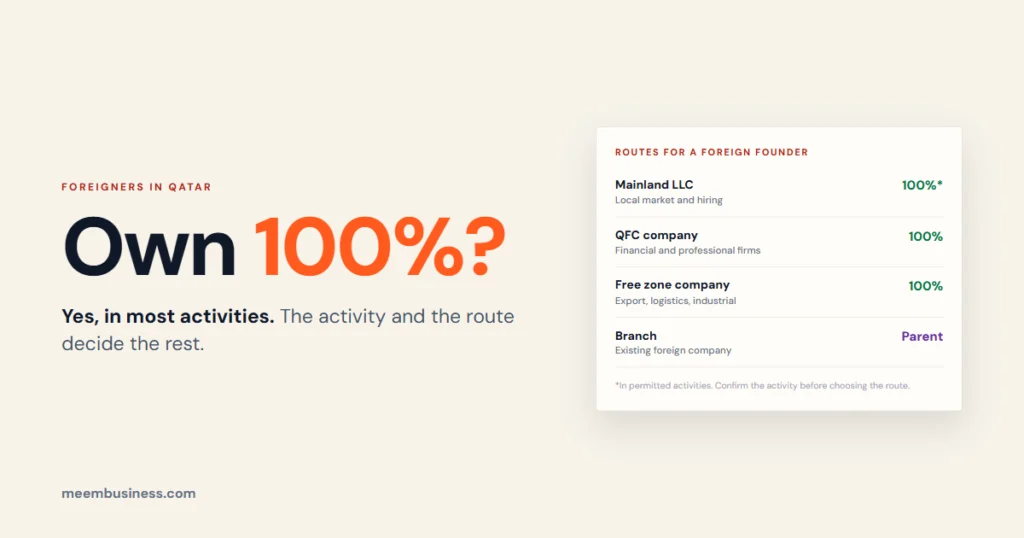
In many sectors, yes but not automatically for every activity. Qatar’s Foreign Investment Law opened 100% foreign ownership across most commercial, industrial, and service sectors.

This was a significant shift from the old rule that required a 51% Qatari partner for most businesses.

However, some important nuances apply:

  • Restricted sectors: Banking, insurance, natural resource exploitation, commercial agencies, and a few other categories still have ownership limitations or require special ministerial approval.
  • Activity-specific rules: Even within open sectors, certain activities (healthcare, education, legal services, financial advisory) require regulatory approvals from bodies like the Ministry of Public Health, Ministry of Education, or QFC Regulatory Authority before the company can operate.
  • Structure matters: 100% ownership is standard in QFC and Qatar Free Zones. On the mainland, it is available in permitted sectors, but the activity classification must be confirmed first.

For a detailed breakdown of how ownership rules apply to your specific situation, see this guide on 100% ownership in Qatar for foreign investors.

What Legal Structures Are Available for Foreign Business Owners?

Foreign investors in Qatar can choose from five main legal structures. The right one depends on whether you want to serve the local Qatari market, operate regionally, or run a specific type of professional service.

Mainland (MOCI) Company

Best for: Trading, retail, restaurants, cafés, contracting, general services, and any business that needs direct access to the Qatari local market.

  • Registered through the Ministry of Commerce and Industry (MOCI)
  • Can trade directly with Qatari consumers, government entities, and local businesses
  • 100% foreign ownership available in permitted sectors
  • Requires a physical office or commercial address in Qatar

Qatar Financial Centre (QFC)

Best for: Consulting, professional services, financial services, fintech, asset management, holding companies, and technology firms.

  • Operates under its own legal and regulatory framework (QFC Law)
  • 100% foreign ownership as standard
  • Taxed at 10% on locally sourced profits (with exemptions available)
  • Separate from the mainland system, QFC companies cannot directly conduct retail or trading activities in Qatar without specific permissions

Qatar Free Zones (QFZ)

Best for: Logistics, manufacturing, import/export, warehousing, industrial activity, and international trade.

  • Located in Ras Bufontas (near Hamad International Airport) and Um Alhoul (near Hamad Port)
  • 100% foreign ownership, zero corporate tax for qualifying periods, and customs advantages
  • Strong for companies focused on regional or international operations rather than domestic retail
  • Learn how to register a free zone company in Qatar

Branch of a Foreign Company

Best for: An existing foreign company that has won a specific contract in Qatar or needs a licensed presence for a defined project.

Representative Office

Best for: Market research, brand promotion, and liaison activities — not for generating revenue or signing commercial contracts in Qatar.

Mainland vs QFC vs Qatar Free Zone: Quick Comparison

StructureBest ForForeign OwnershipLocal Market AccessCorporate TaxKey Point
Mainland (MOCI)Trading, retail, F&B, contracting100% in permitted sectorsFull access10% (standard)Most flexible for local operations
QFCConsulting, fintech, financial services100% standardLimited (service-based)10% on local profitsOwn legal framework, strong for professional firms
Qatar Free ZoneLogistics, manufacturing, import/export100% standardRestricted (B2B focus)0% (tax holiday periods)Best for regional/international trade
Branch OfficeProject-based foreign company operationsParent company ownsContract-specificPer parent structureTied to specific approvals
Representative OfficePromotion and research onlyN/ANone (no trading)N/ACannot generate revenue

Step-by-Step Process to Start a Business in Qatar as a Foreigner

The registration process has become more streamlined in 2026, but it still involves multiple sequential steps. Skipping any one of them can delay the entire setup.

  1. Decide your business activity: Be specific. The activity code you choose determines ownership rules, approvals needed, and which structure fits.
  2. Check ownership and approval requirements: Confirm whether your activity allows 100% foreign ownership and whether sector-specific approvals are required.
  3. Choose your legal structure: Mainland, QFC, free zone, branch, or representative office (see comparison above).
  4. Reserve your trade name: Through MOCI’s online portal for mainland; through QFC or QFZ authority for those structures.
  5. Prepare and attest documents: Passport copies, proof of address, and corporate documents if a company is a shareholder. Foreign documents typically need notarisation and attestation.
  6. Draft and sign incorporation documents: Articles of association, shareholder agreements, and other constitutional documents.
  7. Obtain activity-specific approvals: Healthcare businesses need MoPH approval; education needs Ministry of Education sign-off; financial services need QFC Regulatory Authority clearance, and so on.
  8. Apply for Commercial Registration (CR): The CR is your company’s official registration number and the foundation for everything that follows.
  9. Obtain your commercial/trade license: Issued after CR, confirming your right to operate the registered activity.
  10. Register with Qatar Chamber: Required for most mainland commercial activities.
  11. Complete tax card registration: With the General Tax Authority (GTA). This is mandatory and often delayed by new business owners.
  12. Obtain establishment card (computer card): Required to sponsor employees and process visas through the Ministry of Interior.
  13. Open a corporate bank account: Requires CR, license, tax card, and supporting documents. Banks in Qatar have thorough due diligence processes.
  14. Apply for investor and work visas: Once the establishment card is active, the company can sponsor visas for owners and employees.
  15. Maintain renewals and compliance: CR renewal, license renewal, tax filings, labour quota management, and PRO services are ongoing.

For a full breakdown of legal requirements for business setup in Qatar, Meem has a dedicated guide worth reviewing before you begin.

What Documents Are Required?

Document requirements vary by structure and shareholder type, but here is a practical overview:

Individual shareholder documents:

  • Valid passport (all shareholders and managers)
  • Proof of residential address
  • No-objection letter (if currently employed in Qatar on a residence permit)
  • CV or professional profile (required for regulated activities)

Corporate shareholder documents:

  • Certificate of incorporation of the parent company
  • Memorandum and articles of association
  • Board resolution authorising the Qatar company setup
  • Power of attorney for the authorised representative
  • All documents typically need notarisation and embassy/MOFA attestation

Mainland-specific documents:

  • Completed MOCI application forms
  • Signed articles of association (in Arabic)
  • Lease agreement or Ejari for office address

Regulated activity documents:

  • Professional qualifications and licences (healthcare, legal, engineering)
  • Sector-specific application forms for the relevant ministry or authority

How Much Does It Cost to Set Up a Company in Qatar in 2026?

There is no single fixed cost and anyone quoting you one number without knowing your activity and structure is guessing. The total cost of setting up a business in Qatar depends on several factors:

  • Business activity: Regulated activities (healthcare, financial services) involve additional approval fees.
  • Legal structure: QFC and free zone setup fees differ from mainland MOCI fees.
  • Office requirements: Renting a physical office in Doha adds to monthly costs; some structures allow flexi-desk arrangements.
  • Number of shareholders and nationalities: More shareholders or corporate shareholders mean more document attestation costs.
  • Visa requirements: Investor visa, employee visas, and medical fees add to the total.
  • Professional service fees: Government fees are only part of the picture; PRO support, translation, and consultancy fees are additional.

Use Meem’s Qatar company opening cost calculator to get a structured estimate based on your specific situation. For a precise figure, speak directly with Meem Business Services based on your activity and ownership plan.

How Long Does It Take to Get a Business License in Qatar?

Timeline varies significantly based on activity, structure, and document readiness. As a general guide:

  • Mainland (MOCI) company: Roughly 4 to 8 weeks for straightforward activities where all documents are ready and no special approvals are required.
  • QFC company: Often faster due to the QFC’s one-stop-shop platform; some registrations complete in 2 to 5 weeks.
  • Qatar Free Zone company: Comparable to QFC in speed for standard activities. Can be between 3 to 6 weeks.
  • Regulated activities: Healthcare, education, financial services, and similar sectors add weeks or months depending on the approving authority’s processing time.

The biggest delays come from: foreign document attestation (which must be done before submission), missing information in applications, and waiting for sector-specific ministry approvals. Having all documents ready before you start the process is the single most effective way to reduce the timeline.

Are There Special Economic Zones With Easier Business Rules?

Yes, Qatar has two free zones that offer distinct advantages for foreign investors. The Qatar Free Zones Authority (QFZ) operates Ras Bufontas Free Zone near Hamad International Airport and Um Alhoul Free Zone near Hamad Port.

Key benefits of Qatar’s free zones:

  • 100% foreign ownership as standard
  • Zero corporate income tax for qualifying periods (tax holidays are a major draw)
  • No customs duties on goods within the zone
  • Streamlined one-stop-shop registration
  • Strong logistics infrastructure for regional and international trade

Important limitation: Free zone companies are primarily designed for B2B, manufacturing, logistics, and international trade. If your goal is to sell directly to Qatari consumers or operate a retail shop or restaurant in Doha, a free zone setup is not the right fit, you would need a mainland company for that.

The QFC is a separate special jurisdiction (not a free zone in the geographic sense) that is particularly strong for professional services, financial firms, and technology companies.

It has its own courts, regulations, and dispute resolution framework based on English common law principles, which many international businesses find reassuring.

What Types of Businesses Can Foreigners Actually Own in Qatar?

Foreigners can own businesses across a broad range of sectors. The most common and accessible categories in 2026 include:

  • Trade and retail: General trading, import/export, e-commerce, and specialty retail
  • Food and beverage: Restaurants, cafés, catering, and cloud kitchens
  • Consulting and professional services: Management consulting, IT consulting, marketing, HR
  • Technology: Software development, SaaS, app development, IT services
  • Construction and contracting: Civil, MEP, fit-out, and specialist contracting
  • Healthcare: Clinics, pharmacies, medical centres (with MoPH approval)
  • Education and training: Training centres, corporate learning, tutoring services
  • Logistics and freight: Warehousing, freight forwarding, last-mile delivery
  • Manufacturing: Light manufacturing and industrial production (best suited to free zones)

Sectors with restrictions or special rules:

  • Banking and financial institutions
  • Insurance companies
  • Natural resource extraction (oil and gas)
  • Commercial agencies (representing foreign brands exclusively)
  • Legal practice (subject to Qatar Bar Association rules)

If you are exploring profitable business ideas in Qatar, the sectors above represent the most accessible entry points for foreign entrepreneurs in 2026.

Which Business Sectors Have the Most Growth Potential for Foreign Investors?

Technology, healthcare, logistics, and food and beverage are among the strongest sectors for foreign investors entering Qatar in 2026. Qatar’s National Vision 2030 continues to drive investment in economic diversification, infrastructure, and digital transformation; all of which create opportunities for foreign-owned businesses.

Specific high-growth areas:

  • E-commerce and digital retail: Qatar’s e-commerce market is expanding rapidly. See the Qatar ecommerce market research 2026–2030 for detailed projections.
  • Healthcare services: Demand for private healthcare is strong. The 2026 healthcare licensing updates have also made it easier for qualified foreign professionals to enter the sector.
  • Fintech and financial services: QFC is actively promoting fintech, asset management, and professional services firms.
  • Logistics and supply chain: Qatar’s port and airport infrastructure makes it a regional logistics hub.
  • Hospitality and F&B: Doha’s growing tourism and expat population sustains strong demand for dining and hospitality concepts.

Do I Need a Local Qatari Partner to Register My Business?

In most sectors, no, a Qatari partner is no longer required for foreign-owned businesses. This changed significantly with the 2019 Foreign Investment Law, and the position has been reinforced through subsequent government policy in 2025 and 2026.

However, there are situations where a Qatari partner or sponsor is still relevant:

  • Restricted sectors: As noted above, banking, insurance, and a few other categories may still require Qatari participation.
  • Commercial agency activities: Representing a foreign brand exclusively in Qatar typically requires a Qatari commercial agent.
  • Government tenders: Some government contracts have local content or Qatari partnership requirements.
  • Practical facilitation: Some foreign investors choose to work with a local sponsor or PRO service (not an equity partner) for government liaison, even when it is not legally required.

For a full explanation of when a local sponsor is and is not needed, read Meem’s guide on local sponsors in Qatar for foreign investors.

What Taxes and Fees Should I Expect When Starting a Business?

Qatar has a relatively straightforward tax environment for businesses, but it is not zero-tax for everyone. Here is what foreign business owners need to know:

  • Corporate income tax: Standard rate is 10% on taxable profits for companies operating in Qatar. This applies to mainland companies and QFC entities (on locally sourced income).
  • Qatar Free Zones: Qualifying free zone companies benefit from tax holidays (zero corporate tax for defined periods). Confirm the current terms with QFZ directly, as conditions can change.
  • No personal income tax: Qatar does not tax personal income, which is a significant benefit for business owners drawing salaries.
  • No VAT: Qatar has not implemented VAT as of 2026 (unlike some GCC neighbours).
  • Withholding tax: Applies to certain payments made to non-residents (royalties, fees, dividends). Rates and exemptions depend on double tax treaties.
  • Government registration fees: These are paid at various stages: trade name reservation, CR application, license issuance, Qatar Chamber registration, and annual renewals.

Tax registration with the General Tax Authority (GTA) is mandatory for all registered companies. Delaying this step is a common mistake that creates compliance problems later.

What Banking and Financial Requirements Exist for New Business Owners?

Opening a corporate bank account in Qatar requires a fully registered company with active documentation. Banks in Qatar conduct thorough KYC (Know Your Customer) and AML (Anti-Money Laundering) checks, so weak documentation is a common reason for delays or rejections.

What you typically need for a corporate bank account:

  • Commercial Registration (CR) certificate
  • Commercial/trade license
  • Tax card
  • Establishment card (computer card)
  • Memorandum and articles of association
  • Passport copies of all shareholders and authorised signatories
  • Proof of office address (lease agreement)
  • Business plan or description of activities (some banks request this)

Practical tips:

  • Choose a bank that has experience with foreign-owned companies — not all branches handle corporate account opening equally.
  • Prepare a clear explanation of your business model and expected transaction flows.
  • Some banks require an initial minimum deposit; amounts vary by bank and account type.
  • The process typically takes 2 to 6 weeks after submitting complete documents.

What Are the Visa Requirements for Business Owners in Qatar?

Once your company has an active establishment card, it can sponsor residence visas for the owner and employees. The establishment card (also called the computer card) is the gateway to Qatar’s immigration and labour system for companies.

For the business owner/investor:

  • An investor visa or partner visa can be applied for once the company is registered and the establishment card is issued.
  • The visa is tied to the company’s registration and must be renewed in line with company renewals.

For employees:

  • The company can sponsor work visas (residence permits) for employees based on its approved labour quota.
  • Labour quota is linked to the company’s size, activity, and office space.

Qatar also offers a 10-year residency visa programme for qualifying investors and professionals worth reviewing if long-term residency is a goal alongside your business setup.

Post-Setup Requirements: What Happens After You Get Your CR?

Getting the CR is a milestone, not the finish line. Several post-registration steps are required before the business is fully operational and compliant:

  • Tax card: Register with the General Tax Authority. Required for invoicing, banking, and compliance.
  • Establishment card: Apply through the Ministry of Interior’s system. Required for employee visa sponsorship.
  • Labour and immigration registration: Register with the Ministry of Labour to manage your workforce legally.
  • Corporate bank account: Open after CR, license, and tax card are in hand.
  • Investor/employee visas: Processed after establishment card is active.
  • Accounting and bookkeeping: Qatar requires companies to maintain proper financial records; annual tax filing is mandatory.
  • Annual renewals: CR, license, Qatar Chamber membership, and establishment card all require annual renewal. Missing renewal deadlines results in fines.
  • PRO services: Ongoing government liaison, document processing, and compliance management. PRO services in Qatar cover all of these ongoing requirements.

Common Mistakes Foreigners Make When Starting a Business in Qatar

These are the errors Meem’s team sees most often and all of them are avoidable:

  1. Choosing the wrong activity code: Picking a broad or incorrect activity at registration creates problems when applying for approvals or tenders.
  2. Assuming 100% ownership is automatic: Sector restrictions and activity-specific rules still apply. Always verify before structuring.
  3. Choosing a free zone without checking local market access: Free zone companies cannot freely sell to Qatari consumers or operate retail outlets in Doha.
  4. Ignoring activity-specific approvals: Starting a healthcare clinic or training centre without the required ministry approval is a serious compliance failure.
  5. Not preparing attested documents in advance: Foreign documents need notarisation and attestation, which takes time. Starting this process late delays everything.
  6. Starting operations before the license is complete: Operating without a valid commercial license exposes the business to fines and closure.
  7. Delaying the tax card and establishment card: These are not optional extras; they are required for banking, visas, and legal operation.
  8. Applying for a bank account with incomplete documentation: Banks will reject or delay applications that lack key documents.
  9. Choosing the cheapest setup service without checking after-service support: The registration itself is step one. Ongoing PRO, renewals, and compliance support matter just as much.

How Meem Business Services Can Help

At Meem Business Services, the team helps foreign investors choose the right business activity, understand ownership options, prepare and attest documents, coordinate approvals with relevant authorities, complete company registration, and handle all post-setup PRO requirements including establishment card processing, visa applications, renewals, and government follow-up.

Whether you are an entrepreneur outside Qatar planning your market entry, an expat already in Doha ready to start your own business, a GCC investor looking at Qatar as a base, or a foreign company exploring a branch or representative office, Meem provides practical, locally grounded support at every stage.

Explore Meem’s company formation services or speak with a business consultant to get clarity before you commit to a structure or activity.

Conclusion

Qatar is one of the most genuinely open business environments in the Middle East for foreign investors in 2026. The legal framework supports 100% foreign ownership in most sectors, the registration process has become more efficient, and the market itself, driven by Vision 2030 and a growing, high-income population, offers real commercial opportunity across multiple industries.

The key to a smooth setup is making the right decisions early: confirm your activity, verify ownership rules, choose the structure that matches your market access needs, and prepare your documents before you start the clock.

Ready to move forward? Contact Meem Business Services for a clear, no-jargon consultation before you choose your activity or structure.

Meem Business Services
Al Maha Business Center, Salwa Road, Doha, Qatar
Call or WhatsApp: +974 7178 1944

Frequently Asked Questions

Can a foreigner start a business in Qatar?

Yes. Foreign nationals can register and operate businesses in Qatar. The Foreign Investment Law (Law No. 1 of 2019) allows foreign investors to establish companies across most commercial sectors, with 100% ownership available in many of them.

Can I own 100% of my company in Qatar as a foreigner?

In most sectors, yes. Qatar allows 100% foreign ownership in the majority of commercial, industrial, and service activities. Restricted sectors (banking, insurance, natural resources, commercial agencies) have different rules.

Do I need a Qatari partner to open a business?

Not in most cases. A Qatari equity partner is no longer required for most business activities. However, certain restricted sectors and commercial agency activities may still require Qatari participation.

Which structure is best for foreigners; mainland, QFC, or free zone?

It depends on your activity. Mainland is best for local market access (retail, F&B, trading). QFC is best for professional services and fintech. Free zones are best for logistics, manufacturing, and international trade.

Is QFC a good option for consultants?

Yes. QFC is specifically designed for professional services, consulting, financial services, and technology firms. It offers 100% ownership, a common-law legal framework, and a streamlined registration process.

What documents do I need to start a company in Qatar?

At minimum: passport copies of all shareholders, proof of address, and signed incorporation documents. Corporate shareholders need additional documents including board resolutions and attested company documents from their home country.

How much does it cost to set up a company in Qatar?

There is no single fixed cost. It depends on your activity, structure, office requirements, approvals, and visa needs. Use Meem’s cost calculator or contact Meem directly for an accurate estimate.

Can I open an online business in Qatar as a foreigner?

Yes. E-commerce and online businesses can be registered in Qatar. You still need a commercial registration and appropriate activity classification. See Meem’s guide on how to start an online business in Qatar.

Can I get a visa after opening a company in Qatar?

Yes. Once your company has an active establishment card, you can apply for an investor/partner residence visa. Your company can also sponsor work visas for employees.

Do I need a physical office to register a company in Qatar?

For mainland companies, a physical office or registered commercial address is generally required. QFC and free zone setups may offer flexi-desk or shared office options depending on the activity.

What is a CR (Commercial Registration)?

A CR is your company’s official registration certificate issued by the Ministry of Commerce and Industry (MOCI). It is the foundational document for all subsequent steps including licensing, banking, and visa processing.

What is an establishment card?

The establishment card (also called the computer card) is issued by the Ministry of Interior and allows your company to sponsor employee residence visas and interact with Qatar’s immigration and labour systems.

Which activities need special approval before registration?

Healthcare, education, financial services, legal services, engineering, and food businesses all require approvals from their respective regulatory authorities before or alongside the MOCI registration process.

Can Meem Business Services handle the full company registration process?

Yes. Meem handles activity selection, document preparation, government approvals, commercial registration, licensing, tax card, establishment card, visa processing, and ongoing PRO and renewal services.

Learn More About Our Services

Download our comprehensive brochure to explore how we can help your business thrive.

Schedule a Free Consultation

Leave your details below and our experts will reach out to you within 24 hours.

Your information is 100% secure and private.