The best time to start a business in Qatar is right now. In 2025 the Ministry of Commerce and Industry issued nearly 28,000 new commercial registrations (+57%), and 12,449 non-Qatari companies were established (+600%). This guide ranks the 24 most profitable business ideas in Qatar for 2026 using verified 2025–2026 data.
Qatar is diversifying away from oil and gas. Billions are flowing into healthcare, tourism, education, real estate, technology, and retail, and the government is actively encouraging entrepreneurs to build outside the energy sector. The challenge is not finding opportunities; it is choosing the right one.
That is why we rebuilt this guide around verified data. Every idea below includes a data snapshot and figures we checked against primary sources: the General Tax Authority, MoCI, Qatar Tourism, the Qatar Central Bank, QatarEnergy, and industry research. Where a number could not be verified, we say so rather than repeating it.
24 Profitable Business Ideas in Qatar (2026)
Want to know which idea fits your budget and setup options? Meem Business Services can help with company formation, licensing, and PRO support in Qatar.
Why Qatar Is the Perfect Place to Start a Business Right Now
Qatar’s economy is shifting fast, and 2025 was a record year for new business formation: ~28,000 new commercial registrations (+57%) and 34,500 business licences (+53%), with 12,449 non-Qatari companies (+600%) (MoCI via QNA, Feb 2026).
On tax, be precise: Qatar levies a 10% corporate income tax on taxable income (and 35% for petroleum/petrochemical activities), with 0% for Qatari/GCC-owned entities and certain free-zone/QFC regimes. Since FY2025, a 15% Global Minimum Tax also applies to large multinationals with revenue above EUR 750 million. Qatar has not introduced VAT.
How We Selected These 20 Businesses
We prioritised businesses with verifiable demand, clear growth drivers, realistic profitability, and an achievable licensing path. We included a mix of capital-light services and capital-intensive sectors, and we dated and sourced every headline figure so you can judge it yourself.
Qatar’s Business Opportunities: The 2026 Data at a Glance
| Indicator | Latest verified figure | Source (date) |
|---|---|---|
| New commercial registrations, 2025 | ~28,000 (+57% YoY) | MoCI via QNA, Feb 2026 |
| Non-Qatari companies established, 2025 | 12,449 (+600% YoY) | MoCI via QNA, Feb 2026 |
| International visitors, 2025 | 5.1 million (+3.7%) | Qatar Tourism |
| International visitors, Q1 2026 | 1.13 million | Qatar Tourism |
| Hotel & serviced-apartment supply | 42,131 keys | Hospitality Qatar, Q2 2026 |
| Consumer spending, 2025 | USD 67.87 billion | Mordor Intelligence |
| Online food delivery market | ~USD 1.6 billion | Research and Markets / KenResearch |
| Digital payments, Jul 2025 | QR16.1bn (~US$4.4bn) | Qatar Central Bank |
| Solar capacity in operation | 1,675 MW | QatarEnergy, Apr 2025 |
| Corporate income tax | 10% (0% for GCC-owned) | General Tax Authority |
1. Healthcare Services & Medical Centers
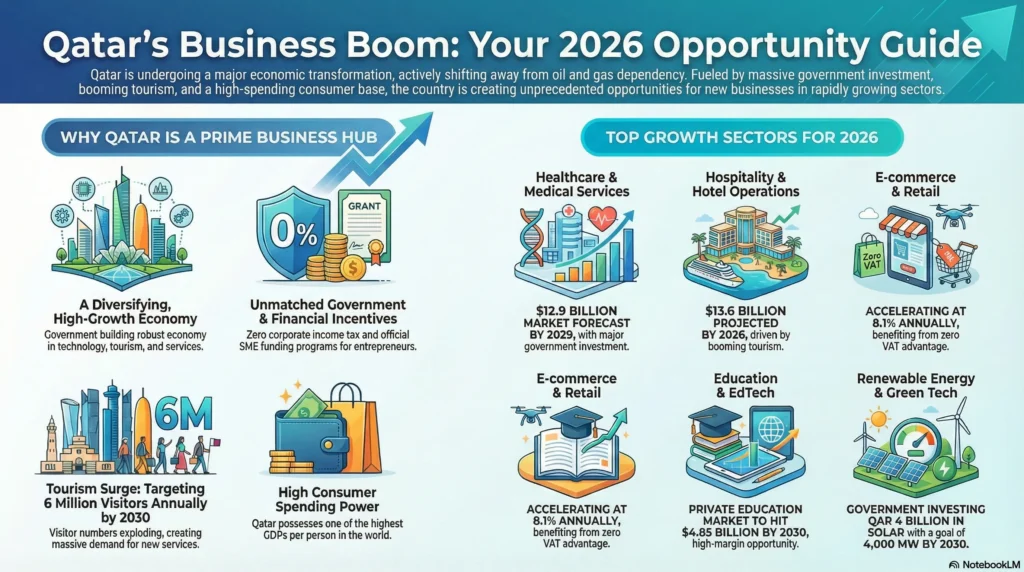
Healthcare is one of Qatar’s most under-served yet fast-expanding sectors. The 2025 budget allocated QAR 22 billion (~US$6 billion, about 10.5% of state spending) to health, and the 2026 budget raised the health allocation to QAR 25.4 billion (QNA, Dec 2025). The healthcare market is projected at roughly USD 12.9 billion by 2029.
The National Health Strategy 2024-2030 flags specialist care (oncology, cardiology, rehabilitation, and mental health) as priority, under-served areas. Licensing is rigorous and capital-intensive, so this fits medical professionals and investors with substantial capital rather than lean entrants.
2. Hospitality & Hotel Operations
Tourism is Qatar’s most dynamic growth lever. Qatar welcomed 5.1 million international visitors in 2025 (+3.7%) and 1.13 million in Q1 2026 (Qatar Tourism). HORECA and F&B are projected to reach about USD 13.6 billion by 2026.
Supply is expanding but still leaves gaps. Hotel and serviced-apartment inventory reached 42,131 keys in Q2 2026, with serviced apartments up 9.6% year on year. Capital intensity is high (QAR 50-200m for development), but boutique, lifestyle, and extended-stay formats remain under-served and command premium pricing.
3. E-commerce & Retail Platform
Qatar’s retail sector is transforming fast, driven by high incomes and near-universal connectivity (99% internet penetration, DataReportal, Digital 2026: Qatar). Total consumer spending reached USD 67.87 billion in 2025, and the retail market was USD 18.68 billion (2025), forecast at USD 19.44 billion in 2026 (Mordor Intelligence).
Definitions matter here: IMARC puts Qatar e-retail at USD 14.81 billion in 2025 (11.15% CAGR to 2034), a broader measure than some “pure” e-commerce estimates. Qatar has not introduced VAT, which keeps online pricing competitive. Risks include data-privacy concerns and competition from global platforms, so niche positioning still matters.
4. Educational Institutions & EdTech
Qatar’s private education sector is high-growth and high-margin. Mordor Intelligence values the private K-12 market at about USD 2.94 billion in 2025, driven by rising incomes and expatriate demand for international curricula.
International schools charge QAR 40,000-100,000+ per student annually, and specialised tutoring and EdTech (STEM, coding, exam prep) run at 40-60% gross margins. Regulatory approval is time-intensive, which protects margins for compliant operators. Published market-size estimates vary significantly between vendors, so cite the base year and source.
5. Renewable Energy & Green Technology Solutions
Qatar is scaling renewables. After the 875 MW solar complex came online in April 2025, the country reached 1,675 MW of solar capacity in operation, alongside the earlier 800 MW Al Kharsaah plant (QatarEnergy). The target is 4,000 MW by 2030.
That creates demand for solar installation, energy auditing, efficient-lighting and green-building suppliers, and water-saving systems, reinforced by energy-efficiency requirements in new construction. Note that the percentage of electricity from renewables cited by different sources varies (roughly 18-30%), so use the 4,000 MW target as the firmer anchor.
6. Fintech & Digital Payment Solutions
Qatar’s payments ecosystem is accelerating. The Qatar Central Bank reported combined digital payments of QR16.1 billion (~US$4.4 billion) in July 2025, and card payments reached QR4.744 billion across 11.77 million transactions in December 2025. The digital payments market is sized at about USD 7.04 billion (2025), heading to USD 12.98 billion by 2030.
An earlier version of this article mislabelled that July figure as “QAR 4.4 billion”; it is QR16.1 billion, or about US$4.4 billion. Opportunities sit in payment gateways, B2B financial software, and payroll/invoice tooling. Regulatory complexity and capital requirements are substantial, and incumbent banks are strong competitors.
7. Logistics & Warehousing Solutions
Qatar is a logistics hub for the region, with world-class infrastructure (Hamad Port) and two state-of-the-art free zones: Ras Bufontas (airport-adjacent) and Umm Al Houl (port-adjacent). Free-zone companies benefit from duty-free imports, a lighter compliance burden, and access to Qatar’s double-taxation treaty network.
Opportunities include third-party logistics, cold-chain and pharma logistics, freight forwarding and customs clearance, and supply-chain software. Margins are typically 5-15% and require operational efficiency and scale, with strong competition from established global players.
8. Real Estate Development & Property Management
Qatar’s real-estate market rebounded strongly. In Q3 2025, residential sales reached QAR 5.9 billion (USD 1.62 billion), up 57% in transaction count to 1,682 units, while total real-estate transactions for the quarter were QR4.493 billion across 1,256 deals (Knight Frank; Arab News).
Rather than the legacy “USD 330 billion over a decade” figure, current official messaging points to a USD 60 billion pipeline, including USD 38.5 billion of new projects over five years (2026). Rental yields of 5-8% and property-management margins of 10-15% are achievable, though capital intensity and cyclicality are real risks.
9. Food & Beverage (Restaurants & Quick Service Restaurants)
Qatar’s food service market is vibrant, supported by 5.1 million visitors in 2025 and a young, high-income resident base. Quick-service restaurants make up over 40% of revenue, and cloud kitchens can run leaner than full dine-in operations.
The online food delivery market is valued at about USD 1.6 billion and is forecast to grow at roughly 10.17% CAGR to 2032 (Research and Markets; KenResearch). F&B is operationally intensive with high labour costs and strong competition, so unit economics and consistent quality decide winners.
10. Beauty, Wellness & Fitness Centers
Qatar’s wellness sector benefits from a young, affluent population. The cosmetics market is a firmer, citable figure: USD 133 million in 2025, projected to reach USD 205.2 million by 2034 (4.79% CAGR) (Gulf Times, Apr 2026). The wider beauty-and-wellness market is often quoted around USD 1.3 billion, though that figure traces to industry sources.
Models range from standalone gyms and boutique studios to integrated wellness centres and beauty e-commerce. Competition is intensifying, but premium positioning and tech-enabled services (app booking, personal training) differentiate. Treat fitness-specific market sizes circulated online with caution, as some lack a verifiable source.
11. Professional Services (Consulting, Accounting, Legal)
Professional services are expanding as entrepreneurs and corporates seek specialised expertise. SMEs make up about 97% of registered private-sector companies in Qatar and contribute roughly 15-17% of non-oil GDP (Qatar Chamber).
Demand spans financial advisory, accounting, legal, compliance, and HR support. Margins of 40-60% are typical, and delivery scales through digital tools and team leverage. Credibility and credentials gate entry, but boutique, sector-specific expertise competes well against the Big Four on price and focus.
12. Software Development & IT Services
Qatar’s digital transformation agenda is creating sustained demand for software, cloud, and AI services. Government agencies and enterprises across oil & gas, finance, healthcare, and real estate are investing in digitalisation, and Qatar Science & Technology Park (QSTP) supports tech ventures with incubation and mentoring.
Opportunities include custom software, mobile apps, SaaS, AI/ML solutions, and cloud/DevOps. Competition from global consultancies and offshore teams is fierce, and developer talent is scarce, but local presence and government preference for local solutions create openings.
13. Vertical Farming & Sustainable Agriculture
Qatar faces a structural challenge: limited arable land and water scarcity. Vertical farming (growing crops in controlled, stacked environments) is a strategic response, supported by national food-security goals and import-substitution priorities.
Controlled-environment farms can produce year-round and claim yields many times higher per square metre than open-field agriculture, with premium pricing for locally grown, pesticide-free produce. Capital and energy costs are significant, and consumer adoption is still developing, so this suits technically strong operators.
14. Event Management & Exhibition Services
Qatar’s events sector is thriving, powered by tourism growth and a strong MICE calendar. The Doha Jewellery & Watches Exhibition 2025 drew about 30,000 visitors and recorded sales above QAR 246 million, up around 10% year on year (The Peninsula).
Opportunities span event production, exhibition and conference organisation, venue management, event technology, and corporate/team-building experiences. Revenue is project-based and can be lumpy, so client networks and a track record matter more than capital.
15. Import/Export & Trading Business
Qatar is a strategic trading hub with world-class port and air infrastructure and two free zones offering duty-free imports and access to a broad treaty network. Trading companies typically run on 5-15% margins but can be highly profitable at scale.
Proven models include re-export of machinery, electronics, consumer goods, and chemicals to GCC markets, plus niche importing (specialty foods, automotive parts, industrial supplies). Market volatility, currency, and supply-chain disruption are inherent risks. On tax: 0% applies to Qatari/GCC-owned entities and specific regimes; foreign-owned entities pay the standard 10% income tax.
16. Interior Design & Construction Services
Qatar’s construction pipeline remains strong, anchored by Lusail City, Msheireb Downtown, and The Pearl, plus a USD 60 billion infrastructure and real-estate pipeline that includes USD 38.5 billion of new projects over five years (Sep 2026).
Interior design, project management, and specialised fit-out command 25-40% margins, especially in luxury residential and hospitality work. Revenue is project-based and cash flow can be uneven, and international design firms compete hard, so local regulatory knowledge is a real edge.
17. Supply Chain & Import Substitution Manufacturing
Qatar’s National Manufacturing Strategy 2023-2030 prioritises import substitution and local production, supported by preferential procurement for local manufacturers, competitive energy, and free-zone incentives.
Opportunities sit in light assembly and manufacturing of machinery, components, and consumer goods, plus food and beverage processing and supplies to oil & gas and construction. Capital and technology requirements are substantial and imports are strong competitors, but local-production incentives favour compliant operators.
18. Tutoring & Specialized Training Centers
Beyond schools, tutoring and test-preparation centres capture high margins by focusing on specific segments: exam prep (SAT, IB, A-Level), language training, coding bootcamps, and professional certifications. Margins typically run 40-60% with low capital requirements.
The market is getting crowded, with established brands and international providers expanding. Niche specialisation (coding, STEM, professional certifications) and online delivery are the clearest ways to differentiate.
19. Travel & Tourism Services
Qatar Tourism targets more than 6 million international visitors annually by 2030. In 2025 the country welcomed 5.1 million visitors (+3.7%) and 1.13 million in Q1 2026, supporting demand for travel agencies, tour operators, and experience providers.
Niche services (luxury travel, corporate team-building, cultural and religious tourism, and destination experiences) are the most defensible. The industry is seasonal and exposed to global conditions, but Qatar’s positioning as a safe, modern destination supports stable demand.
20. Waste Management & Recycling Solutions
Qatar is pursuing sustainability and circular-economy goals, and waste management is a regulated, essential service. Construction waste from mega-projects, plus corporate sustainability compliance, creates consistent revenue streams.
Opportunities include collection services, recycling and material recovery, environmental consulting, and treatment facilities. The sector is capital-intensive and heavily regulated, but long-term government commitment to sustainability supports stable demand for compliant operators.
21. Data Centres & Cloud Infrastructure
Qatar is positioning itself as a regional data-centre and cloud hub under its Digital Agenda 2030. The data-centre market is valued at roughly USD 203-207 million (2025), heading to about USD 702 million by 2031 (22.9% CAGR), while the cloud computing market is forecast to grow from USD 1.8 billion (2025) to USD 10.3 billion by 2034.
This is a high-capital, high-barrier sector: land, power, cooling, and connectivity demand serious investment, plus strong security and regulatory compliance. It suits consortiums, infrastructure investors, and engineering partners rather than lean entrants, but the growth runway is long and government-backed.
22. EV Charging & E-Mobility Infrastructure
Qatar is scaling its electric-vehicle ecosystem. The national EV strategy targets 1,000-1,200+ public charging stations by 2030, with plans for 4,000 by 2035, and EVs expected to reach around 10% of vehicle sales by 2030 (Ministry of Transport, 2025).
Opportunities include charger installation and maintenance, charge-point operation, and fleet electrification services for corporates and facilities. It is capital- and grid-dependent, and coordination with utilities and regulators is essential, but it is a clear, policy-backed growth sector.
23. Home Healthcare & Senior Care
Qatar’s ageing demographics and busy professional households are pushing care into the home. IMARC values the home healthcare market at USD 1.8 billion (2025), rising to USD 3.7 billion by 2034, while Mordor puts senior living at USD 0.62 billion (2026), growing 10.57% CAGR to USD 1.02 billion by 2031.
Models include home nursing, physiotherapy, elderly day care, and assisted-living services. It is licensed by the Ministry of Public Health and requires qualified clinical staff, so it fits healthcare operators and investors rather than casual entrants, but demand is structural and long-term.
24. Pet Care & Veterinary Clinics
Rising pet ownership and high disposable incomes are driving Qatar’s pet economy. The premium pet grooming and supplies market is valued at about USD 150 million (2025), growing 11.8% CAGR to USD 250 million by 2031 (KenResearch), while veterinary healthcare is around USD 100.5 million (2025) (IMARC).
Opportunities range from veterinary clinics and grooming salons to mobile grooming, boarding, and premium supplies retail. Clinical services require qualified veterinarians and licensing, while grooming and retail are lighter to start, making this sector flexible across capital levels.
Compare the 24 Ideas
Capital and margin figures are indicative planning estimates, not guarantees. See each section for the verified market data and sources.
| # | Business idea | Capital intensity | Typical margin |
|---|---|---|---|
| 1 | Healthcare services & medical centers | High | Sector-dependent |
| 2 | Hospitality & hotel operations | High | 25-35% (gross) |
| 3 | E-commerce & retail platform | Medium | 15-40% |
| 4 | Educational institutions & EdTech | High | 40-60% |
| 5 | Renewable energy & green tech | Medium-high | Project-based |
| 6 | Fintech & digital payments | High (regulatory) | 1-3% per txn |
| 7 | Logistics & warehousing | High | 5-15% |
| 8 | Real estate & property management | Very high | 10-15% (mgmt) |
| 9 | Food & beverage (restaurants/QSR) | Medium-high | 20-30% |
| 10 | Beauty, wellness & fitness | Medium | Sector-dependent |
| 11 | Professional services | Low | 40-60% |
| 12 | Software development & IT | Low-medium | Project/SaaS |
| 13 | Vertical farming & agriculture | High | Premium pricing |
| 14 | Event management & exhibitions | Low-medium | Project-based |
| 15 | Import/export & trading | Medium | 5-15% |
| 16 | Interior design & construction | Medium | 25-40% |
| 17 | Import-substitution manufacturing | Medium-high | Sector-dependent |
| 18 | Tutoring & training centers | Low | 40-60% |
| 19 | Travel & tourism services | Low-medium | Project/commission |
| 20 | Waste management & recycling | High | Sector-dependent |
| 21 | Data centres & cloud infrastructure | Very high | Sector-dependent |
| 22 | EV charging & e-mobility | High | Service/operator |
| 23 | Home healthcare & senior care | High | Sector-dependent |
| 24 | Pet care & veterinary clinics | Medium | Sector-dependent |
The Reality: Success Depends on Execution
Choosing the right idea is just the start. Success depends on market timing, regulatory compliance, capital management, operational excellence, and the team and partnerships you build. Qatar’s regulatory environment is navigable, but it rewards founders who plan the licensing path before they spend.
Sources
- MoCI via QNA (Feb 2026): ~28,000 new CRs (+57%), 34,500 licences (+53%), 12,449 non-Qatari companies (+600%) in 2025.
- General Tax Authority: income tax 10% (35% petroleum/petrochemical); 0% for GCC-owned; Global Minimum Tax 15% (FY2025).
- Qatar Tourism: 5.1 million visitors in 2025 (+3.7%); 1.13 million in Q1 2026. Hospitality Qatar: 42,131 keys (Q2 2026).
- Qatar Central Bank: combined digital payments QR16.1bn (~US$4.4bn) in July 2025; card payments QR4.744bn / 11.77m transactions in December 2025.
- QatarEnergy (Apr 2025): 1,675 MW solar in operation; 4,000 MW target by 2030.
- Knight Frank / Arab News: Q3 2025 residential sales QAR 5.9bn (USD 1.62bn), +57% to 1,682 units; total Q3 transactions QR4.493bn / 1,256 deals.
- Mordor Intelligence: consumer spending USD 67.87bn (2025); retail USD 18.68bn (2025) to USD 19.44bn (2026); private K-12 USD 2.94bn (2025).
- IMARC: Qatar e-retail USD 14.81bn (2025), 11.15% CAGR to 2034.
- Research and Markets / KenResearch: online food delivery ~USD 1.6bn (10.17% CAGR to 2032).
- The Peninsula: DJWE 2025 ~30,000 visitors and over QAR 246m in sales (+10%).
- Arabian Business / Fast Company ME (Sep 2026): USD 60bn pipeline (USD 38.5bn new projects).

Jisham
Head of Operations at Meem
4+ years of hands-on Qatar PRO experience, handling approvals and government procedures across multiple ministries and authorities, including establishment licensing and approvals.
Connect On LinkedIn →