Most people assume you need big money to start a business in Qatar. In 2026, that assumption is no longer accurate.
Qatar is now open for various low investment businesses in 2026. Qatar has reduced key barriers for new founders through faster licensing pathways and stronger support for small businesses; especially for service-based, digital, and home-based models.
With the right setup, you can start lean, stay compliant, and scale step by step.
This guide is for anyone searching for low investment business ideas in Qatar 2025 and wants options that are realistic, legal, and aligned with where the market is heading.
Business Ideas in Qatar with Low Investment
- Niche e-commerce via social media (no website, low inventory)
- Brand-first food delivery
- Home-based businesses
- AI readiness & digital literacy consulting
- Bespoke cultural tourism experiences
- Micro-cybersecurity services for SMEs
- ESG & sustainability micro-consulting
- Freelance tech services
- Specialised tutoring & EdTech services
- Bilingual digital content & marketing services
- Professional services for startups & SMEs
- E-gaming & esports event coordination
Want to know which idea fits your budget and visa status? Meem Business Services helps with company formation, licensing, and PRO support in Qatar.
What Low Investment Business Really Means in Qatar (2026)
In Qatar, low investment does not mean informal or unlicensed. It means starting a business that is legally registered, cost-efficient, and structured to avoid heavy fixed expenses.
Lower entry costs than before
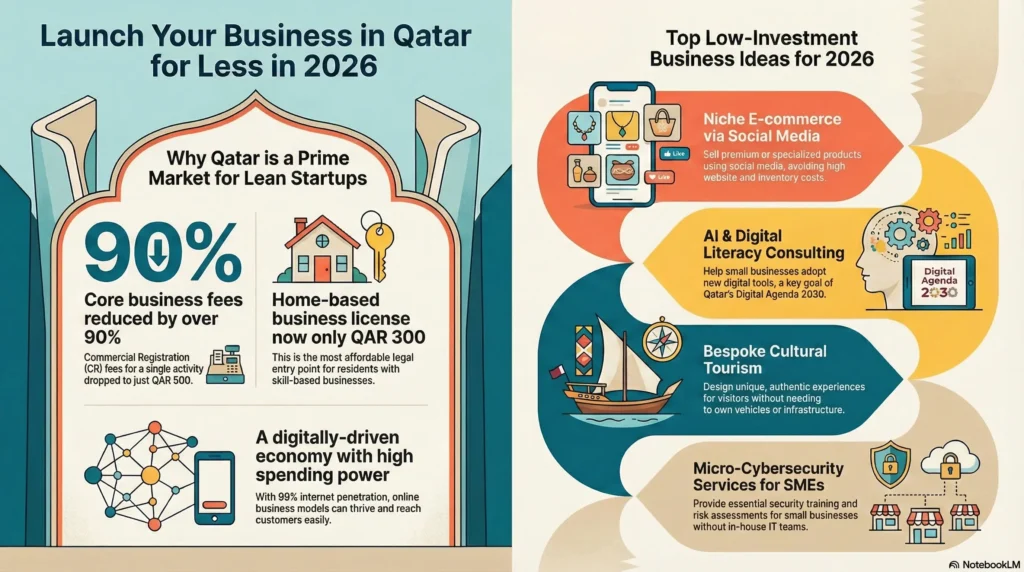
In 2024, the Ministry of Commerce and Industry (MoCI) reduced many core business fees by more than 90%.
For example, the Commercial Registration (CR) fee for a single activity dropped to QAR 500. This change alone made mainland business setup far more accessible for small founders.
You can check government fees that you should expect using our company formation cost calculator.
The home-based business option
For residents, the most affordable legal entry point is the home-based business license, now priced at QAR 300. It allows approved skill-based activities such as services, digital work, and small-scale production without renting an office or commercial space.
This model is designed to help founders start small and test demand with minimal risk.
Service and digital models matter most
Businesses that sell expertise rather than assets usually qualify as low investment in Qatar. These include consulting, education, technology, content, and professional services.
Because they rely on skills instead of inventory or machinery, startup costs stay low and scaling is easier.
This direction is reinforced by Qatar’s Digital Agenda 2030, which encourages online services and digital delivery across sectors.
Why Qatar Is a Strong Market for Low Investment Businesses in 2026
Qatar’s business environment in 2025 favors small, focused, and service-led ventures. Several structural factors make it easier to start lean and grow steadily.
A market built around SMEs
Small and medium enterprises form the backbone of Qatar’s private sector. This creates constant demand for professional services, digital solutions, training, and niche support businesses, the types of models that require low upfront investment.
Strong digital adoption
With near-universal internet access and high smartphone usage, many businesses in Qatar operate and sell online. This reduces the need for physical offices, retail space, or large teams. For founders, it means lower monthly costs and faster market entry.
High spending power, even for niche services
Low investment does not mean low value. Qatar’s consumers and businesses are willing to pay for quality, convenience, and specialization. This allows small businesses to focus on narrow niches instead of competing at scale.
Government-backed entrepreneurship
Institutions such as Qatar Development Bank (QDB) actively support new and small businesses through financing, training, and advisory programs. Combined with lower licensing costs, this reduces early-stage risk for founders.
1: Niche E-Commerce for High-Spending Consumers
Niche e-commerce works well in Qatar because customers prioritise quality and convenience over mass pricing. Instead of competing with large marketplaces, small online stores succeed by serving focused segments such as premium lifestyle products, ethical goods, or halal-certified items tailored to local and expatriate demand.
The demand is supported by strong market data. According to IMARC Group’s Qatar E-Retail Market Report, Qatar’s e-retail market reached USD 14.8 billion in 2025 and is projected to grow at a 11.15% CAGR, driven by widespread digital payments and online shopping adoption.
This growth is reinforced by near-universal internet access, with internet penetration at around 99%, as reported by DataReportal – Digital 2025: Qatar.
This model remains low investment because founders can start with limited inventory, curated sourcing, or on-demand fulfilment, avoiding retail rent and heavy stock commitments.
In the early stage, many founders validate demand using social media storefronts (Instagram, TikTok, WhatsApp) before investing in a full website.
Business registration is completed through the Ministry of Commerce and Industry (MoCI), and many e-commerce founders opt for structures that allow 100% foreign ownership.
2: Brand-First, Kitchen-Last Food Delivery
This model lets you launch a food delivery brand in Qatar without owning a kitchen. You focus on the brand, menu, and online marketing, while a licensed cloud kitchen handles food preparation under Ministry of Public Health (MoPH) compliance.
It works because Qatar’s delivery culture is already mature. The online food delivery market is valued at around USD 1.6 billion, according to Research and Markets, a strong signal that demand is established, especially in Doha.
It stays low-investment because you avoid the biggest costs: kitchen fit-out, equipment, and direct facility approvals.
Instead, you register the business via MoCI and choose a compliant kitchen partner; cloud-kitchen licensing and approvals are typically handled at the facility level
3: Home-Based Businesses in Qatar
Home-based businesses are one of the lowest-cost legal ways to start a business in Qatar. Under this model, residents can operate approved skill-based activities from their residence without renting office or shop space.
Common examples include tailoring, embroidery, Arabic sweets, perfume and bukhoor preparation, and certain digital services such as website design.
The biggest advantage is cost. The home-based business license fee is QAR 300 following MoCI’s fee reduction. The same update also notes that permitted activities were expanded, making it easier for micro-businesses to operate within the law.
This pathway is widely seen as especially suitable for Qatari women and residents with strong local eligibility, because approvals can be harder for non-Qataris depending on activity type and documentation requirements.
In practice, non-Qatari applicants may face stricter screening or delays, so it is best to verify eligibility early through the Ministry of Commerce and Industry (MoCI) before relying on this route.
4: AI Readiness and Digital Literacy Consulting
AI readiness and digital literacy consulting focuses on helping small and medium businesses understand, adopt, and safely use digital tools and artificial intelligence.
This includes basic AI awareness sessions, workflow automation guidance, data handling practices, and staff training without building or selling technology products.
This opportunity is closely linked to Qatar’s national digital direction. The government’s Digital Agenda 2030 prioritises digital transformation across sectors.
While initiatives such as the upcoming QU Spark AI Innovation Hub (expected in early 2026) signal growing institutional and corporate demand for AI-related skills and advisory support.
It remains low investment because the business is built on expertise, not infrastructure. There is no need for offices, equipment, or software development; services can be delivered through workshops, consultations, or online sessions.
5: Bespoke Cultural Tourism Experiences
Bespoke cultural tourism focuses on curating personalised, authentic experiences rather than operating mass-market tours.
This can include heritage walks, local cuisine experiences, art and culture itineraries, or private cultural programs designed for small groups, corporate visitors, or high-value travellers.
The opportunity is supported by Qatar’s tourism strategy. Qatar Tourism has set a target of welcoming over six million international visitors annually by 2030, and progress is already visible, with four million visitors recorded by October 2024.
This model remains low investment because it does not require owning vehicles, hotels, or large infrastructure. Entrepreneurs rely on local knowledge, partnerships, and coordination rather than assets.
Licensing is handled through the Ministry of Commerce and Industry (MoCI), and costs stay manageable when the business focuses on planning, curation, and experience design rather than physical operations.
6: Micro-Cybersecurity Services for SMEs
Micro-cybersecurity services focus on basic, practical protection for small and medium businesses that do not have in-house IT teams.
Typical services include risk assessments, staff awareness training, password and access-control setup, and guidance on safe data handling.
This demand is growing as Qatar accelerates digital adoption. The government approved the Qatar National Cybersecurity Strategy (2024–2030), which places strong emphasis on strengthening cyber resilience across all sectors, including SMEs. As more businesses move online, smaller firms become more exposed to cyber risks.
The business remains low investment because it is knowledge-driven. Services are delivered through audits, training sessions, and advisory work without the need for hardware, offices, or complex tools.
Registration is completed through the Ministry of Commerce and Industry (MoCI), making this a suitable option for professionals with IT or security backgrounds who want to start lean.
7: ESG and Sustainability Micro-Consulting
ESG and sustainability micro-consulting helps small and medium businesses understand and meet basic environmental, social, and governance expectations without complex frameworks.
Typical services include simple sustainability policies, supplier compliance documents, and introductory ESG reporting support tailored for SMEs.
The demand is linked to the Qatar Stock Exchange (QSE) direction on ESG transparency. QSE has actively promoted ESG disclosure and launched sustainability reporting tools for listed companies, creating a ripple effect across supply chains.
This is a low-investment model because it relies on regulatory knowledge rather than physical assets. Services can be delivered through documentation, assessments, and advisory sessions without offices or equipment.
Business setup is handled via the Ministry of Commerce and Industry (MoCI), making it suitable for professionals with compliance, sustainability, or corporate governance experience who want to start small and scale gradually.
8: Freelance Tech Services (Web, App, and Digital Solutions)
Freelance tech services focus on building and maintaining websites, e-commerce stores, and simple applications for businesses that want an online presence but do not have in-house technical teams. Demand is especially strong for bilingual (Arabic–English) websites and mobile-friendly platforms.
This need is driven by Qatar’s digital behaviour. With around 99% internet penetration, businesses increasingly rely on online channels to reach customers, as shown by DataReportal – Digital Qatar.
The push is further reinforced by the government’s Digital Agenda 2030, which encourages digital service delivery across sectors.
It remains low investment because the business is skill-based. Founders typically need only a laptop, software subscriptions, and technical knowledge.
Registration is completed through the Ministry of Commerce and Industry (MoCI), making freelance tech services one of the most accessible options for professionals looking to start a business in Qatar with limited capital.
9: Specialized Tutoring and EdTech Services
Specialized tutoring and small-scale EdTech services focus on high-demand subjects such as STEM, coding, exam preparation (IB, SAT, British and American curricula), and skills-based learning. These services are usually delivered through one-to-one sessions, small groups, or online classes, keeping operations simple and flexible.
The demand is supported by steady growth in private education. According to DataInsightsMarket, Qatar’s private K–12 education market is projected to grow at a 4.54% CAGR from 2025 to 2033, driven by population growth, international curricula, and emphasis on future-ready skills.
This remains a low-investment business because it is knowledge-based. Many tutors start solo, operating online or from home, before scaling into small centres or platforms.
10: Digital Content and Marketing for a Bilingual Market
Digital content and marketing services focus on helping businesses communicate effectively in both Arabic and English, which is essential in Qatar’s mixed local and expatriate market. Services typically include content writing, social media management, basic SEO, and short-form video or campaign support.
The demand is driven by Qatar’s digital behaviour and language requirements. Studies on SEO and digital communication in Qatar highlight that bilingual content is critical for reach and trust, especially for local search and social platforms.
This business stays low investment because it relies on skills rather than infrastructure. Most founders operate remotely with basic software tools and minimal overhead.
11: Professional Services for Startups and SMEs
Professional services for startups and SMEs include outsourced bookkeeping, HR support, business documentation, compliance assistance, and basic advisory services.
Many small businesses in Qatar prefer external support rather than hiring full-time staff, especially in the early stages.
The demand is strong because SMEs dominate the market. Qatar Chamber reports that SMEs make up about 97% of the private sector, and national development plans expect their contribution to the non-oil economy to grow steadily.
This remains a low-investment model because services are expertise-driven. Most work can be delivered remotely or from a small setup without offices or equipment.
12: E-Gaming and Esports Event Coordination
E-gaming and esports event coordination focuses on organising small tournaments, community events, and online leagues rather than owning gaming venues or hardware.
The business centres on planning, sponsorship coordination, marketing, and managing player communities, which keeps startup costs low.
The market is growing steadily. The global esports segment is projected to expand rapidly, and Qatar’s local esports market is expected to grow at a 17.01% CAGR through 2033, according to IMARC Group’s Qatar Esports Market report.
High digital engagement also supports this trend, with internet penetration around 99%, as reported by DataReportal – Digital Qatar.
This model remains low investment because it avoids permanent venues and equipment purchases. Events can be hosted in rented spaces or online, with revenue generated through sponsorships, entry fees, and brand partnerships.
Conclusion: Starting Small Is a Strategy, Not a Limitation
The key takeaway is simple: successful low investment businesses in Qatar are built around structure, not shortcuts. They focus on services, skills, digital delivery, or niche demand, avoiding heavy fixed costs in the early stages.
For founders navigating this process, having the right guidance can save both time and cost. Meem Business Services can assist entrepreneurs with company formation, licensing, and ongoing PRO support.