Many foreign investors search for a local sponsor in Qatar when they plan to open a mainland company.
Qatar’s commercial law requires 51 percent Qatari ownership for most LLC structures, so the sponsor becomes part of the legal framework.
The country now allows 100 percent foreign ownership in many sectors, but some activities still require a local sponsor. This creates confusion for new investors who want to make the right choice.
Meem works with foreign investors and helps them choose the safest structure for company formation. Our team explains the law in simple steps, drafts compliant agreements, and guides clients through the full process.
This guide gives you a clean and practical explanation of the local sponsor system. You will learn the legal rules, the real costs, the risks, and the safer alternatives like full ownership and free zone setups.
What Are The Legal Requirements For a Local Sponsor in Qatar?
Foreign investors must follow Qatar’s commercial laws when forming a mainland company.
The local sponsor requirement comes from the rules set by the Ministry of Commerce and Industry (MOCI) and the Commercial Companies Law No. 11 of 2015.
The 51% Qatari Ownership Rule
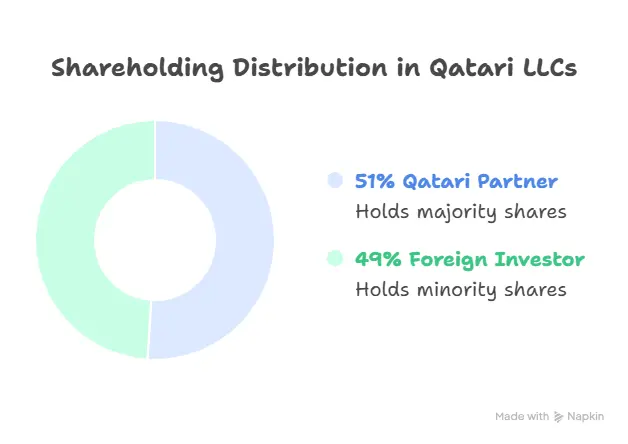
Qatar’s Companies Law states that a mainland Limited Liability Company must have a Qatari partner holding at least 51 percent of the shares.
This rule defines the company as a “Qatari company” under the law. The foreign investor can hold the remaining 49 percent.
The 51 percent rule applies mainly to retail, trading, services, contracting, and general commercial activities. The rule is structural. It applies to the legal shareholding, not to profit distribution or daily control.
Proper agreements allow foreign investors to manage the company while staying compliant.
Who Qualifies as a Local Sponsor in Qatar
A local sponsor must meet specific legal criteria. The sponsor can be:
- A Qatari citizen aged 21+
- A 100 percent Qatari-owned company
The sponsor must be legally able to sign commercial documents, act as a 51 percent shareholder, represent the company before authorities, and hold a valid Qatari ID or commercial registration.
The sponsor is not required to invest capital. Their liability is limited to their share contribution.
MOCI and Companies Law Requirements
MOCI sets the registration rules for all mainland companies. To form an LLC with a local sponsor, the company must submit:
- Commercial Registration (CR) application
- Articles of Association (AoA)
- Partner details
- Activity approval
- Office address (tenancy contract)
- Identification documents for all partners
The Commercial Companies Law defines shareholding rules, partner liability, governance, signing authority, and rules for appointing a manager.
Our PROs manage all MOCI steps on behalf of clients and ensures each document follows Qatar’s requirements.
When a Sponsor is NOT Needed
A local sponsor is not needed in all cases. Qatar allows 100 percent foreign ownership for many activities under Law No. 1 of 2019.
Investors can also avoid local sponsorship when choosing:
- A Free Zone structure
- A QFC or QSTP setup
- A Branch Office for government projects
- A Representative Office for marketing only
- MOCI-approved activities for full ownership
Meem helps investors check which structure applies to their activity and recommends the safest and most compliant setup route.
How Much Does a Local Sponsor in Qatar Typically Cost?
The cost of a local sponsor in Qatar is not fixed by any government rule. Each sponsorship arrangement is private, and the fee depends on the sponsor’s role, level of responsibility, and availability.
Investors often expect one standard amount, but the actual fee changes based on the structure chosen.
Breakdown of Sponsor Fees in Qatar (individual vs corporate)
There are two sponsorship models in Qatar. Each model comes with different expectations and support levels.
Individual Sponsor
- A single Qatari citizen acts as the 51 percent shareholder.
- Usually lower cost because the arrangement is simple.
- Support depends on the individual’s time and availability.
- Limited structure for signatures and renewals.
Corporate Sponsor
- A 100 percent Qatari-owned company acts as the 51 percent shareholder.
- Higher fee due to stronger governance and reliability.
- Multiple authorised signatories ensure smooth operations.
- Better continuity and long-term stability.
Comparison Table
| Feature | Individual Sponsor | Corporate Sponsor |
|---|---|---|
| Structure | Basic | Professional |
| Availability | Depends on one person | Multiple signatories |
| Continuity | Moderate | Strong |
| Legal Protection | Lower | Higher |
| Annual Fee | Lower | Higher |
Both models use a fixed annual fee. This fee is not linked to profit sharing when proper agreements are drafted.
What Affects the Fee (risk, availability, authority, responsibilities)
Sponsor fees change based on several practical factors.
Main Factors that Influence the Fee
- Risk level the sponsor takes on.
- Authority required on official documents.
- Frequency of signatures needed for renewals and changes.
- Availability and responsiveness expected by the investor.
- Government liaison responsibilities, if included.
- Time commitment, especially during formation or renewals.
A sponsor who takes on more responsibility usually requests a higher fee. A sponsor with limited involvement may request a lower fee.
What is Included in a Sponsor Fee
A sponsor fee generally includes:
- The sponsor’s role as the 51 percent legal shareholder.
- Their presence for required signatures.
- Their legal standing on the Commercial Registration (CR).
- Their availability for MOCI or immigration-related approvals.
What is NOT included
These items are separate operational or setup expenses:
- Commercial Registration (CR)
- Trade Licence
- Establishment ID
- Computer Card
- Office rent
- Visa and immigration charges
- PRO services
- Labour approvals and quota requests
These costs depend on the business activity and government requirements, not on the sponsor.
Setup costs vs sponsor fee
Investors often confuse sponsor fees with setup costs. The table below shows the difference clearly.
Comparison Table: Sponsor Fee vs Setup Costs
| Category | Sponsor Fee | Setup Costs |
|---|---|---|
| Paid To | The Qatari sponsor | Government authorities |
| Purpose | Legal shareholding and availability | Company formation and licensing |
| Frequency | Annual | One-time + renewals |
| Includes | Shareholding role and signatures | CR, Licence, Establishment ID, PRO steps |
| Depends On | Responsibilities of sponsor | Business activity and approvals |
Understanding this difference helps investors plan their budget correctly.
Meem’s goal is simple: clarity, compliance, and zero confusion for investors setting up a mainland company in Qatar.
Can A Foreigner Own 100% Of A Business In Qatar Without A Sponsor?
Foreign investors can own 100 percent of their company in Qatar under specific conditions. Qatar introduced clear reforms to support foreign investment, and many business activities no longer require a local sponsor.
Law No. 1 Of 2019 Explained
Law No. 1 of 2019 allows foreign investors to own up to 100 percent of a company in Qatar. This law replaced older rules that limited foreign ownership to 49 percent in many activities.
Under this law, foreign ownership beyond 49 percent requires approval from the Ministry of Commerce and Industry (MOCI).
The law supports Qatar’s investment goals by opening most sectors to international investors. It also improves investor protection and encourages long-term commercial activity.
Which Sectors Allow 100% Foreign Ownership
Many business activities now allow full foreign ownership.
The approved list includes commercial, industrial, and service activities.
Common Sectors Approved For 100% Ownership
- Information technology
- Consulting
- Education
- Healthcare
- Agriculture
- Manufacturing
- Services and professional activities
- Tourism-related services
- Trading activities included in the approved list
Some activities still require a local sponsor, such as commercial agencies and certain regulated financial services. These exceptions follow national policy and sector-specific regulations.
Approval Process From MOCI
Foreign investors must follow a clear process when applying for full ownership.
Key Steps In The Approval Process
- Select an approved business activity
- Prepare a business plan and supporting documents
- Submit the application to MOCI’s foreign investment department
- Provide financial projections if required
- Receive foreign ownership approval
- Complete CR, trade licence, and establishment ID steps
The timeline depends on the activity and the completeness of the documents.
Free Zone Alternatives
Foreign investors can also achieve full ownership by registering in Qatar’s free zones. These zones offer strong incentives, especially for companies focused on technology, logistics, and international operations.
Main Free Zone Options
- Qatar Free Zones Authority (QFZA)
- Qatar Financial Centre (QFC)
- Qatar Science & Technology Park (QSTP)
Why Free Zones Allow 100% Ownership
- They are designed to attract global companies
- They operate under special regulatory frameworks
- They allow full profit repatriation
- They offer tax incentives
Free zones are ideal for multinational or export-focused companies that do not require direct mainland retail access.
When Investors Should Choose 100% Ownership Vs 51/49 Sponsorship
The right structure depends on the business model and regulatory requirements.
Choose 100% Ownership When
- Your activity is approved under Law No. 1 of 2019
- Full control is important
- You run a service-based or professional activity
- You plan to scale the business globally
- You need long-term ownership security
Choose 51/49 Sponsorship When
- Your activity is not eligible for full ownership
- You need a physical presence on the mainland
- The sector requires Qatari participation
- A local partner adds strategic or operational value
Meem helps investors choose the correct structure based on activity, goals, and MOCI rules.
What Are The Main Responsibilities And Liabilities Of A Qatari Sponsor?
A Qatari sponsor plays an important legal role in mainland company formation.
The sponsor appears as the 51 percent shareholder on the Commercial Registration, but their responsibilities are defined by Qatar’s Companies Law and by the private agreements signed between both parties.
Legal Representation
- The sponsor is the formal Qatari partner on record.
- Their name appears on the company’s Commercial Registration (CR).
- They represent the company before MOCI when a Qatari signature is required by law.
- This role is structural and does not give them automatic authority over daily business activities.
Government Liaison Duties
The sponsor may assist with government steps that require a Qatari representative.
These duties vary based on the agreement but may include:
- Supporting licence renewals
- Assisting with activity updates
- Signing specific applications that require a Qatari shareholder
- Helping with immigration or labour approvals if agreed
These tasks are usually minimal when the foreign investor has a full PRO team.
Signature And Documentation Responsibilities
The sponsor provides signatures for documents that legally require a Qatari shareholder.
These signatures are often needed for:
- Commercial Registration changes
- Trade licence renewals
- Activity modifications
- Partner resolutions that require all shareholders
- Ministry submissions where a Qatari signatory is mandatory
These signatures do not give the sponsor operational power. They are part of their role as the legal majority shareholder.
Liability Under Companies Law
Under the Commercial Companies Law, the sponsor’s liability is limited.
The law states that each shareholder is responsible only to the extent of their share capital contribution. This means the sponsor is not personally liable for company debts or obligations beyond their shareholding.
Operational liability belongs to the company manager, not the sponsor. The manager is usually appointed by the foreign investor.
Liability Under Immigration Law
Qatar’s Immigration Law outlines liability only in specific cases.
A sponsor may be liable for an expatriate’s obligation only if they accept responsibility in writing.
Even in such cases, the law requires authorities to pursue the expatriate first before approaching the sponsor.
What The Sponsor Does NOT Control When Agreements Are Drafted Properly
A common misunderstanding is that the 51 percent sponsor controls the business.
In reality, the sponsor’s role is limited by the agreements.
When proper agreements are drafted, the sponsor does not control:
- Daily operations
- Hiring and staff management
- Banking access
- Commercial decisions
- Profit distribution
- Contracts and client work
- Intellectual property
- Financial management
- Company strategy
These rights stay fully with the foreign investor when agreements such as the management agreement, shareholder agreement, and power of attorney are in place.