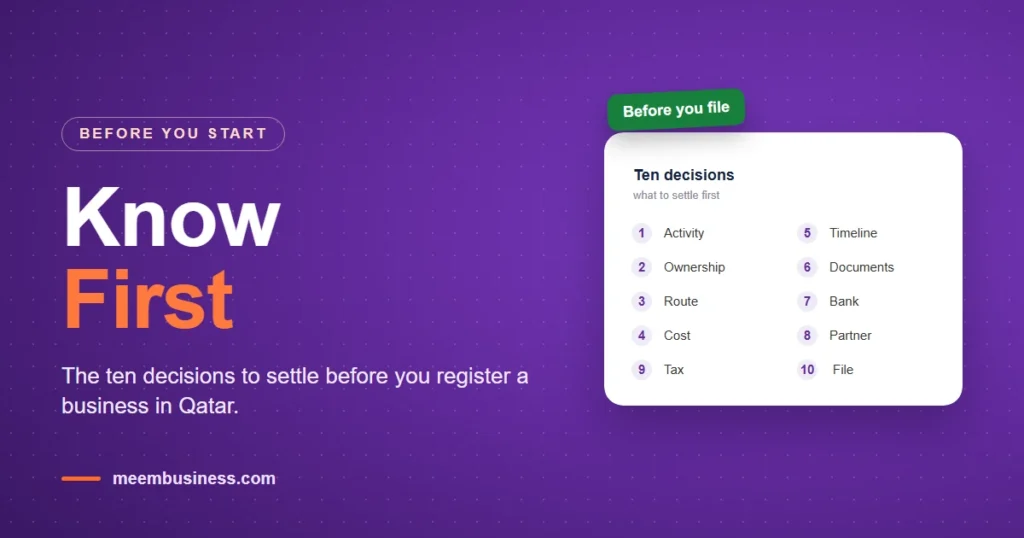
Settle ten things before you file anything to start a business in Qatar.
These ten decisions set your cost, your timeline and whether the structure is even right. Most come before the paperwork, not during it. Qatar is worth the work: most sectors allow full foreign ownership, and the free zones and the QFC add tax advantages, which is why founders shortlist it.
Work through them first, then follow the registration steps in company formation in Qatar.
Key Takeaways
- Your activity sets the ownership rule and the approvals, so choose it before the structure.
- Ownership depends on the activity, not on nationality alone.
- The route (mainland, free zone or QFC) decides where you register and the tax terms.
- Budget for more than the government fee, and plan around approvals, not just the form.
- Get the documents right the first time; it is the fastest way to avoid a delay.
Find Your Qatar Setup Path
Answer three questions. We map the decisions that matter for your business.

1. Choose the Activity Before the Structure
The activity you pick decides almost everything else. It sets whether you need a partner, which authority approves the request, and what licences follow.
The MOCI activity list groups every business activity under a code, and the code carries the ownership rule and any extra approvals. Confirm the exact activity and its code first, then match the structure to it.
Compare the options in types of companies in Qatar.
2. Ownership Depends on the Activity
A foreign investor can own up to 100% in most mainland sectors under Article 4 of Law No. 1 of 2019. Some activities still need a Qatari partner or a set ownership split.
Banking and insurance, unless exempted, and commercial agencies are the main exceptions. Confirm the rule for your activity code before you commit.
Read the full foreign ownership rules in Qatar.
3. The Route Decides Where You Register
The common structures are the limited liability company (LLC or WLL), a branch and a representative office. Qatar has three routes: the mainland through MOCI, a Qatar Free Zone such as Ras Bufontas or Umm Alhoul, registered with the Qatar Free Zones Authority (QFZA), and the Qatar Financial Centre (QFC).
The route decides the authority, the ownership terms and the tax treatment. Mainland suits selling into the local market, a free zone suits export and logistics, and QFC suits financial and professional firms.
The differences matter for ownership, tax and where you can trade, so compare them in mainland vs free zone vs QFC and in the free zone company guide. A Commercial Registration can be issued before premises are ready; the commercial permit that follows needs the premises.
4. The Real Cost Is More Than the Fee
The government fee is only one line of the budget. Commercial registration fees start from QAR 500, and extra activities add fees.
Add the trade name reservation, the premises, the licences and any approvals your activity needs; regulated activities can add a higher licence and a capital certificate.
Most mainland activities carry no fixed minimum share capital. Regulated activities set their own, and the free zones and the QFC set theirs. Itemise the fees with the company formation cost calculator.
5. The Timeline Depends on Approvals
The MOCI Single Window registration process takes about two days. Full setup takes longer when your activity needs approval from another authority, and regulated sectors can add several weeks.
Build the plan around the slowest approval, not the fastest form. The full sequence is in how to start a business in Qatar.
6. The Documents Must Be Right and Valid
Every document must be valid and match on every form. Foreign-issued documents usually need attestation and Arabic translation.
A small mismatch in a name or a date can return the whole file, so check it before you submit.
The full list is in documents required to register a company in Qatar.
7. A Bank Account Follows the CR
Banks ask for the Commercial Registration (CR) and a complete compliance file. The account usually follows registration, not the other way round.
Prepare the company file, the commercial licence, the establishment card and the Qatar ID of the signatories.
Meem opens accounts at CBQ and QNB for the companies it forms; the process is in the business bank account guide.
8. Local Partner or No Partner
Most activities no longer need a local partner for full ownership. Some still do, so confirm the ownership rule before you agree to any partnership.
A partner is a real decision, not a default, and any shareholders agreement should match the Articles of Association.
Where a partner is required, the route is covered in company formation in Qatar.
9. Tax and Renewals Are Ongoing
Registration is the start, not the finish. Renew the commercial registration each year, register with the General Tax Authority through Dhareeba once the business is active, and keep the Qatar Chamber membership current.
Plan the establishment card, work permits and visas for your team. Keep the records current when the owners, the activity or the premises change.
10. Get the File Right the First Time
Most delays come from the file, not the authority. Confirm the activity, the ownership rule and the documents before you submit.
One clean file is faster than three returned ones. The full sequence is in how to start a business in Qatar.
Settle These Ten Before You Register
Meem Business Services confirms the activity, the ownership rule and the route before any filing. The team then handles company formation in Qatar, the Commercial Registration and the licensing that follows.
Common Mistakes That Delay a Qatar Setup
These mistakes come up again and again, and each one is avoidable.
- Choosing the structure before the activity and its MOCI activity code.
- Assuming every activity allows 100% foreign ownership.
- Filing before checking the register, which returns the trade name.
- Documents that are expired, unattested or not translated into Arabic.
- Signing a lease before confirming the premises fit the activity.
- Treating tax registration and renewals as one-off steps.
Conclusion
Start with the activity, then settle ownership, route, cost, timeline and documents. The ten decisions decide whether the setup is right and how fast it moves. Get them right first, and the registration follows.
Frequently Asked Questions
What should I decide before starting a business in Qatar?
Choose the exact activity first, then confirm the ownership rule, the route, the full cost, the timeline and the documents. These decisions set everything that follows.
Do I need a Qatari partner to start a business in Qatar?
Most mainland activities allow up to 100% foreign ownership. Some activities still need a Qatari partner or a set ownership split, so confirm the rule for your activity code.
How much does it cost to start a business in Qatar?
Commercial registration fees start from QAR 500, and extra activities add fees. Add the trade name, premises, licences and any approvals, because the total is more than the registration fee.
How long does it take to start a business in Qatar?
The MOCI Single Window registration process takes about two days. Full setup takes longer when your activity needs approval from another authority.
Should I register on the mainland, in a free zone or in the QFC?
Mainland suits selling into the local market, a free zone suits export and logistics, and QFC suits financial and professional firms. The route sets the authority and the tax terms.
Do documents for a Qatar company need translation?
Foreign-issued documents usually need attestation and Arabic translation before they are accepted. Check every document is valid and matches on all forms.
Official sources

Jisham
Head of Operations at Meem
4+ years of hands-on Qatar PRO experience. Handles approvals and government procedures across multiple ministries and authorities.
Connect On LinkedIn →