

Most people assume you need big money to start a business in Qatar. In 2026 that is no longer true. The Commercial Registration (CR) fee is now QAR 500 and the home-based business licence (Qatari citizens only) is QAR 300, so lean, fully licensed ventures are realistic. This guide ranks 15 low investment business ideas in Qatar for 2026 using verified 2025–2026 market data.
Qatar has reduced key barriers for new founders through faster licensing pathways and stronger support for small businesses, especially for service-based, digital, and home-based models. In 2025, the Ministry of Commerce and Industry (MoCI) issued nearly 28,000 new commercial registrations (+57% year on year) and 34,500 business licences (+53%), while 12,449 non-Qatari companies were established (+600%). The message is simple: Qatar is open, and it is cheaper than ever to start legally.
With the right setup, you can start lean, stay compliant, and scale step by step.
This guide is for anyone searching for low investment business ideas in Qatar in 2026 who wants options that are realistic, legal, and aligned with where the market is heading. Every figure below is dated and sourced, and each idea includes a practical data snapshot so you can compare options on cost, margin, and time to launch.
15 Low Investment Business Ideas in Qatar (2026)
- Niche e-commerce for high-spending consumers
- Brand-first, kitchen-last food delivery (cloud kitchen)
- Home-based businesses (QAR 300 licence, 63 activities, Qatari citizens only
- AI readiness & digital literacy consulting
- Bespoke cultural tourism experiences
- Micro-cybersecurity services for SMEs
- ESG & sustainability micro-consulting
- Corporate gifting & branded merchandise
- Specialised tutoring & EdTech services
- Bilingual digital content & marketing
- Professional services for startups & SMEs
- E-gaming & esports event coordination
- Holiday home & short-term rental management
- Mobile car detailing & auto care
- Solar panel cleaning & O&M
Want to know which idea fits your budget and visa status? Meem Business Services helps with company formation, licensing, and PRO support in Qatar.
What Low Investment Business Really Means in Qatar (2026)
In Qatar, low investment does not mean informal or unlicensed. It means starting a business that is legally registered, cost-efficient, and structured to avoid heavy fixed expenses. Two official fee cuts made this possible: the Commercial Registration (CR) fee fell from QAR 5,000 to QAR 500, and the home-based licence fell from about QAR 1,500 to QAR 300 (MoCI Ministerial Decision No. 60 of 2024; home-based fee announced August 2024).
The same reforms expanded permitted home-based activities from 15 to 63. Note that this licence is available to Qatari citizens only; non-Qataris should use a standard commercial registration instead.
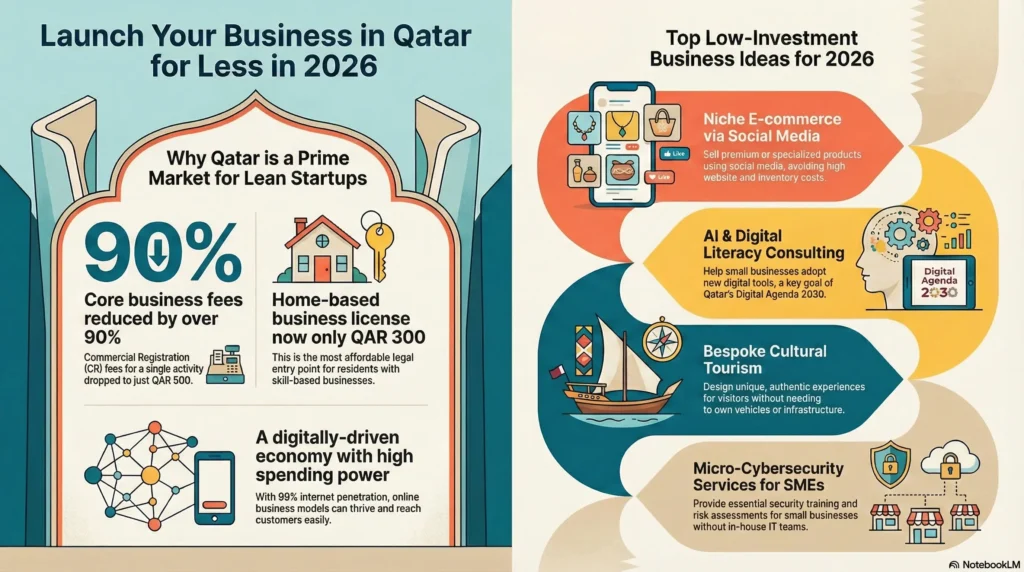
The 2026 Numbers at a Glance
Before choosing an idea, it helps to see the market you are entering. These are the verified figures this guide relies on.
| Indicator | Latest verified figure | Source (date) |
|---|---|---|
| Commercial Registration fee | QAR 500 | MoCI, Decision No. 60/2024 |
| Home-based business licence | QAR 300 per activity (Qatari citizens only) | MoCI, Aug 2024 |
| New commercial registrations, 2025 | ~28,000 (+57% YoY) | MoCI via QNA, Feb 2026 |
| Non-Qatari companies established, 2025 | 12,449 (+600% YoY) | MoCI via QNA, Feb 2026 |
| Internet penetration | 99.0% (3.10M users) | DataReportal, Digital 2026: Qatar |
| Consumer spending, 2025 | USD 67.87 billion | Mordor Intelligence, 2025 |
| E-retail market, 2025 | USD 14.81 billion, 11.15% CAGR | IMARC, Jun 2026 |
| Online food delivery market | ~USD 1.6 billion | Research and Markets / KenResearch |
| International visitors, 2025 | 5.1 million (+3.7%) | Qatar Tourism |
| International visitors, Q1 2026 | 1.13 million | Qatar Tourism |
| Corporate income tax | 10% (35% petroleum/petrochemical) | General Tax Authority |
You can model these costs for your own case using our company formation cost calculator.
Why Qatar Is a Strong Market for Low Investment Businesses in 2026
Qatar’s business environment in 2026 favours small, focused, service-led ventures for four structural reasons.
A market built around SMEs
Small and medium enterprises make up about 97% of registered private-sector companies in Qatar and contribute roughly 15–17% of non-oil GDP (Qatar Chamber, 2022). That mix creates constant demand for professional services, digital support, training, and niche B2B services, the models that need the least upfront capital.
Strong digital adoption
Qatar had 3.10 million internet users (99.0% penetration) and 2.95 million social media identities (94.3%) as of October 2025 (DataReportal, Digital 2026: Qatar). Near-universal connectivity lets a small business sell, deliver, and support customers without expensive physical space.
High spending power, even for niche services
Total consumer spending reached about USD 67.87 billion in 2025, with the retail market at USD 18.68 billion (2025) and forecast to reach USD 19.44 billion in 2026 (Mordor Intelligence). Low investment does not mean low value: customers will pay a premium for quality, convenience, and specialisation.
Government-backed entrepreneurship
Institutions such as Qatar Development Bank (QDB) support new and small businesses through financing, training, and advisory programs, while MoCI has digitised registration. The result was visible in 2025: ~28,000 new CRs (+57%), 34,500 licences (+53%), and 12,449 non-Qatari companies (+600%). If you want to explore broader online models first, see our guide on ways to make money online in Qatar legally.
1: Niche E-Commerce for High-Spending Consumers
Niche e-commerce works in Qatar because customers prioritise quality and convenience over the lowest price. Instead of competing with large marketplaces, small stores win by serving focused segments: premium lifestyle products, ethical goods, or halal-certified items for local and expatriate buyers.
The demand is measurable. Qatar’s e-retail market reached USD 14.81 billion in 2025 and is projected to grow at an 11.15% CAGR through 2034 (IMARC), supported by 99% internet penetration (DataReportal, Digital 2026: Qatar). The model stays low investment because founders can test demand through social storefronts (Instagram, TikTok, WhatsApp) before building a website, using limited inventory or on-demand fulfilment to avoid retail rent.
Registration is completed through MoCI, and most commercial e-commerce activities now permit up to 100% foreign ownership. Note that e-commerce licence fees are commonly quoted at around QAR 500 following the 2024 fee reforms, though exact fees depend on the activity code.
2: Brand-First, Kitchen-Last Food Delivery
This model lets you launch a food brand in Qatar without owning a kitchen. You focus on the brand, menu, and marketing; a licensed cloud kitchen prepares the food under Ministry of Public Health (MoPH) compliance. You avoid the biggest costs entirely: kitchen fit-out, equipment, and direct facility approvals.
Qatar’s delivery culture is mature. The online food delivery market is valued at about USD 1.6 billion and is projected to grow at roughly 10.17% CAGR to 2032 (Research and Markets; KenResearch). You register the business via MoCI and partner with a compliant kitchen, where the food-handling licence is held at facility level.
3: Home-Based Businesses in Qatar
Home-based businesses are one of the cheapest legal ways to start in Qatar, but this route is available to Qatari citizens only. It lets a Qatari citizen run an approved activity from their official residence without renting office or shop space. Common examples include tailoring, embroidery, Arabic sweets, perfume and bukhoor, and selected services.
The licence costs about QAR 300 per activity (total cost is typically around QAR 1,020 depending on the activity), and covers one activity per licence. The property must be the owner’s registered home, and the address on the owner’s Qatari ID must match the licensed address. Hiring workers from outside Qatar is not permitted, and sales are made directly to end customers. Non-Qataris cannot use this route; they should register a standard commercial activity instead.
4: AI Readiness and Digital Literacy Consulting
AI readiness and digital literacy consulting helps small and medium businesses understand, adopt, and safely use digital tools and artificial intelligence. It covers basic AI awareness, workflow automation, data-handling practices, and staff training, without building or selling technology products.
The opportunity tracks Qatar’s national direction: the government’s Digital Agenda 2030 prioritises digital transformation across sectors, and businesses across the economy are under pressure to adopt AI responsibly. Because the service is built on expertise rather than infrastructure, there is no need for offices, equipment, or software development.
5: Bespoke Cultural Tourism Experiences
Bespoke cultural tourism curates personalised, authentic experiences rather than running mass-market tours. That can include heritage walks, local cuisine experiences, art and culture itineraries, or private programs for small groups, corporate visitors, and high-value travellers.
The demand base is large and growing. Qatar welcomed 5.1 million international visitors in 2025 (+3.7%) and 1.13 million in Q1 2026 (Qatar Tourism), against a hotel and serviced-apartment supply of 42,131 keys in Q2 2026. Because you rely on local knowledge, partnerships, and coordination rather than assets, the model avoids the cost of owning vehicles, hotels, or large infrastructure. Licensing runs through MoCI, and the cost stays manageable when the business focuses on planning, curation, and experience design.
6: Micro-Cybersecurity Services for SMEs
Micro-cybersecurity focuses on practical protection for small and medium businesses that have no in-house IT team. Typical services include risk assessments, staff awareness training, password and access-control setup, and guidance on safe data handling.
Demand grows as Qatar accelerates digital adoption. The government approved the Qatar National Cybersecurity Strategy 2024–2030, which stresses cyber resilience across all sectors, including SMEs. As smaller firms move online they become more exposed. The business is knowledge-driven, delivered through audits, training, and advisory, so it needs no hardware, offices, or complex tools. Registration runs through MoCI, which suits IT and security professionals who want to start lean.
7: ESG and Sustainability Micro-Consulting
ESG and sustainability micro-consulting helps small and medium businesses meet basic environmental, social, and governance expectations without complex frameworks. Typical work includes simple sustainability policies, supplier compliance documents, and introductory ESG reporting support tailored to SMEs.
Demand flows from the Qatar Stock Exchange’s ESG transparency drive: as listed companies formalise disclosure, their suppliers are pushed to demonstrate compliance too. Because it relies on regulatory knowledge rather than physical assets, this is a low-investment, documentation- and advisory-led model. Setup is handled via MoCI.
8: Corporate Gifting & Branded Merchandise
Corporate gifting and branded merchandise is a low-overhead B2B model: you source, customise, and deliver branded items (executive gifts, onboarding kits, event giveaways, promotional products) for companies, exhibitions, and conferences.
The demand is tied to Qatar’s dense corporate and events calendar. With a strong MICE pipeline and major exhibitions, businesses and organisers spend continuously on branded items, such as the Doha Jewellery & Watches Exhibition 2025 recorded over QAR 246 million in sales (The Peninsula). You avoid retail rent and heavy inventory by working to order, and you register a trading or branding activity via MoCI.
9: Specialised Tutoring and EdTech Services
Specialised tutoring focuses on high-demand areas: STEM, coding, exam preparation (IB, SAT, British and American curricula), and skills-based learning. Services are usually delivered one-to-one, in small groups, or online, which keeps operations simple and flexible.
Demand is anchored in private education. Qatar’s private K–12 market was valued at about USD 2.94 billion in 2025 (Mordor Intelligence), with growth driven by population, international curricula, and the push for future-ready skills. Because it is knowledge-based, many operators start solo and online before scaling into a small centre. Note that published market estimates vary significantly between research vendors, so treat any single CAGR figure with caution.
10: Digital Content and Marketing for a Bilingual Market
Digital content and marketing helps businesses communicate in both Arabic and English, essential in Qatar’s mixed local and expatriate market. Services typically include content writing, social media management, basic SEO, and short-form video or campaign support.
Demand is driven by scale and language. Qatar had 2.95 million social media identities (94.3% of the population) as of October 2025 (DataReportal, Digital 2026: Qatar), and bilingual content is critical for reach and trust on local search and social platforms. The business stays low investment because it relies on skills rather than infrastructure; most operators work remotely with basic software tools.
11: Professional Services for Startups and SMEs
Professional services for startups and SMEs include outsourced bookkeeping, HR support, business documentation, compliance assistance, and basic advisory work. Many small businesses prefer external support over hiring full-time staff in their early stages.
Demand is structural: SMEs are about 97% of registered private-sector companies in Qatar (Qatar Chamber). The model is expertise-driven and can be delivered remotely or from a small setup without offices or heavy equipment, making it one of the most capital-efficient options on this list.
12: E-Gaming and Esports Event Coordination
E-gaming and esports event coordination focuses on organising small tournaments, community events, and online leagues rather than owning venues or hardware. The business centres on planning, sponsorship coordination, marketing, and managing player communities, which keeps costs low.
Be realistic about scale here. IMARC projects Qatar’s esports market at only about USD 19 million by 2034 (15.67% CAGR), while the country’s broader gaming market is far larger. That means the opportunity is best treated as a sponsorship- and community-led events business rather than a capital-intensive one. Revenue comes from sponsorships, entry fees, and brand partnerships, with events hosted in rented spaces or online.
13: Holiday Home & Short-Term Rental Management
Qatar’s short-term rental market is growing fast, and many property owners do not want to manage guest bookings themselves. A management service that handles listings, pricing, cleaning coordination, and guest communication for owners is a low-investment model because you do not need to own property.
Demand is underpinned by record tourism: 5.1 million visitors in 2025 and 42,131 accommodation keys by Q2 2026. The short-term vacation rental market is valued at about USD 1.1 billion (2025), growing 10.25% CAGR to USD 1.8 billion by 2031 (KenResearch). Units must be licensed through Qatar Tourism’s Holiday Homes scheme. You earn a management commission per booking, a genuinely asset-light, recurring model.
14: Mobile Car Detailing & Auto Care
Qatar is a car-heavy market with a punishing dusty climate, which makes on-demand car care a recurring need rather than a one-off. A mobile detailing setup (van, water tank, equipment) lets you serve homes and offices without paying for a fixed location.
The demand is measurable: 88,065 new vehicles were registered in 2025 (+21.9% year on year), against a national fleet of roughly 1.8 million. Mobile detailing suits a lean start with recurring subscriptions and corporate fleet accounts. For full licensing, costs, and ROI, see our detailed guide on starting a car wash business in Qatar.
15: Solar Panel Cleaning & O&M Services
Qatar’s dust and heat mean solar panels lose efficiency as grime builds up, so operators need regular cleaning and basic maintenance. With 1,675 MW already in operation and a 4,000 MW target by 2030 (QatarEnergy), a specialist cleaning and O&M service serves a growing installed base.
This is a B2B, contract-based model: cleaning cycles, performance checks, and minor repairs for solar farms, rooftops, and facility managers. It needs modest equipment and training rather than heavy capital, and demand scales automatically as Qatar’s solar fleet expands.
Compare the 15 Ideas: Cost, Margin and Time to Launch
Cost and margin figures below are indicative planning estimates for a lean start, not guarantees. Market signals are the verified figures cited in each section.
| # | Business idea | Startup capital (indicative) | Typical margin | Time to launch |
|---|---|---|---|---|
| 1 | Niche e-commerce | QAR 5,000–25,000 | 15–40% | 1–5 days (licence) |
| 2 | Cloud-kitchen food brand | QAR 10,000–40,000 | 10–20% | 2–6 weeks |
| 3 | Home-based business | QAR 1,000–10,000 | High (rent-free) | Days |
| 4 | AI & digital literacy consulting | Near zero | 40–60% | 1–5 days |
| 5 | Bespoke cultural tourism | QAR 5,000–30,000 | 20–40% | 1–4 weeks |
| 6 | Micro-cybersecurity | Near zero | 40–60% | 1–5 days |
| 7 | ESG micro-consulting | Near zero | 40–60% | 1–5 days |
| 8 | Corporate gifting & merchandise | QAR 5,000–30,000 | 20–35% | 1–3 weeks |
| 9 | Tutoring & EdTech | QAR 2,000–15,000 | 40–60% | 1–3 weeks |
| 10 | Bilingual content & marketing | QAR 1,000–10,000 | 40–60% | 1–5 days |
| 11 | Professional services for SMEs | QAR 2,000–15,000 | 40–60% | 1–5 days |
| 12 | Esports event coordination | QAR 5,000–25,000 | Sponsorship-led | 2–6 weeks |
| 13 | Holiday home management | QAR 10,000–40,000 | Commission-based | 1–4 weeks |
| 14 | Mobile car detailing | QAR 15,000–60,000 | 20–40% | 1–3 weeks |
| 15 | Solar panel cleaning & O&M | QAR 10,000–50,000 | Contract-based | 1–3 weeks |
Conclusion: Starting Small Is a Strategy, Not a Limitation
The takeaway is simple: successful low investment businesses in Qatar are built on structure, not shortcuts. They sell services, skills, or niche demand, and avoid heavy fixed costs early. With the CR fee at QAR 500, the home-based licence at QAR 300, and a record wave of new company formation in 2025, the barriers to a legal, lean start have never been lower.
For founders navigating the process, the right guidance saves both time and cost. Meem Business Services assists with company formation, licensing, and ongoing PRO support in Qatar.
Sources
- MoCI: Commercial Registration and fee reductions (Ministerial Decision No. 60 of 2024); home-based licence QAR 300 and 63 activities (The Peninsula / MoCI, Aug 2024); ~28,000 new CRs, 34,500 licences and 12,449 non-Qatari companies in 2025 (via QNA, Feb 2026).
- DataReportal: Digital 2026: Qatar (October 2025 data).
- Mordor Intelligence: Qatar consumer spending (USD 67.87bn, 2025) and retail market (USD 18.68bn 2025, USD 19.44bn 2026); Qatar private K–12 education (USD 2.94bn, 2025).
- IMARC Group: Qatar E-Retail Market (USD 14.81bn, 2025; 11.15% CAGR to 2034) and Qatar Esports Market (USD ~19m by 2034; 15.67% CAGR, 2026).
- Research and Markets / KenResearch: Qatar online food delivery (~USD 1.6bn; 10.17% CAGR to 2032).
- Qatar Tourism: 5.1 million visitors in 2025 (+3.7%); 1.13 million in Q1 2026. Hospitality Qatar: 42,131 keys in Q2 2026.
- General Tax Authority (GTA): income tax 10% (35% petroleum/petrochemical); Global Minimum Tax 15% (FY2025 onwards).
- Qatar Chamber: SMEs ~97% of registered private-sector companies; 15–17% of non-oil GDP (2022).

Jisham
Head of Operations at Meem
4+ years of hands-on Qatar PRO experience, handling approvals and government procedures across multiple ministries and authorities, including establishment licensing and approvals.
Connect On LinkedIn →